




Monitoring Structural Health of Electricity Transmission Towers With Dewesoft

December 29, 2025
Environmental loads and structural aging constantly affect electricity transmission towers, yet most failures occur without visible warning. Continuous monitoring provides the only reliable way to detect early changes and prevent unexpected collapse. Dewesoft’s NEMOSENSE system enables remote, long-term tracking of tower oscillations, converting structural behavior into actionable insights through automated processing and cloud-based alarming.
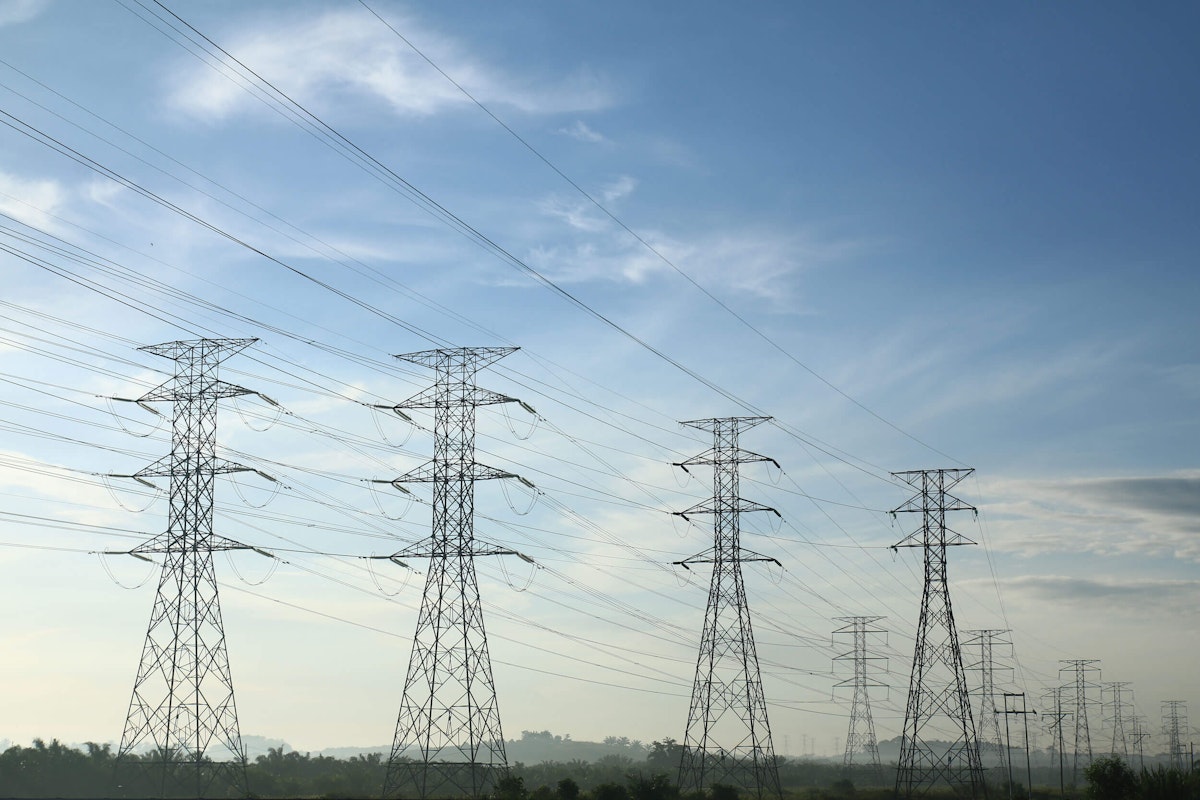
Transmission towers can fail suddenly due to a combination of environmental and structural factors. Engineering incident reports identify several recurring root causes, including:
Foundation instability from flooding, landslides, or soil liquefaction
Corrosion in coastal or industrial regions that reduces cross-sectional strength
Material fatigue caused by decades of cyclic loading from wind-induced motion
Intentional removal of structural members, such as cross-bracing theft
Many towers stand in remote areas where routine inspections are difficult and visual checks cannot reveal subtle internal degradation, loose bolts, or early-stage foundation movement.


Why oscillation monitoring works
Every tower behaves like a mechanical resonator, vibrating at natural frequencies determined by its geometry, mass, and structural stiffness. Although wind and environmental noise continuously excite the structure, the frequencies remain stable as long as the tower is intact.
Even small structural changes—corrosion, joint loosening, or bracing loss—can cause measurable shifts in:
natural frequencies
oscillation amplitudes
damping characteristics
Continuous vibration monitoring, therefore, provides a non-intrusive and reliable indicator of structural health without requiring physical inspection or load testing.
Monitoring challenges in the field
Implementing long-term tower monitoring requires addressing several practical constraints:
Lack of power supply, requiring autonomous energy storage and solar recharging
Limited network coverage, with communication only through cellular or low-bandwidth links
Harsh outdoor conditions, such as temperature extremes, moisture, and UV exposure
Fast, low-skill installation, since tower access is restricted and operator time is limited
These requirements eliminate conventional wired data-acquisition systems and require a purpose-built, low-power solution designed for unattended operation.
NEMOSENSE system overview
Dewesoft’s NEMOSENSE is an integrated vibration data logger and IoT device engineered for permanent structural monitoring. The unit combines a low-noise triaxial MEMS accelerometer, onboard processing, and data storage within a sealed IP67 enclosure suitable for outdoor installation.


The device processes vibration data locally—extracting natural frequency, peak-to-peak displacement, and statistical indicators—before transmitting the results to a central server using Ethernet or LTE.
You can power NEMOSENSE devices in three ways:
Passive PoE (Power-Over-Ethernet) using our power injector
Active PoE by using an Ethernet switch with PoE.
Built-in batteries with the battery pack option (NEMOSENSE-B)
With an optional internal battery and solar panel, NEMOSENSE can operate autonomously for extended periods. You can recharge the internal battery over PoE.


Multiple NEMOSENSE units can be synchronized via NTP or GPS, enabling fleet-wide comparison across tower networks.
System architecture and data flow
Each NEMOSENSE unit performs signal acquisition and preliminary analysis at the edge. Data is stored internally and transferred securely to the Dewesoft Historian time-series database using the MQTT protocol whenever connectivity is available.
Engineers can review live or historical data through:
A web-based dashboard for fleet-level status and trend visualization
DewesoftX software for detailed analysis and reporting
GPS positioning automatically places every monitored tower on a map, simplifying fleet management and eliminating manual configuration.


Deployment and installation
Installation requires only attaching the device and solar panel to the tower using magnetic or bracket mounts and powering on the unit. You need no configuration on-site. Once activated, the system:
acquires GPS position and time
connects to the selected mobile network
begins streaming vibration indicators to the central server
Because of the low-noise accelerometer, installation does not need to occur at the top of the tower, improving safety and reducing installation time.
NEMOSENSE devices have a waterproof aluminum casing with an RJ45 Harting push-pull connector. The enclosure is designed for outdoor mounting, is fully waterproof, and complies with the IP67 environmental rating.


The outdoor enclosure automatically vents air to equalize the pressure inside the enclosure with the outside air pressure, while preventing water from entering. This feature extends the seal's lifespan and increases the enclosure's durability.
It is often helpful to correlate oscillations with environmental conditions, and NEMOSENSE offers the option to integrate an ambient temperature sensor and an anemometer for wind direction and speed.
Operational benefits
Continuous monitoring with NEMOSENSE enables:
Early detection of structural degradation through frequency drift, e.g., detection of loose bolts, corrosion, and foundation shifts
Reduced need for manual inspection and emergency repairs in remote locations
Automatic alarms for abnormal behavior
Historical trend analysis for data-driven predictive maintenance instead of periodic checks
Comparison of towers with similar geometry or loading
AI-based server-side analytics can further enhance anomaly detection across large infrastructure networks.
Conclusion
Electricity transmission towers undergo gradual structural changes that often go unnoticed until failure. Continuous oscillation monitoring provides a reliable method for identifying early-stage degradation without invasive inspection.
NEMOSENSE offers a compact, autonomous, and field-proven solution for long-term and real-time tower monitoring. It combines low-noise vibration measurement, onboard processing, and secure data transmission within a rugged, easy-to-deploy system. The result is a modern, scalable approach to infrastructure health management that supports safer operations, reduced maintenance costs, and data-driven decision-making.