




Measuring DC-DC Converter Efficiency with Differential Power Processing
Tofopefun Nifise Olayiwola
Tallinn University of Technology
November 13, 2026
As data centers face rising energy demands driven by AI and cloud computing, improving power conversion efficiency has become increasingly critical. This application note presents the measurement and evaluation of a switched-capacitor DC–DC resonant converter with differential power processing (DPP) using Dewesoft instrumentation. The results demonstrate efficiency levels above 98% under dynamic load conditions, highlighting the potential of DPP architectures for next-generation energy-efficient data centers.
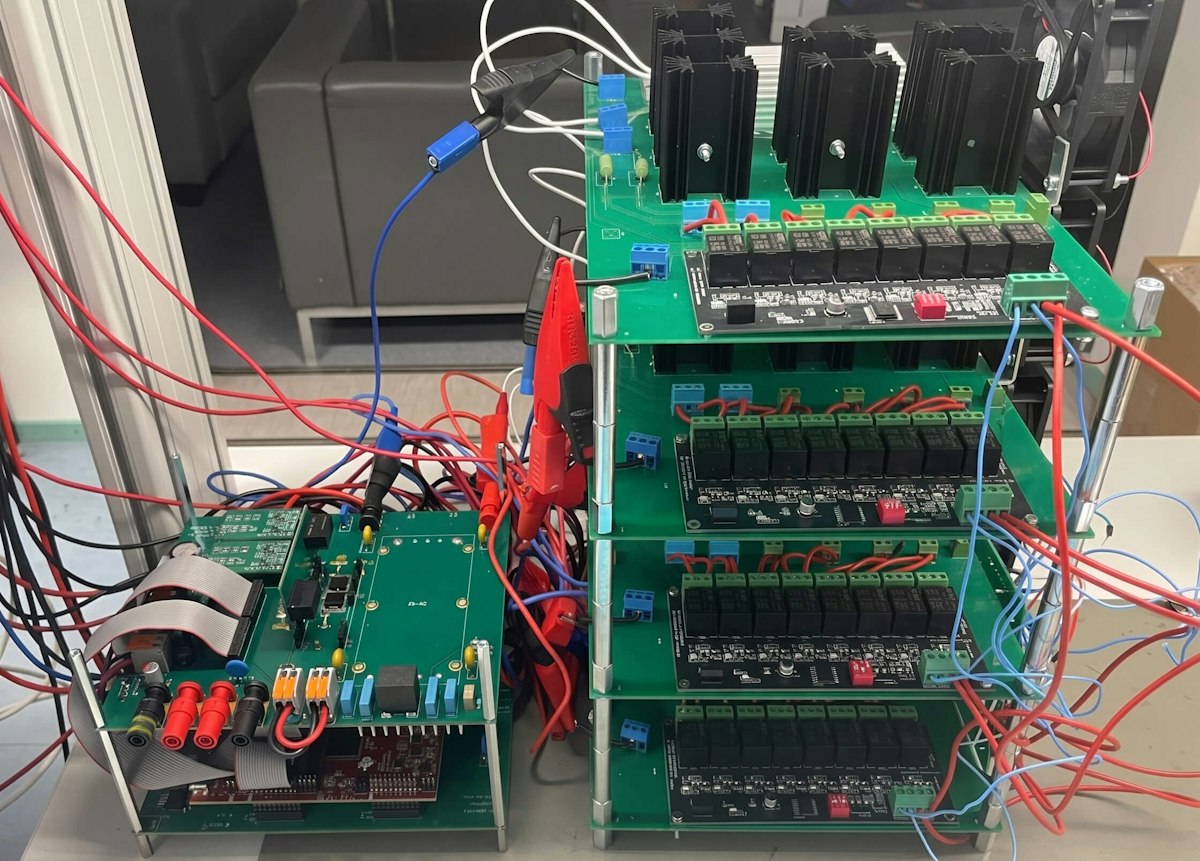
Improving data center power efficiency with differential power processing
As AI and cloud computing increase data center energy demand, reducing power conversion losses becomes increasingly important. Researchers at Tallinn University of Technology (TalTech), working within the Horizon Europe Shift2DC project, evaluated a resonant switched-capacitor DC-DC converter with differential power processing (DPP). The tested system uses a 48 V DC input to supply four series-connected 12 V loads, with a combined power rating of 0.6 kW.
Using the Dewesoft OBSIDIAN-R8w data acquisition system and DewesoftX software, the team synchronously measured input and output voltages and currents to calculate power and system efficiency. During stepped-load testing, measured system efficiency ranged from 98.2% to 99.5%. The results highlight the potential of DPP, which processes only the mismatch power between loads, for efficient power delivery to stacked servers in data centers.
Data centers are becoming one of the fastest-growing consumers of electrical energy worldwide. In Europe alone, electricity consumption reached approximately 70 TWh in 2024 and is projected to exceed 110 TWh by 2030 [1]. Alongside this growth, there is increasing pressure to improve energy efficiency and reduce environmental impact.
Power Usage Effectiveness (PUE) remains a key metric for evaluating data center efficiency. Given that the current European average is around 1.36, various regulatory targets have been proposed to reduce it to 1.3 or lower [2]. Achieving these goals requires improvements not only in cooling and infrastructure but also in power conversion architectures.
Traditional architectures rely on full-power processing, in which the entire load power passes through multiple conversion stages, resulting in cumulative losses. Differential power processing (DPP) offers an alternative approach by processing only the mismatch power between loads, significantly reducing losses and improving overall efficiency.
This work, conducted within the Horizon Europe Shift2DC project at Tallinn University of Technology, investigates a novel switched-capacitor resonant DC–DC converter with DPP (see Fig. 1). This application note focuses on performance measurements using Dewesoft instrumentation and analysis tools.


DC-DC converter design and measurement setup
Resonant switched-capacitor topology for stacked server loads
The system under investigation is a switched-capacitor DC–DC resonant converter designed for stacked server applications with a combined total power rating of 0.6 kW. It operates from a 48 V DC input bus and supplies four series-connected loads, each rated at 12 V. In this configuration, the input voltage is distributed across the loads, while the DPP converter ensures voltage balancing and compensates for load mismatches. This architecture minimizes unnecessary energy conversion and enhances efficiency.
Synchronized voltage and current measurement with OBSIDIAN-R8w
To evaluate the system's performance, voltage and current signals were measured using the Dewesoft OBSIDIAN-R8w data acquisition system.


The key measurement points, as illustrated in Figure 2, include: input voltage Vin, input current Iin, individual server voltages Vout,i, and individual server currents Iout,i.
Note: All signals were acquired simultaneously using synchronized data acquisition, enabling accurate analysis of power and efficiency.
Calculating input power, output power, and efficiency in DewesoftX
Based on the measured signals, the recorder was subsequently used to capture the following signals:
Input voltage and output voltage – recorded directly from the sensors,
Input and output current – recorded directly from the sensors.
Furthermore, using the built-in math functions in DewesoftX, real-time monitoring of other quantities, such as power and efficiency, is easy to perform.
Input Power – Computed through the Dewesoft math plugin by multiplying the input voltage by the input current
Output Power – Computed using the Dewesoft math plugin by multiplying the output voltage by the output current. Hence, the total output power becomes the sum of the individual output powers of the load servers.
Efficiency – calculated as a ratio of output to input power, expressed as a percentage.


Note: Figure 3 illustrates that the incremental predefined load-shifting command is hardcoded into the Arduino Uno S3, which then controls the MOSFETs in the four-step converter.
DC-DC converter efficiency and dynamic load test results
Real-time power monitoring and response to load changes
Figure 4 shows the continuous real-time graphical user interface (GUI) designed to visualize the system's performance effectively. This GUI displays continuous values of the input and output voltages and currents along with their corresponding power measurements and calculated efficiency.
During the test, the input voltages remained relatively stable at approximately 48 V, with the individual server voltages close to their nominal 12 V. Synchronization of all channels ensured that instantaneous power calculations were accurate and free of phase-misalignment errors.
In addition, the incremental load test provided valuable insights into the system's transient response. The recorded waveforms clearly show three step changes in power, corresponding to load adjustments.
The ability to capture these transient events with high temporal resolution highlights the effectiveness and reliability of the measurement system.


Measured system efficiency: 98.2–99.5%
As expected, the efficiency values recorded by the DewesoftX during testing remained within the 98.2–99.5% range, as indicated in Figure 4. To carry out further verification, we exported the measurement values, specifically the input power, as the output power and efficiency via the Dewesoft software into a .csv file (see Figure 5). Figure 6 illustrates that the values during the test and in the exported data were well synchronized.
The efficiency trend demonstrates stable high-performance operation with only minor deviations, confirming the effectiveness of the DPP architecture in minimizing conversion losses.


Key findings for data center power conversion
This study evaluated a resonant switched-capacitor DC-DC converter with differential power processing for data center applications using Dewesoft instrumentation. During the stepped-load test, measured system efficiency ranged from 98.2% to 99.5%, while the input voltage remained approximately 48 V and the individual load voltages stayed close to their nominal 12 V. These results demonstrate high system efficiency under the tested conditions and support further investigation of DPP architectures for stacked server power delivery.
In addition, the measurement approach proved to be highly effective. The use of synchronized data acquisition, real-time computation, and detailed post-analysis enabled accurate characterization of system performance. This study validates the suitability of the proposed architecture for next-generation high-efficiency data center power systems.
References
Directorate-General of Energy, “In focus: Data centres – an energy-hungry challenge” (Online 17 November 2025).
Avgerinou, M., Bertoldi, P., & Castellazzi, L. (2017). Trends in data centre energy consumption under the European code of conduct for data centre energy efficiency. Energies, 10(10), 1470.
Dos Santos, N. G. F., Carvalho, E. L., & Chub, A. (2025, October). Switched-Capacitor Resonant DC–DC Converter with Differential Power Processing for Stacked Servers in Data Center Applications. In IECON 2025–51st Annual Conference of the IEEE Industrial Electronics Society (pp. 1-6). IEEE.