




Remote Railway Vehicle Monitoring for Dynamics and Homologation Testing
Ainhoa Insausti
CETEST and Mondragon University
September 28, 2026
Railway vehicle homologation can take months or even years, requiring continuous monitoring to ensure safe operation before final approval. CETEST developed a remote monitoring system based on Dewesoft OBSIDIAN Gate and IOLITE modules that enables autonomous data acquisition, automated alarms, and secure data transmission without requiring test engineers to remain onboard. The solution improves safety and operational efficiency while providing reliable access to vehicle dynamics data throughout the homologation process.
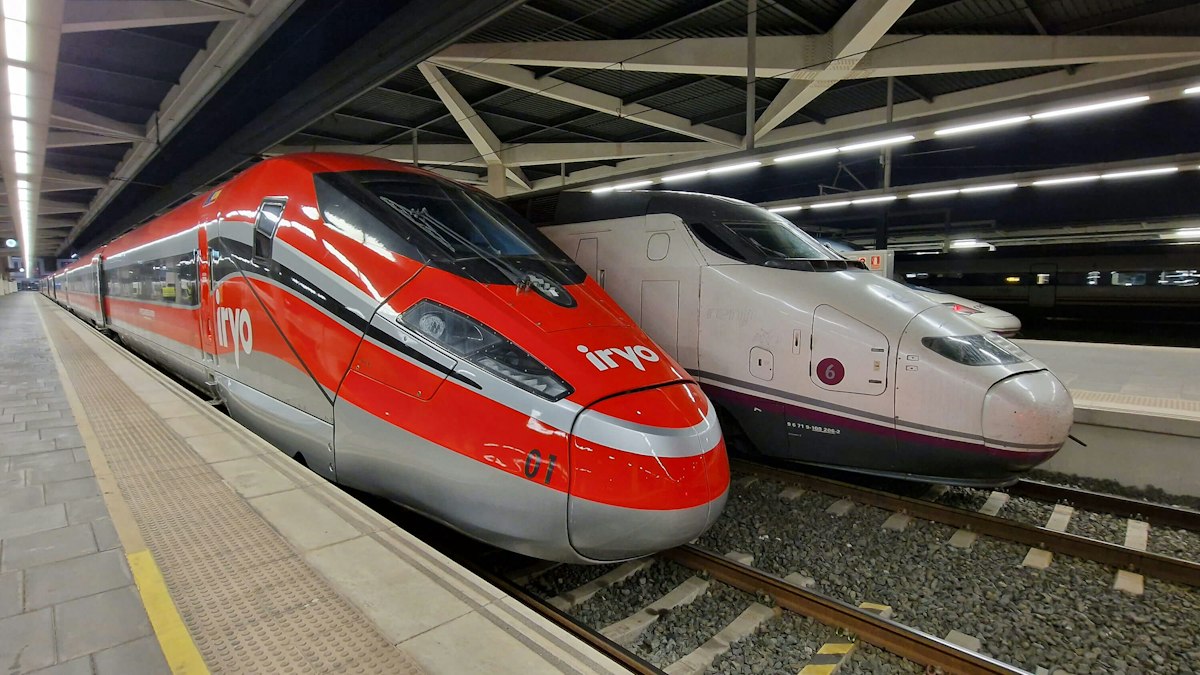
Railway vehicle monitoring during homologation
CETEST is an accredited, independent testing and validation laboratory based in northern Spain. The company provides testing, engineering, and monitoring services to railway manufacturers and operators, supporting the regulatory approval of new and refurbished vehicles, components, and systems.
This project was carried out in cooperation with Mondragon University, where students can combine academic work with industry experience. In this case, the work was performed at CETEST as part of the university’s applied research activities.
Railway vehicle homologation is a lengthy process that can take months or even years. During this period, several vehicles may be tested simultaneously. While one vehicle undergoes dynamic behavior testing, others may be used for braking, pantograph, noise, or other validation tests.
Because these vehicles have not yet received final approval, safety-critical parameters must continue to be monitored. However, the instrumentation used during this phase can be reduced compared with the full setup required for dynamic homologation tests.
Since monitoring may continue over long periods, CETEST needed a solution that could operate without test engineers remaining onboard. The system provides immediate alerts in the driver’s cab through a horn or LEDs and sends email notifications to CETEST headquarters when predefined limits are exceeded. This allows the train speed to be reduced and the recorded event to be analyzed remotely.
The vehicles are monitored from the completion of dynamic behavior testing until the final report is delivered and approved.
Objective: remote railway vehicle monitoring without onboard engineers
The objective of the project was to continuously monitor railway vehicles throughout the homologation process, from dynamic testing to final authorization, without requiring test engineers to remain onboard.
Railway vehicle monitoring equipment
The equipment used for this measurement application is:
Dewesoft IOLITE 6xSTG
Dewesoft IOLITE 8xDI-4xDO
5G Router
Accelerometers
Gyroscope
GPS
Speed Sensor (Doppler)
Remote railway vehicle monitoring solution
To meet the application requirements, we developed a comprehensive system based on the Dewesoft OBSIDIAN and IOLITE DAQ modules.
Railway vehicle data acquisition and sensor setup
The instrumentation setup uses accelerometers installed at key structural locations on the railway vehicle, including the axle boxes, bogies, and car body. These sensors capture vibration and acceleration data in the lateral and vertical directions, enabling the measurement of safety-related and running-dynamics parameters under operating conditions.
The system also measures linear and angular velocity and uses GPS to determine the vehicle’s position along the track. Together, these measurements provide a comprehensive view of the vehicle’s dynamic behavior and support safety monitoring and subsequent data analysis.
An OBSIDIAN Gate is installed onboard the train to handle data acquisition and processing without the need for a dedicated external computer. This enables autonomous operation and simplifies deployment during long-term monitoring.
Multiple IOLITE modules are distributed throughout the vehicle according to the requirements of each test campaign and the vehicle configuration. This distributed architecture enables flexible signal acquisition close to the sensors while maintaining measurement accuracy.
Together, OBSIDIAN Gate and IOLITE form a scalable and robust data acquisition system for autonomous railway vehicle monitoring during homologation.
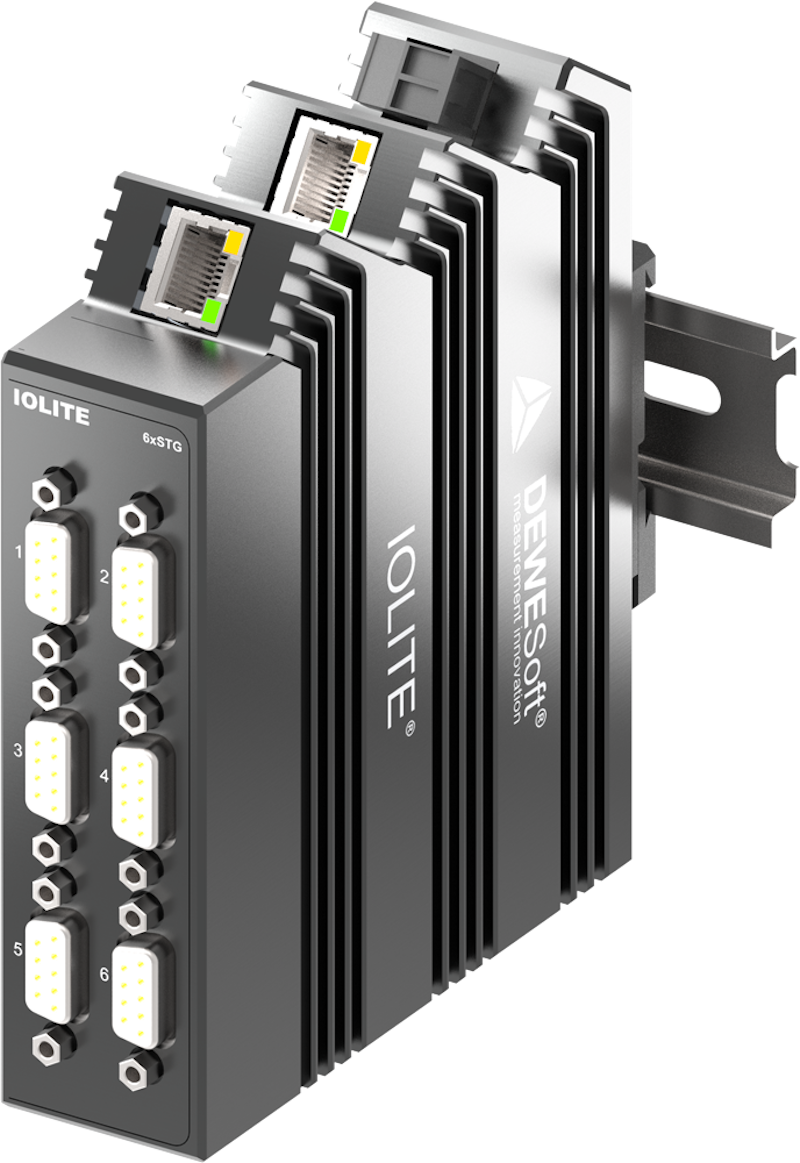
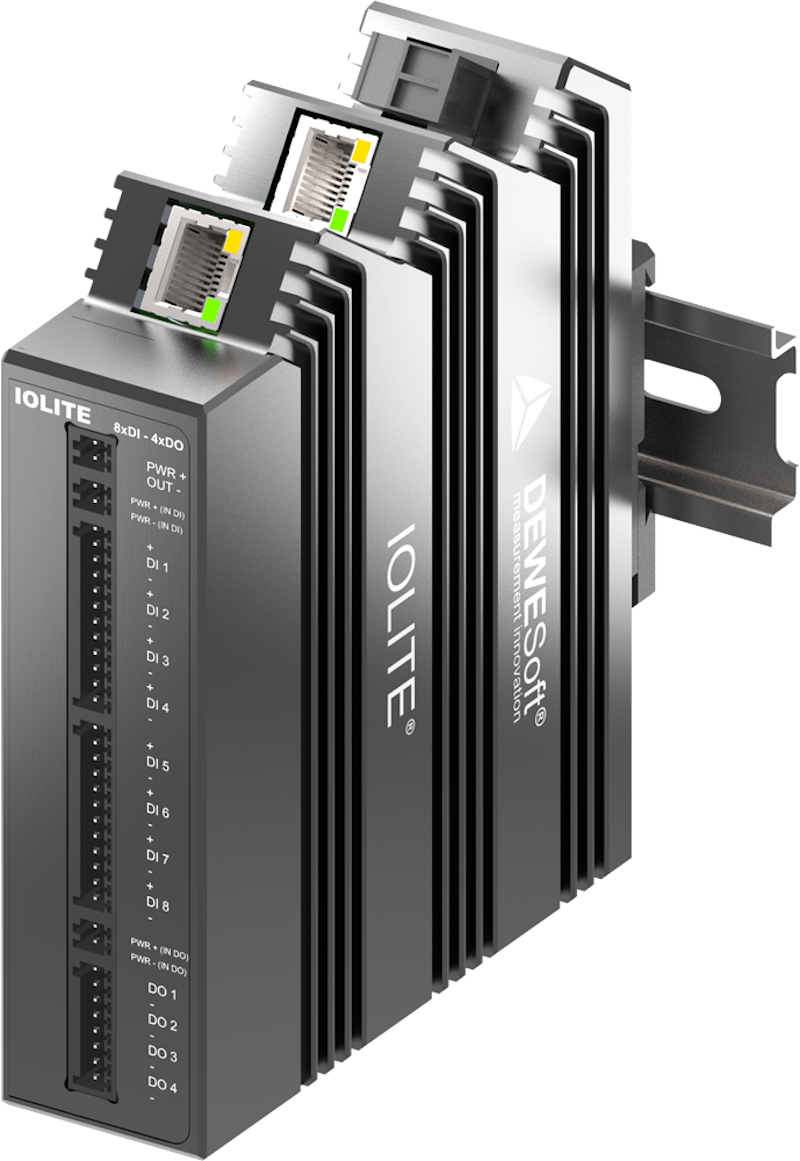
Figures 2 and 3 show the project configuration and analog channel setup, with 1 OBSIDIAN and 4 IOLITE 6xSTG and IOLITE 8xDI-4DO units.


Without onboard test engineers, the data acquisition system operates autonomously using predefined triggers. These triggers respond to specific conditions or events and automatically start and stop data recording without manual intervention.
Trigger-based acquisition ensures that relevant events are captured consistently while reducing unnecessary data storage. It also improves repeatability across test campaigns and ensures that critical events are recorded for later analysis, even during unattended operation.
Typical railway vehicle dynamics measurement setup
The following figures show a typical instrumentation setup for dynamic tests.


Remote railway vehicle monitoring and connectivity
The system enables remote acquisition, management, and monitoring of measurement data throughout the homologation process.
A secure Virtual Private Network (VPN) connection provides reliable and protected communication between
Remote measurement data transmission and storage
Depending on the client’s requirements, measurement data can be transmitted and stored in two different ways.
The first approach uses an SFTP server for secure, encrypted transfer and storage of recorded data. This helps protect data integrity and confidentiality while preventing unauthorized access during transmission.
Once stored on the SFTP server, the data can be synchronized with cloud-based platforms for centralized access, scalable storage, and further analysis.
This approach combines secure data handling with the flexibility of cloud-based access, making measurement data available to distributed teams without compromising transmission security.
The second approach involves transmitting the collected data from the Historian Client to the Historian Server, where it can be effectively visualized and analyzed in Grafana.


This architecture enables centralized data storage and provides a powerful interface for real-time monitoring, historical trend analysis, and customizable visualization dashboards.
By leveraging Grafana’s capabilities, users can gain clear insights into system performance and quickly identify anomalies or patterns in the data.
Both transmission methods ensure secure, reliable access to recorded data, maintaining integrity and confidentiality throughout the process.
Furthermore, they offer flexibility to accommodate a wide range of client infrastructure and monitoring requirements, allowing the system to be tailored to specific operational needs while supporting scalable, efficient data management.
Automated alarms for railway vehicle safety monitoring
Predefined threshold conditions are set for each monitored variable to detect potentially critical events during operation. When a threshold is exceeded, the system automatically triggers an alarm.
The alarm is communicated directly to the driver’s cab through digital outputs, such as a horn or LEDs, providing immediate feedback to onboard personnel. At the same time, an automated email notification is sent via the 5G connection to CETEST headquarters, allowing engineers to review the event and begin analyzing the recorded data remotely.
This dual alarm system supports a rapid response to critical conditions, including reducing the train’s operating speed when necessary. Recorded events can then be analyzed in detail to determine their cause and support further safety and performance evaluation.
Preventing data loss during 4G and 5G connectivity outages
Temporary 4G or 5G connectivity loss is unavoidable in railway applications, particularly when trains pass through tunnels or areas with limited network coverage.
To prevent data loss, the Historian uses a local retransmission database that temporarily stores measurement data whenever the connection is unavailable. Once connectivity is restored, the stored data is automatically retransmitted to the central database.
The size of the local retransmission database can be configured according to the expected duration of connectivity interruptions. Although data may appear in the central database with a slight delay, no measurement data is lost during temporary network outages.
Results of remote railway vehicle monitoring
Using OBSIDIAN Gate, IOLITE modules, and a 5G router, CETEST developed a remote monitoring system that eliminates the need for test engineers to remain onboard during extended homologation testing.
The system enables autonomous data acquisition, remote monitoring, secure data transmission, and synchronized measurement without compromising data quality or reliability. It also reduces the need for onboard personnel, helping improve operational efficiency and simplify test logistics.
The project demonstrates the practical benefits of remote and unattended railway vehicle monitoring during homologation. It also provides a foundation for further development of automated testing and long-term monitoring solutions.