




Bridge Weigh-in-Motion and Structural Health Monitoring on Tomačevo Bridge
Doron Hekič, Andrej Anžlin, and Martin Hauptman
CESTEL, ZAG
June 4, 2026
The Tomačevo Bridge near Ljubljana is being used as a “living laboratory” to show how bridge weigh-in-motion (B-WIM) traffic data can be combined with structural health monitoring (SHM) measurements. By synchronizing strain-based load detection with accelerometers, temperature sensors, and displacement measurements, engineers can connect each vehicle crossing with the bridge’s structural response.
The monitoring system combines multiple measurement technologies into one synchronized setup. Results from a controlled load test confirm the value of combining B-WIM and SHM monitoring for long-term bridge diagnostics and condition assessment.
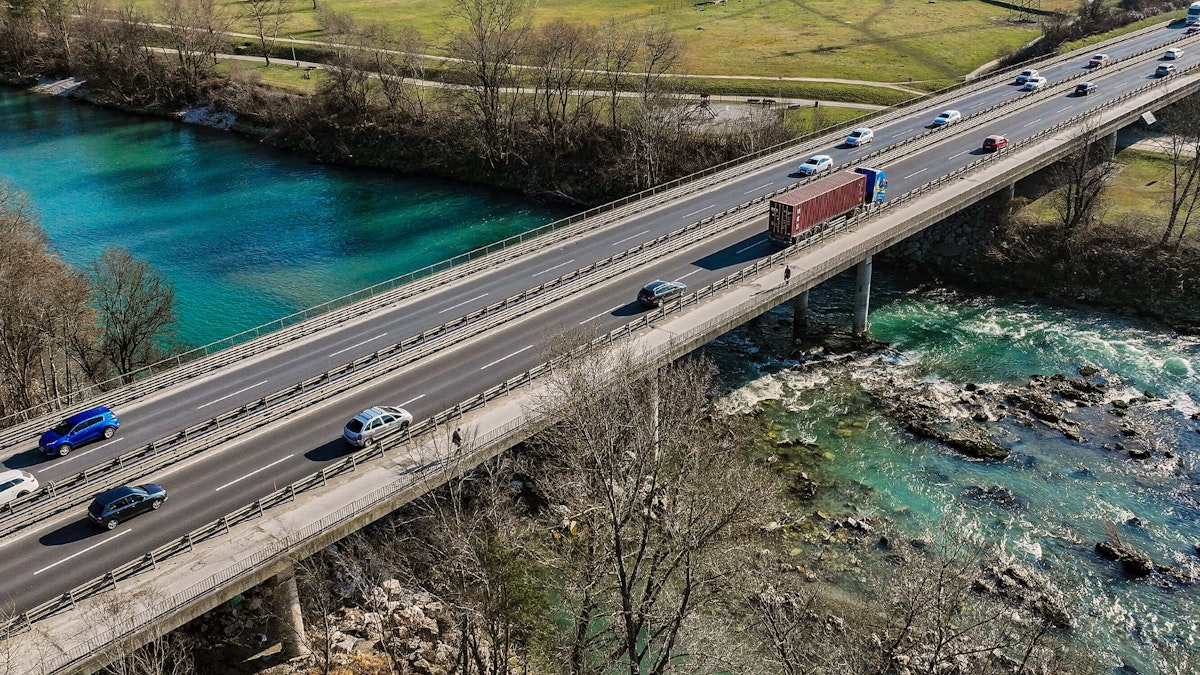
Monitoring the Tomačevo bridge as a living laboratory
Tomačevo Bridge is a continuous prestressed concrete bridge over 7 spans, built in the early 1980s and located near Ljubljana, Slovenia.
In 2022, the bridge underwent an upgrade, including the installation of a monitoring system and a bridge weigh in motion (WIM) system. Since then, we have progressively advanced the systems into a hybrid B-WIM and structural health monitoring system (SHM system) setup.
The current configuration combines B-WIM strain transducers with structural monitoring sensors, including accelerometers, temperature sensors, and, when required, displacement sensors.
Most sensors are installed on the underside of the bridge superstructure. Data from the B-WIM and SHM systems are synchronized and integrated into a unified data environment, making it possible to match each heavy vehicle crossing with the bridge’s measured strain and acceleration response.
The challenge: connecting traffic loads to bridge response
Bridges carry highly variable traffic loads and are continuously affected by environmental conditions. When a monitoring system measures only the bridge response, such as acceleration, strain, or deflection, without knowing the load that caused it, engineers can struggle to interpret peaks, establish reliable baselines, and distinguish structural deterioration from changes caused by traffic or temperature.
The Tomačevo Bridge living laboratory addresses this challenge by synchronizing bridge weigh-in-motion (B-WIM) traffic load data with structural health monitoring (SHM) response data in a shared environment. This hybrid platform links each significant vehicle crossing, including rare heavy vehicles and special transports, with the bridge’s measured strain, acceleration, temperature, and, when needed, deflection response.


The Tomačevo bridge, built in 1982, crosses the Sava River near Ljubljana. Structurally, it is a seven-span continuous post-tensioned (prestressed) double-T concrete superstructure on circular piers. Two parallel, independent structures carry the two carriageways; the monitored/tested structure in the referenced study carries traffic toward Ljubljana.

![Plan view, side view, and cross-section view of the bridge [1]](https://www.datocms-assets.com/53444/1780578305-plan-view.jpg?auto=format&dpr=2&fit=max&w=1024 "Plan view, side view, and cross-section view of the bridge [1]")
Despite being assessed as generally in good condition, the bridge exhibits typical aging-related defects, e.g., local cover deficiencies and spalling, clogged expansion joints, corroded bearings, and drainage-related deterioration near abutments. These issues motivate more continuous performance tracking than periodic inspections alone can provide.
At the industry level, engineers have traditionally used B-WIM for traffic load characterization, gross vehicle weight, axle loads/spacing, and classification.
In contrast, they have been using SHM to track structural response, modal parameters, and strain/deflection trends. Cestel and ZAG’s future direction is to combine both into an asset-oriented “Bridge WIM Diagnostic / SHM + WIM” approach.
Project partners: CESTEL, ZAG, and Dewesoft Monitoring
A partnership of two private companies and a government institution conceived and carried out the project: CESTEL d.o.o., Dewesoft Monitoring d.o.o., and the Slovenian National Building and Civil Engineering Institute, ZAG.
CESTEL d.o.o. is a Slovenian company specializing in high-speed weigh-in-motion and traffic analysis and having 30 years of experience in bridge weigh-in-motion measurements, bridge assessments, and traffic data. In the project, Cestel is responsible for the system concept and B-WIM: B-WIM sensing and algorithms, load identification, influence lines identification, and system installation.
ZAG (Zavod za gradbeništvo Slovenije) performs research in building materials and structures, develops new test and measurement methods, and certifies products, materials, and executed works. The institute uses the project’s synchronized dataset to evaluate bridge behavior, conduct controlled load tests, and develop/validate advanced identification workflows, e.g., influence-line-based methods and model updating, logic, and “WIM + SHM” concept development.
Dewesoft Monitoring d.o.o., the Dewesoft monitoring unit, offers a variety of solutions for monitoring applications, such as structural health, structural dynamics, bridge health, and condition-based monitoring. This project provided the data acquisition (DAQ) and monitoring stack: distributed sensing and DAQ hardware, acquisition software, database integration, dashboards, and OMA connectivity.
Why B-WIM and SHM data need to be synchronized
How can we continuously correlate real traffic loads, including rare heavy/special vehicles, with the bridge’s measured structural response so that unusual responses can be attributed correctly, trends normalized for environmental conditions, and decisions based on measured evidence rather than assumptions?
What makes bridge response hard to interpret
Traffic variability: Axle configurations, lane position, speed, and heavy-vehicle frequency all change over time; extreme events are rare but important.
Environmental variability: Temperature changes affect stiffness and boundary conditions, shifting modal parameters and response levels.
Interpretation gap: Response-only SHM can flag “something happened” but often cannot answer “what caused it” without synchronized loading information.
Why load context matters for reliable bridge diagnostics
Without synchronization and integration, we could interpret the same strain/acceleration peak as:
a heavy vehicle event, or
a meaningful behavioral change suggesting deterioration.
The hybrid B-WIM + SHM approach reduces this ambiguity by assigning a load context to each response record, including vehicle and axle timing/weights, while also enabling vibration-based tracking via OMA.
Hybrid B-WIM and SHM monitoring solution
Deploy a hybrid B-WIM + SHM architecture where:
B-WIM: SiWIM, a portable Bridge Weigh-in-Motion System, + strain sensors provide axle detection, vehicle speed, and weight estimation via influence-line principles.
SHM sensors capture:
accelerations for OMA/modal parameters,
strains for load effects and influence-line extraction,
temperature for normalization,
displacement/deflection (campaign-based or continuous, depending on needs).
Synchronization + integration ensures that traffic events and structural responses share a common time base and are stored/visualized together.
Implementing the hybrid bridge monitoring system
Project timeline and measurement campaign milestones
Year 2022: monitoring research initiative established and a hybrid concept advanced on the Tomačevo bridge correlating structural response with registered traffic load.
March 2023: example extreme event captured: 13-axle vehicle >200 tons
May 2024: controlled night-time measurement campaign with two pre-weighed calibration vehicles, multiple speeds, and repeated runs for repeatability and influence-line work.


Installing sensors and DAQ hardware under the bridge
Underside installation across long distances requires safe access and durable cable routing; we used a lifting platform for remote locations.
Distributed synchronization is achieved via EtherCAT daisy-chaining over standard Ethernet cabling (signal, power, and sync), with ~1 μs synchronization between nodes and up to 50 m node-to-node spacing.
Power autonomy can be supported via two 300 Ah LiFe batteries and four 150 W solar panels, as described for the deployed system.
DAQ hardware, sensors, and system layout

![Disposition of the SHM sensors on the Tomačevo bridge [1]. The B-WIM sensors are at the mid-span of the MG1 and MG2 main girders.](https://www.datocms-assets.com/53444/1780578305-disposition-of-shm-sensors-on-tomacevo-bridge.jpg?auto=format&dpr=2&fit=max&w=1024 "Disposition of the SHM sensors on the Tomačevo bridge [1]. The B-WIM sensors are at the mid-span of the MG1 and MG2 main girders.")
Long-term B-WIM and SHM monitoring setup
B-WIM strain sensors: SiWIM ST-504 full-bridge strain gauge sensors.
Accelerometers: 14× IOLITEiw-3xMEMS-ACC tri-axial MEMS accelerometers with low-noise density 25 μg/√Hz and IP67 environmental protection. Sensors are integrated DAQ, sensor, with EtherCAT communication protocol.
Signal conditioning: 5× IOLITEi-1xSTG (3 for ST-504, 2 for PT100 temperature); Module for conditioning voltage/current and bridge sensors with excitation.
Temperature sensors: PT100 sensors (ambient + asphalt context).
Deflection measurement (continuous option): Deflection Multi Meter (DMM), 10 Hz, range 160 mm, resolution 0.5 mm, distance up to 350 m, using a flat laser reference (example: Leica Rugby 830).
Power (autonomous option): 2× 300 Ah LiFe batteries + 4× 150 W solar panels.
Software/data: SiWIM, DewesoftX, Dewesoft Historian (InfluxDB) + Grafana dashboards; Dewesoft Artemis OMA for online operational modal analysis (OMA) via FTP.
Additional sensors used during the 2024 load test
Strain transducers: 2 inductive strain transducers on main girders (B-WIM sensors).
Displacement sensors: (campaign option): 2 LVDTs (HBK) for vertical displacement on both main girders.
Temperature sensors: T_OUT (environment) and T_IN (~5 cm inside girder).
Data acquisition rate: 500 Hz sampling during the campaign.
What the system measures
Traffic load, strain, acceleration, temperature, and deflection measurements
Traffic load (B-WIM): axle timing, speed, axle loads / GVW estimates; influence lines as the bridge “transfer function” from load to response.
Response (SHM):
Strain (load effects, calibration, influence line extraction),
Acceleration (vibration/OMA indicators: frequencies, mode shapes, damping),
Temperature (normalization and interpretation),
Deflection/displacement (serviceability checks, extreme event documentation, validation).
Controlled bridge load test in May 2024
We conducted the May 2024 campaign at night to minimize traffic interference. The average measured temperatures on the two nights differed by only 0.5 °C (18.2 °C vs 17.7 °C).
We used two statically pre-weighed calibration vehicles:
V1: tri-axle rigid truck
V2: two-axle tractor + three-axle semi-trailer
Each vehicle performed repeated runs in the driving lane:
10 passes at 90 km/h
5 passes at 70 km/h
3 passes at 30 km/h
Total: 72 passages across two nights (loaded first night, empty second night).


![Strain response, measured by the E_MG1 sensor under three passages of the fully-loaded V2 truck [1]. Grey and black lines denote the FE model response updated based on the measured strain and modal responses.](https://www.datocms-assets.com/53444/1780578305-strain-response-measured-by-e_mg1-sensor.png?auto=format&dpr=1.5&fit=max&w=1024 "Strain response, measured by the E_MG1 sensor under three passages of the fully-loaded V2 truck [1]. Grey and black lines denote the FE model response updated based on the measured strain and modal responses.")
In addition to the calibration vehicle passages, we measured the bridge's acceleration response.

![Identified natural frequencies and mode shapes [1].](https://www.datocms-assets.com/53444/1780578305-identified-natural-frequencies-and-mode-shapes.png?auto=format&fit=max&w=1024 "Identified natural frequencies and mode shapes [1].")
Results from the B-WIM and SHM load test
Microsecond synchronization across distributed DAQ nodes
The system uses EtherCAT daisy-chained IOLITE devices to achieve synchronization of approximately 1 μs between nodes. This architecture also simplifies long-distance deployment by carrying signal, power, and synchronization through a single-cable concept, with up to 50 m between nodes.
B-WIM outputs from SiWIM and structural response channels from DewesoftX are integrated into Dewesoft Historian, which uses an InfluxDB backend, and visualized in Grafana dashboards. This enables engineers to review specific vehicle events, analyze the corresponding bridge response, and track long-term structural trends.
Repeatable load test results and stable influence lines
During the controlled calibration campaign, the extracted strain influence lines showed only minor sensitivity to vehicle type, load, and speed. The maximum influence-line values deviated by less than ±5% from the mean, confirming strong repeatability across the tested vehicle passages.
For this bridge configuration and measurement point, the result confirms that a stable influence-line representation can be used to link traffic loads with structural effects and to compare the bridge’s behavior over time.
Capturing rare heavy vehicle events in real time
The synchronized platform also captured a special transport event with a documented deflection response of approximately 3.6 mm. This example highlights the value of continuous hybrid monitoring, especially for rare, high-consequence load cases that are unlikely to occur during short-term testing campaigns.
Using B-WIM data for structural identification and model updating
The living-lab data also show that measured strain influence lines, which are produced as a by-product of B-WIM measurements, can support structural identification and model updating workflows. By using these measured influence lines, engineers can improve the agreement between modeled and measured traffic-induced bridge responses, including validation against independent displacement measurements.

![Displacement response, measured by the D_MG1 sensor under three passages of the fully-loaded V2 truck [1]. Grey and black lines denote the FE model's response, updated based on the measured strain and modal response.](https://www.datocms-assets.com/53444/1780578305-displacement-response-measured-by-d_mg1-sensor.jpg?auto=format&dpr=3&fit=max&w=1024 "Displacement response, measured by the D_MG1 sensor under three passages of the fully-loaded V2 truck [1]. Grey and black lines denote the FE model's response, updated based on the measured strain and modal response.")
Conclusion: toward long-term hybrid bridge diagnostics
The Tomačevo Bridge living laboratory demonstrates a scalable approach to synchronizing and integrating B-WIM and SHM data. By linking measured structural responses with the actual traffic loads that caused them, engineers can interpret strain, acceleration, temperature, and deflection data with greater confidence.
The deployed architecture combines strain-based B-WIM sensing with accelerometers, temperature sensors, and displacement measurements when required. All measurements are connected through a distributed, precisely synchronized acquisition network and integrated into a unified data environment for storage, dashboards, and optional automated OMA outputs.
The controlled load test in May 2024 provided repeatable strain, displacement, and acceleration datasets under known truck and speed conditions. At the same time, continuous operation makes it possible to capture rare extreme events, including special transports. Together, these capabilities support practical bridge management, such as event documentation and long-term trending, as well as advanced engineering workflows, including influence-line tracking and structural identification. This creates a strong foundation for long-term bridge monitoring and future hybrid diagnostic development.
References
1. Hekič, D.; Kalin, J.; Žnidarič, A.; Češarek, P.; Anžlin, A. Model Updating of Bridges Using Measured Influence Lines. Appl. Sci. 2025, 15.