




Dewesoft USA Summer Camp 2026
July 15, 2026
Dewesoft headquarters has long hosted summer camps in Slovenia for students of all ages. From the robotics camp for younger students to the 2025 rally race for college-age STEM students, Dewesoft is dedicated to educating and inspiring the next generation about test and measurement technology in a challenging and collegial atmosphere.
Traveling to Central Europe is a significant expense for American students, so we decided to create the Dewesoft USA Summer Camp. Its mission: to educate and inspire young adults about engineering and show them a path many have not considered: test and measurement. Many high school students aspire to be design engineers or research engineers, but few have ever had the opportunity to experience the hands-on world of test engineering. Here was their chance to try their hand at real, practical engineering under the careful supervision of our DAQ experts.
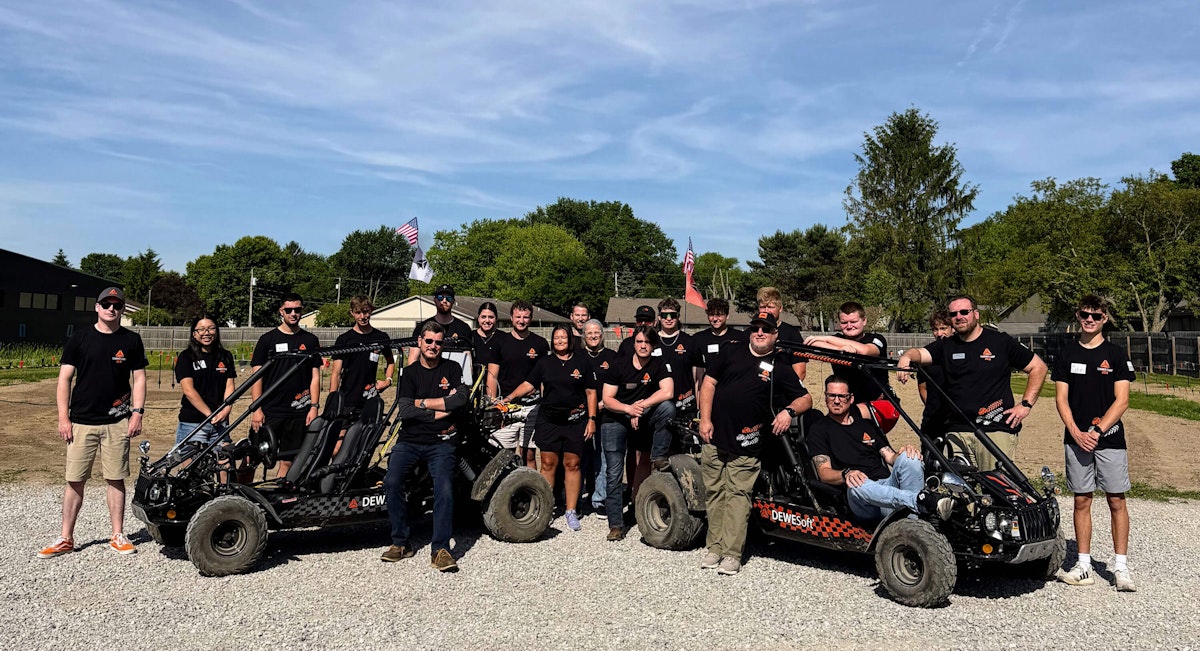
We designed a training curriculum and invited 12 high school students (and recent graduates) to our northern Ohio headquarters for an experience they would not soon forget. Their challenge: to put two off-road go-karts to the ultimate test using Dewesoft DAQ (data acquisition) instruments and advanced sensors.
The test vehicles
We purchased two identical off-road capable go-karts. Despite their size, these go-karts feature several systems that are found on road cars, such as:
An Independent front suspension
A solid rear axle
A continuously variable transmission (CVT)
A single-cylinder engine with electronic fuel injection (EFI)
A water cooling system
Hydraulic disk brakes
Rack-and-pinion steering


Each go-kart weighs 950 pounds (~431 kg) and has a top speed of 39 MPH (~63 kph). Their liquid-cooled 300 cc engines produce 17.4 HP (~13 kW) at 6500 RPM and 16 ft-lb of torque (~ 21.7 N·m) at 5000 RPM.
They’re designed for a driver plus three passengers, so they measure 116.1” L x 54.5” W x 59.2” H (1.161 m L × 0.545 m W × 0.592 m), with a respectable ground clearance of 15.8” (0.4 m). They’re really made for off-road driving on rugged terrain, and good old American dirt and mud!
The test track
The test track was designed to feature the most grueling durability tests from the real-life proving grounds located just north of our Ohio office. The track features 4 distinct zones where students could put the go-karts through their paces in a controlled and repeatable manner. Repeatability and objectivity are central hallmarks of modern automotive testing regimens, and our small track was designed to fully comply.


Challenging track features
Our automotive customers use test tracks to put their cars through the paces. We wanted our students to face some of the same challenges with our test track. First, we designed our offset sine track to feature two sine waves set out of phase to induce flex in the chassis and suspension, oscillating the entire go-kart.
We also dug 6- to 8-inch (15- to 20-cm) deep trenches in the track to simulate driving off a curb. These trenches would allow us to test how the suspension would handle shocks and chassis flexure.
Potholes are a great way to test how a vehicle handles rough roads and how its suspension isolates the driver from the worst impacts. So, of course, we made sure that our test track featured several of them.
Designed as a final punishing test, the “random” section of the track is a stretch of potholes and divots to shake the go-karts around. Track features like these test passenger comfort and shake anything loose before it can fail in the real world.
Identical acceleration and braking zones on asphalt and gravel allow measuring the go-kart’s maximum acceleration and braking performance. With any vehicle, it’s important to profile both off-road and on-road performance. Simple figure-eight testing enables low-speed maneuverability testing, which is important for a vehicle that may be used on narrow trails.
Our students would also conduct noise testing with the go-karts. Just like the big car companies do, we set it up so they could measure static exhaust sound levels, under load, and while driving.
Collecting the data


The sensors
Sensors for the go-karts were chosen to measure the information required by our testing protocol. These included strain gages, IEPE and MEMS accelerometers, string pots for measuring displacement, inertial sensors, thermocouples, and video cameras.
Strain gages
Strain gages were pre-mounted at critical locations, such as the upper control arms of the front suspension, the lower chassis rails, the brake pedal, and the chassis cross members. We wanted our students to be able to measure and analyze chassis flex, material fatigue, and braking forces.


IEPE accelerometers
Mounted at the top of the shocks, the IEPE accelerometers allowed the students to measure the shock induced in the chassis while driving. Single-axis accelerometers were used because the suspension acts only in the Z-axis in this particular configuration.


MEMS accelerometers
To measure chassis movements, MEMS accelerometers were chosen for their near-DC frequency response and the ability to calculate displacement via double integration of acceleration.


String potentiometers
String potentiometers, or string pots as they are colloquially known, are used to measure the displacement of the front shocks and to determine the steering angle from the steering rack.


Inertial measurement unit (IMU)
A Dewesoft IMU was used to measure vehicle dynamics, including pitch, roll, body acceleration, slew, and slip angle. The added benefit of Dewesoft’s IMU is the ability to correlate this data with GNSS positioning and collect additional speed data for reference.


Thermocouples
To assess the vehicle's thermal performance, thermocouples were placed at strategic locations around the go-kart to measure cooling system performance, braking system temperature, engine temperature, and shock temperature.


Video cameras
USB webcams provided video data as an additional layer of context for the collected data. This allows students to see what is happening as they review the data and provides insight into what may have caused an anomaly.


The DAQ system
KRYPTON was chosen for this application due to its ruggedness and ease of mounting. With features such as integrated mounting points, easy daisy-chain distribution via EtherCAT cables, a wide range of input types, and the ability to withstand the worst we could throw at it, KRYPTON was the natural choice. The following modules were used based on the sensor list:


KRYPTON-6xSTG - A versatile module that accepts voltage, a potentiometer, and strain gauges. Dewesoft STG amplifiers can handle additional sensors via DSIs (Dewesoft Smart Interfaces). This module has overvoltage protection.
KRYPTON-8xACC - This module is specifically for IEPE accelerometers, providing the constant-current excitation at the compliance voltage these sensors require. This module has overvoltage protection.
KRYPTONi-16xTH - A galvanically isolated 16-channel thermocouple module that handles K, J, T, R, S, N, E, C, and B sensors.
ECAT-SYNC-JUNCTION - This interface allows the KRYPTON modules to use GPS PPS as a time source.


Testing the go-karts
Students acted as the test engineers and drove the go-karts through the various stages of the course while collecting data. The students all had different driving styles; some drove confidently while others were more cautious. This allowed them to collect data about how the go-karts would handle a wide variety of driving styles. Each student was given the opportunity to drive the go-kart in each testing event, allowing the teams to collect a large amount of data.
The students pushed the go-karts to the point of overheating during nearly eight hours of grueling testing. They encountered unexpected problems and participated in troubleshooting sensor errors, including issues that were completely unexpected, such as the GPS signal cutting out as fighter jets from a nearby airbase flew overhead.


Results
More than 30 data files and 1000 channels were collected for analysis. While time constraints limited the depth of the analysis, the students and their mentors identified several key findings from the data. Here’s a short summary of what they found:
Proven fatigue from the durability testing
Using the Fatigue Analysis plugin available for DewesoftX, the students generated plots showing fatigue cycles across various go-kart components. The screenshot below conclusively proves that the upper control arms in the front suspension were fatigued by the testing.


Surprising results from the braking and acceleration tests
The braking and acceleration tests were conducted on both asphalt and gravel to see how the vehicles would perform on very different surfaces. The students expected to see the best acceleration and braking performance on the asphalt, but were surprised to find out that this was not the case. Why? On asphalt, the tires had the most traction during initial acceleration, and the go-karts achieved the most rapid acceleration. But during braking, the gravel piled up in front of the locked front tires. This additional force combined with the knobby tires caused the go-karts to brake faster on gravel than on asphalt.


Another thing students noticed was that the go-karts felt like they were pitching down during acceleration. This was also seen by test observers and shown in the data. The IMU reported negative pitch during positive acceleration. This behavior is related to the go-kart's suspension geometry, which features a large rear swingarm on which the engine, transmission, and axle are mounted.


Noise testing during all phases of operation
Idle sound level
To measure idle sound level, a microphone was positioned approximately 24 inches away from the exhaust outlet and at a 45° angle to the exhaust. The kart was then started and left idling for several seconds while the sound level was measured in dB.


Engine revving
The microphone configuration was identical to that used for idle sound-level testing, but in this test, the engine was revved multiple times to determine the maximum sound level (dB) it produced when not moving.


Drive-away Sound Level
The microphone position was identical to that used for the idle sound level testing, but in this test the vehicle was started and then driven away under full engine load to measure the maximum exhaust sound level in dB.


Drive-by Sound Level
For this test, the microphone was placed halfway along the go-karts' path of travel, at a point where the engine is nearing peak output. The goal of this test was to measure the drive-by sound level from the exhaust, analogous to the go-kart driving through a residential zone.

A final challenge
As much fun as testing can be, it would not be a summer camp without some form of competition. To that end, the students were challenged to brave the durability course with one caveat: they had an open-top water cup in their go-kart, and their goal was to bring it back with as much water as possible still in it. Given how intense the durability course is, this challenge required students to drive smoothly to avoid spilling too much water. The winner of this contest received a prize and bragging rights, while the team with the highest average remaining water received a group prize.

Conclusion

This day would not have been possible without the time, help, and knowledge of so many professionals from the Dewesoft USA team. We believe that the future depends on developing new, better technologies, and that we must invest in our bright young minds to help them build it. The future is truly in their hands.
Dewesoft USA Summer Camp 2026 provided high school students and recent graduates with access to tools, advanced DAQ equipment, and a hands-on automotive testing experience they would not otherwise have had. They learned about testing and measurement from a team of mentors and subject-matter experts in a setting that even many college-level students don’t have access to. Having graduated from our Summer Camp, these young people have put themselves ahead of their peers and may have a leg up when it comes time to apply to college and seek internship opportunities.