




Tennis Racket Modal Analysis and Vibration Damper Testing
Vsevolod Svinin
FH CAMPUS 02
July 23, 2026
Players most often describe the “feel” of a tennis racket in subjective terms, yet their sensations originate from measurable structural vibrations. Using impact testing and modal analysis, this study compares how two rackets respond to impact across a wide frequency range. The findings reveal clear links between racket construction, vibration behavior, and perceived comfort and control.
Can tennis racket feel be measured?
Tennis players often describe rackets as stiff, flexible, comfortable, or precise. These characteristics influence how the racket feels during impact and how you can control the ball. In general, players associate stiffer rackets with more direct feedback and control, while they perceive more flexible rackets as more comfortable and forgiving.
Because of these differences, manufacturers typically recommend different rackets based on the player’s experience level, playing style, and physical strength. However, the perceptions mostly derive from subjective feelings rather than measurable data.
The question is: Can these differences be measured and explained objectively? In this study, I use experimental modal analysis to identify and compare the dynamic characteristics of two tennis rackets. I base my analysis on Frequency Response Functions (FRFs), natural frequencies, and mode shapes, which describe how the racket responds to impact.
By analyzing these properties, the goal is to explain how structural differences influence perceived feel. In addition, I evaluate the effect of a vibration damper on the racket's global dynamic response to determine whether it significantly alters it.
Tennis racket vibration and modal analysis
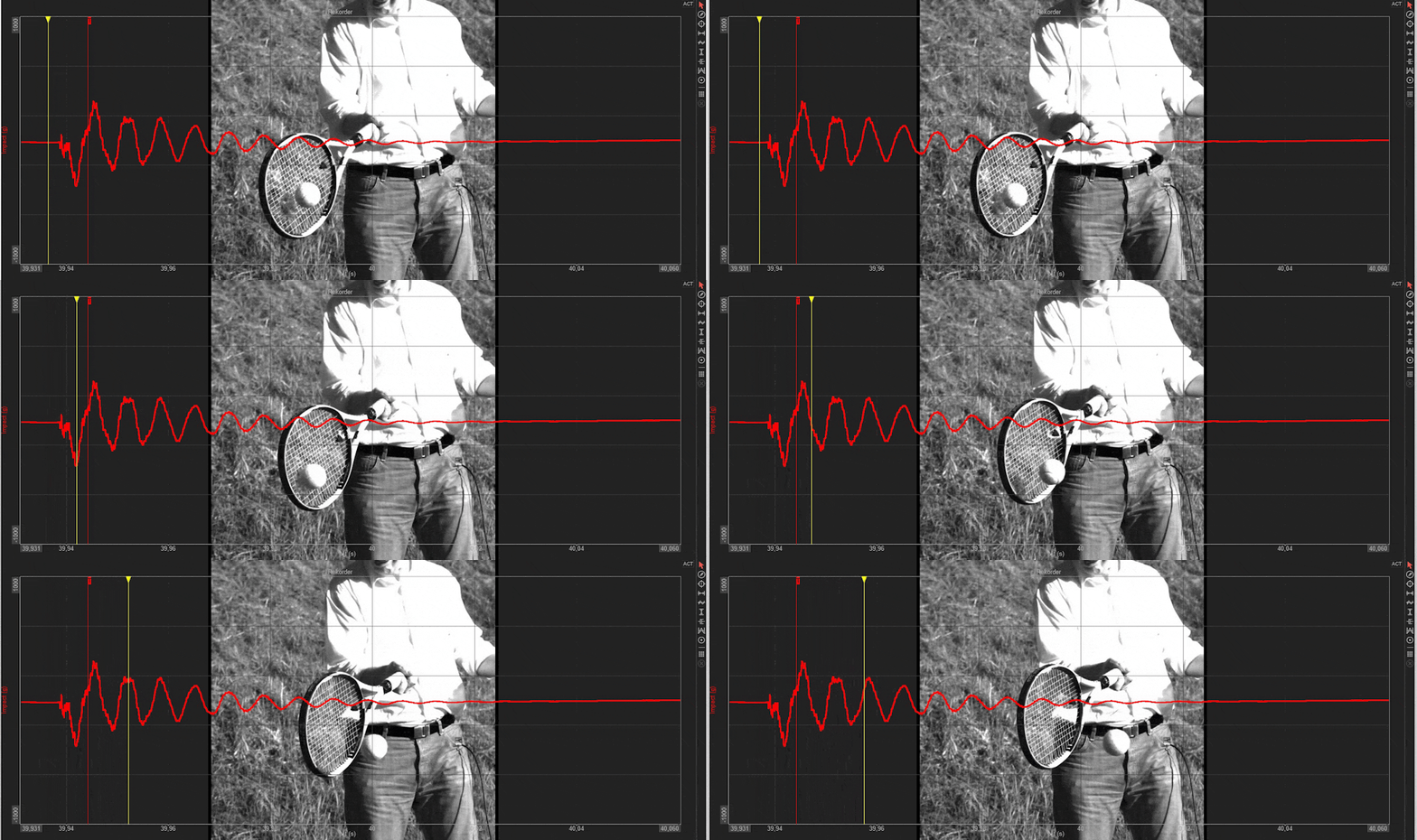
When a tennis ball impacts the racket, it excites the structure over a wide range of frequencies. As a result, the racket begins to vibrate according to its physical properties, such as stiffness, mass distribution, and structural damping ratio.
Every mechanical structure has a set of natural frequencies at which it tends to vibrate more strongly. At these frequencies, excitation near a natural frequency can produce a disproportionately large dynamic response due to resonance. The corresponding deformation patterns are called mode shapes, and they describe how different parts of the racket move during vibration.
To analyze this behavior, I used a Frequency Response Function (FRF). The FRF describes the frequency-dependent relationship between excitation force and structural response.
where F(ω) is the input force and X(ω) is the measured response. Peaks in the FRF indicate natural frequencies, while the shape and width of the FRF provide information about structural damping.
Experimental modal analysis combines these measurements to identify the dynamic properties of the structure, including:
natural frequencies
mode shapes
structural damping characteristics
By applying this method to tennis rackets, I can objectively describe how they vibrate after impact and how these vibrations may influence the perceived feel during play.
Tennis racket modal test setup
Rackets and vibration damper under test
I selected two rackets with similar geometry but different construction:
| Babolat E-Sense Comp | Dunlop Tristorm Elite 100 |
| higher-end model | more accessible model |
| designed for stiffness and control | designed for comfort and ease of use |
| slightly higher mass and a more rigid handle | slightly more flexible structure |


| Parameter | Babolat E-Sense Comp | Dunlop Tristorm Elite 100 |
|---|---|---|
| Material | Graphite | Aluminium + Glass fibre |
| Headsize | 645 cm2 | 645 cm2 |
| Mass | 275 g | 270 g |
| Balance | 335 mm | 320 mm |
| Stiffness (RA) | 66 | 60 |
I hypothesized that the stiffer graphite racket would exhibit a lower structural damping ratio and stronger global vibration modes. In contrast, the more flexible composite racket would show increased localization and a higher structural damping ratio.

In addition, a vibration damper was tested on the Babolat racket to assess its effect on dynamic behavior.


Data acquisition system
I applied a Dewesoft data acquisition system for the measurements:
Software: DewesoftX Professional with additional Modal Test license - data acquisition software for signal measurement, data recording, signal processing, and data visualization.
Hardware: SIRIUS-6xACC-2xACC+ - modular Dewesoft data acquisition system with signal-conditioning amplifiers, high dynamic range (160 dB), galvanic isolation, etc.
Input type: IEPE signal conditioning for dynamic measurements
This setup allows accurate acquisition of both the force and acceleration signals, which I required for FRF calculation.
Accelerometer and modal impact hammer
I measured the dynamic response of the racket using:
IEPE accelerometer: Dytran 3097M5
Mass: 4,3g
Sensitivity: 100 mV/g
Modal impact hammer: DYTRAN 5800B2T with an integrated force transducer
Sensitivity: 100 mV/lbf
The hammer provides a controlled broadband excitation, while the accelerometer captures the resulting structural response.
Impact testing pocedure


Measurement geometry and excitation points
I defined a measurement geometry consisting of 18 points on each racket:
1 point at the center of the string bed
17 points distributed across the frame (head) and handle
This geometry enables capturing both:
Global vibration modes (entire racket motion)
Local modes (e.g., string bed and frame deformation)


Boundary conditions
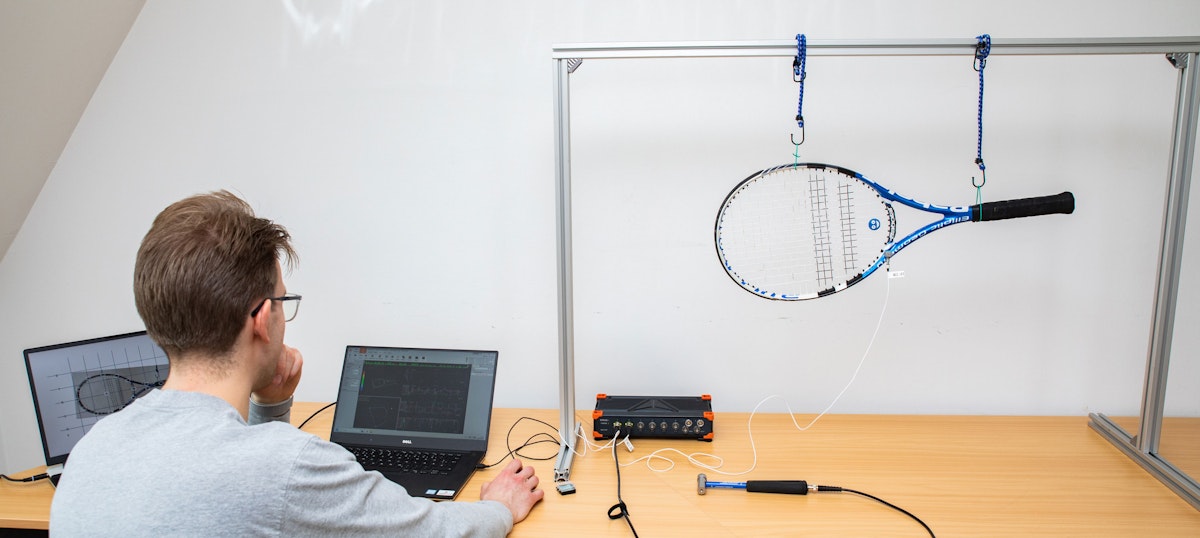
To minimize the influence of external constraints, I suspended the racket using rubber bands during the measurement.
This suspension method approximates free-free boundary conditions by minimizing constraint stiffness at the support points. Such conditions are essential for identifying the structure’s inherent dynamic properties without introducing stiffness from supports or fixtures.


Accelerometer mounting
I mounted the sensor on the throat area of the racket frame, which is sensitive to both global vibration modes (frame bending) and local dynamic behavior of the racket structure.
I attached it using wax, ensuring secure contact and minimal influence on the dynamic properties.


Impact hammer excitation
Each measurement point was excited using an instrumented modal hammer:
impacts applied sequentially to all defined points
force input recorded simultaneously with the acceleration response
This approach provides the input-output data required for FRF calculation.
Measurement limitations
Accelerometer mass influence
String tension variability
Only one sensor location
Free-free suspension differs from actual hand grip conditions
Limited number of racket models


Impact repetition and signal averaging
To improve measurement quality and reduce variability:
I applied 3 impacts at each point, and
averaged the resulting signals
This procedure ensures more stable and reliable FRF estimation.
Test configurations
I repeated this procedure for the following configurations:
Babolat racket - without vibration damper
Babolat racket - with vibration damper
Dunlop racket - without vibration damper

Modal analysis results
I performed the modal analysis in the frequency range 0-2.5 kHz.
For each configuration, I evaluated Frequency Response Functions (FRFs) to identify natural frequencies, structural damping characteristics, and overall dynamic behavior.
The results are presented for each racket and configuration, followed by a direct comparison.
Babolat modal behavior without a damper
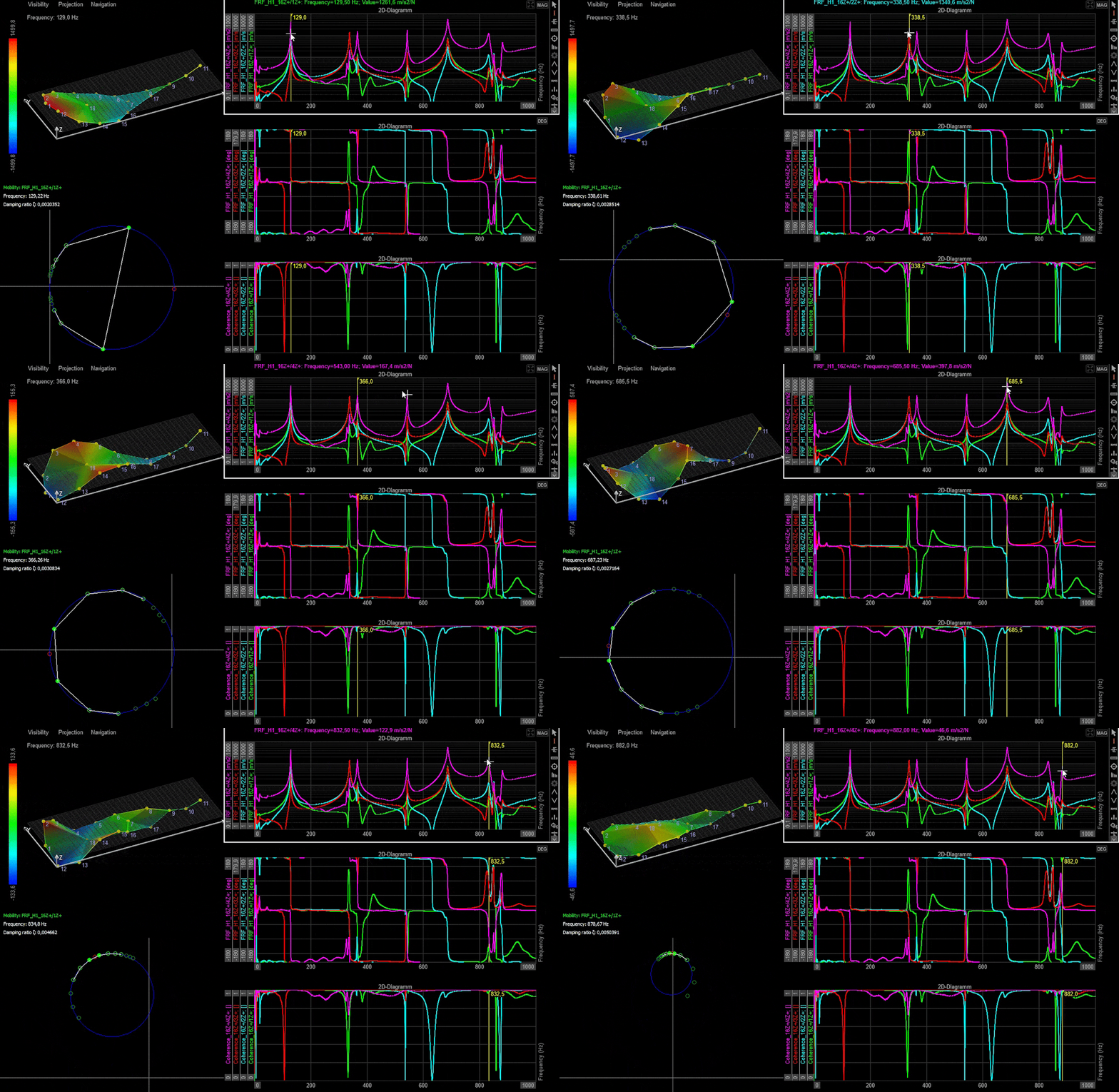
I first analyzed the modal behavior of the Babolat racket without the vibration damper to establish its baseline dynamic characteristics.
Within the analyzed frequency range, I identified approximately 8-10 dominant resonance modes. The response shows a combination of global and localized vibration behavior.
Global bending modes dominate the response at low frequencies.
Around 139 Hz, large portions of the racket structure undergo deformation, with the head and handle moving in opposite directions. This frequency represents the structure's fundamental bending behavior.
At intermediate frequencies, more complex behavior appears.
Around 373 Hz, the frame exhibits an S-shaped bending mode, mainly localized in the head.
Around 589 Hz, the motion is concentrated in the string bed, indicating a localized mode with minimal participation from the frame.
At higher frequencies, the vibration becomes more complex and distributed.
In the range of approximately 1150–1300 Hz, the entire racket exhibits combined deformation patterns.
Around 2000 Hz, coupled modes appear, in which both the frame and the string bed contribute to the motion.
In addition, several localized modes are observed, particularly in the head region and string bed, indicating that different parts of the racket can vibrate independently at higher frequencies.
Overall, the Babolat racket exhibits dominant global bending behavior at low frequencies and increasing vibration localization at higher frequencies, with a relatively low structural damping ratio, as reflected by sharp resonance peaks in the FRF.


Effect of the vibration damper
I evaluated the influence of the vibration damper by comparing the FRFs of the Babolat racket with and without the damper.
The measured FRFs show that the overall response of the racket remains largely unchanged:
The positions of resonance peaks are nearly identical
The overall shape of the FRF curves remains consistent
I observed no additional dominant modes within the measured frequency range or significant shifts in frequency
This consistency indicates that the natural frequencies and global modal behavior are not affected by the presence of the vibration damper.
In terms of structural damping ratio, both configurations exhibit similar characteristics:
relatively sharp and high peaks, indicating lower structural damping
no noticeable broadening of peaks when the vibration damper is applied
From a modal analysis perspective, this means that the vibration damper does not introduce significant changes in structural-level energy dissipation.
Overall, the results show that the vibration damper has minimal influence on the racket's global dynamic properties. Its effect is therefore likely limited to local vibrations, particularly in the string bed, rather than altering the behavior of the entire structure.
Dunlop modal behavior
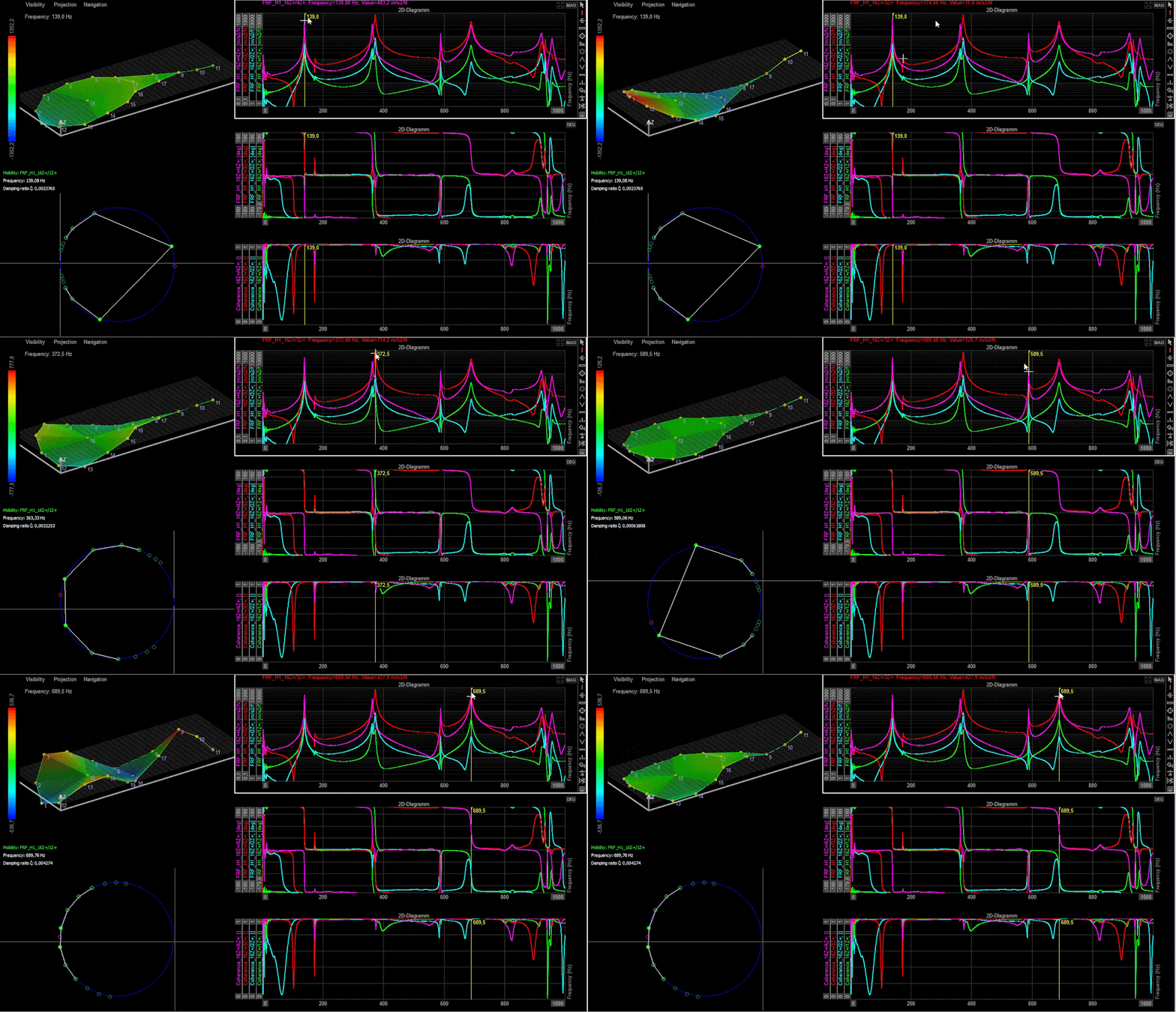
I identified approximately 10–14 modes, showing a combination of global, torsional, and localized vibration behavior. Global modes involve motion of the entire racket structure, while local modes are in specific regions such as the string bed or frame.
At low frequencies, global bending modes dominate the response.
At around 129 Hz, I observed the fundamental bending mode, in which the entire racket deforms along its length.
At intermediate frequencies, more complex behavior occurs.
Around 687 Hz, I observed a global mode with strong participation of the handle.
Around 833 Hz, the frame exhibits a combined bending–torsional mode in which the left and right sides move in opposite directions.
At higher frequencies, the response becomes increasingly dominated by localized modes, particularly in the string bed.
In the range of approximately 1350–1550 Hz, the motion is concentrated at the center of the racket.
Around 2377 Hz, I observed a highly localized mode with minimal frame participation.
In addition, complex coupled modes appear, for example, around 1694 Hz, where multiple parts of the racket participate simultaneously with asymmetric deformation.
Overall, the Dunlop racket exhibits global bending behavior at low frequencies and increasingly localized, complex vibration patterns at higher frequencies, with a slightly higher structural damping ratio reflected in broader resonance peaks in the FRF.
Babolat and Dunlop racket comparison
The comparison of the two rackets reveals clear differences in their dynamic behavior, despite their similar geometry and string configuration.
Natural frequencies and mode distribution
Both rackets exhibit multiple modes across the full frequency range up to 2.5 kHz. However, differences are observable in the number and distribution of modes:
Babolat: approximately 8–10 modes
Dunlop: approximately 10–14 modes
The Dunlop racket exhibits more identifiable modes, particularly in the mid- and high-frequency ranges, indicating a more complex dynamic response.
Global and local structural behavior
The two rackets differ significantly in the distribution of vibration across the structure.
The Babolat racket is characterized by:
dominant global bending behavior, especially at low frequencies
more uniform participation in the frame
smoother transition from global to local modes
The Dunlop racket shows:
a combination of bending and torsional modes
stronger involvement of individual regions (e.g., handle or string bed)
more pronounced localized behavior at higher frequencies
Global versus local vibration response
A key difference lies in the balance between global and local vibration:
In the Babolat racket, global modes dominate a larger portion of the frequency range.
In the Dunlop racket, localized modes - especially in the string bed - appear earlier and more frequently.
These balances indicate that different parts of the Dunlop racket can vibrate more independently, while the Babolat behaves more as a unified structure.
Structural damping characteristics
I also observed differences in the damping ratio behavior:
The Babolat racket exhibits:
sharper and higher resonance peaks
lower structural damping ratio
The Dunlop racket shows:
broader and lower peaks
slightly higher structural damping ratio
This behavior affects how vibration energy is sustained and dissipated after impact.
| Property | Babolat | Dunlop |
|---|---|---|
| Fundamental mode | 139 Hz | 129 Hz |
| Dominant behavior | Global bending | Mixed bending/torsion |
| Damping | Lower | Higher |
| Localized modes | Less pronounced | More pronounced |
| Perceived feel | Direct/precise | Comfortable/forgiving |
How racket construction affects vibration and feel
The results show that the two rackets behave differently as vibrating systems. Variations likely influence these differences in material composition, stiffness distribution, and structural design.
Structural Influence
The rackets differ in:
material (graphite vs aluminum + glass fiber)
stiffness (higher vs lower RA)
overall construction
The Babolat racket, with higher stiffness, tends to exhibit stronger global structural coupling.
The Dunlop racket exhibits more localized vibration modes, indicating reduced dynamic coupling between regions of the structure, particularly between the string bed and frame.
Structural damping behavior
The FRF results show differences in structural damping:
Babolat -> sharper peaks -> lower structural damping ratio
Dunlop -> broader peaks -> higher structural damping ratio
The damping differences mean that vibrations in the Babolat racket are more pronounced, while they are reduced more quickly in the Dunlop racket.
Effect of the vibration damper
After adding the damper, I observed no significant changes in:
natural frequencies
mode shapes
Overall response of the racket
This observation suggests that the vibration damper has little influence on the racket’s global structural dynamics within the measured frequency range. Its effect is likely limited to small, local vibrations, especially in the string bed.
Link to player perception
These results help explain why rackets feel different.
Stronger, more persistent structural vibrations may contribute to a perception of increased feedback and control, as reported by experienced players, and to more direct, precise control.
A racket that reduces and localizes vibrations can feel more comfortable and forgiving.
The results show that players' perceptions are closely related to the racket's vibration after impact.
Conclusion: measuring racket feel with modal analysis
My goal has been to determine whether I can explain differences in how tennis rackets feel by using measurable dynamic properties. The results confirm that the two rackets exhibit clearly different vibration characteristics, including differences in natural frequencies, mode shapes, and structural damping ratios.
These differences influence how impact-induced vibrations propagate through the racket structure and potentially transmit to the player.
More experienced players seeking control often prefer a stiffer racket with lower structural damping. At the same time, the more flexible, higher-structural-damping racket better suits beginners.
Player preference is closely related to racket design, vibration behavior, and perceived performance.
Experimental modal analysis, therefore, provides a valuable engineering tool for understanding and optimizing the performance of sports equipment.
These findings may be useful for racket designers, sports equipment engineers, and players seeking equipment optimized for control, comfort, or vibration transmission.