



Dewesoft Summer Camp 2026: Hands-On Engineering, Teamwork, Learning, and Fun
Carsten Frederiksen & Grant M. Smith
November 9, 2026
During a very hot week in early August, Dewesoft Summer Camp 2026 brought 52 students from 18 countries to Trbovlje, Slovenia, for an intensive week of hands-on measurement engineering. Their mission was to build measurement systems, test vehicles, solve technical problems, and work together to turn raw sensor data into engineering insight.
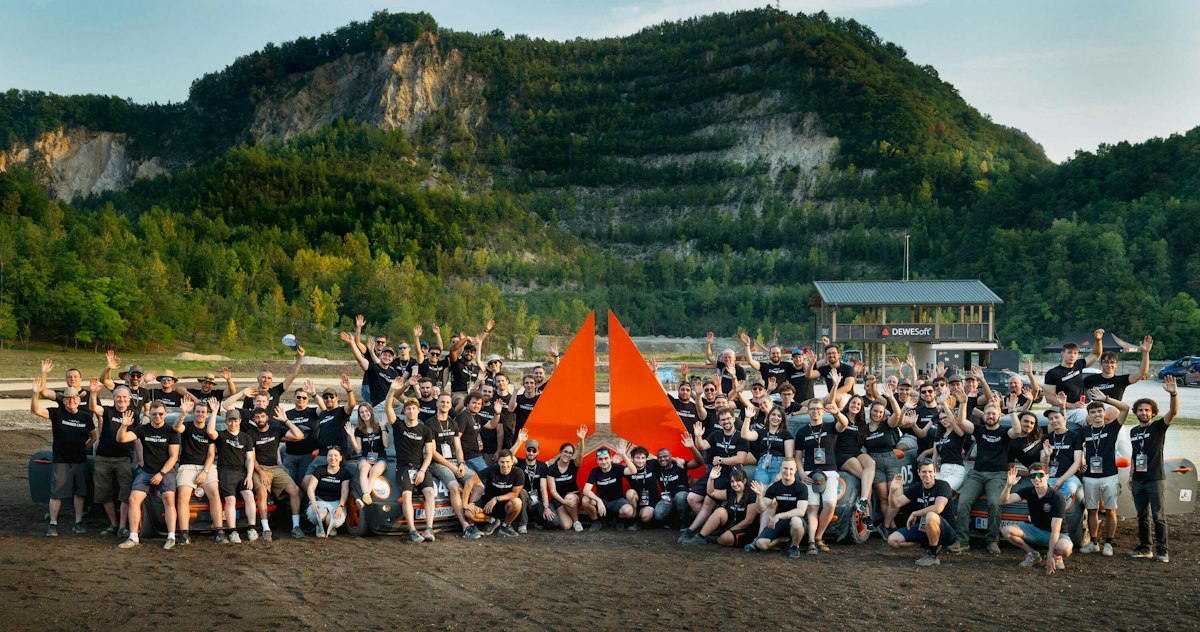
Six teams, six Mini Coopers, and seven measurement challenges set the stage. The cars were hardly new, and their varying condition and reliability introduced uncertainty that no classroom exercise could replicate. As in real engineering, the students had to deal with whatever equipment and circumstances they faced.
The auction: decisions under pressure


At the opening event, Dewesoft President and cofounder Dr. Jure Knez handed each team D€ 10,000 in virtual “Dewesoft Euros” to spend at an auction. Teams raised their paddles and bid on cars, garage spaces, and measurement equipment. Excitement quickly gave way to tough decisions as students realized their budgets were limited. Choosing one item meant having less money for another, introducing a practical lesson in resource management even before the technical work began.
The auction also set the week's competitive tone. Each team had to make strategic choices about the resources it needed to complete the challenges, while leaving enough flexibility to handle the unexpected.

The students had their work cut out for them. They would need to install inertial measurement units (IMUs), fit strain gauges, decode CAN bus data, measure sound with professional microphones, build and install load cells, and more. Their Mini Coopers would serve as testbeds for a wide range of automotive measurements using Dewesoft hardware and DewesoftX software.
Toward the end of the opening evening, Dr. Knez encouraged the students to engage, stay curious, and, above all:
Learn something and have some fun along the way.

From the classroom to the garages
Over the following days, technical lectures were combined with practical work. At Katapult, part of the Dewesoft campus in Trbovlje, students attended presentations by engineering experts, learned about measurement technologies, and discussed how to approach their challenges. The classroom sessions provided useful background, but the students soon had to apply what they had learned to their own vehicles.

Each team had a garage where members could prepare their Mini Cooper and install the required measurement equipment. The work involved configuring sensors, connecting instrumentation, wiring systems, and preparing the cars for testing. The teams also had to manage their time carefully, deciding which tasks to tackle first and how to divide responsibilities.
The facilities were far from luxurious. Some garages were originally outdoors, but the extreme heat forced teams to move some workspaces inside. Teams shared indoor areas, creating opportunities to help one another and exchange ideas, even as they competed for points.
Temperatures climbed above 40 °C in the afternoons. Cool water was readily available, and the track's central building offered some relief from the blazing sun, but the conditions made an already demanding schedule even more challenging.

The students didn't have to figure everything out alone. Each of the six teams had a mentor, typically a Dewesoft Student Ambassador who represents the company at their university and helps organize demonstrations and training events. Every mentor had participated in previous Summer Camps themselves and understood the difficulties the students were likely to encounter.
Dewesoft employees from several departments also supported the teams, sharing their expertise in measurement hardware, sensors, DewesoftX, vehicle testing, CAN data, strain gauges, IMUs, and load cells.

For Richard Schumann, the previous year's Summer Camp MVP and a returning mentor, helping others was rewarding in its own right:
Mentoring brings me a lot of joy. It’s a rewarding role that really helps me grow.
The mentors encouraged students to investigate problems and consider alternative approaches rather than simply providing answers. Their support helped participants make decisions, learn from mistakes, and build confidence in their abilities.

Collecting data is only the first step in a measurement project: the real objective is to understand what the data mean and how they relate to the engineering question.
Data science student Martina Gallemí from the Universitat Pompeu Fabra in Spain describes this as one of the most interesting aspects of the experience:
It was especially interesting to see how data goes from raw sensor signals to something you can actually use to make engineering decisions.
A sensor produces a signal, but the signal itself is not necessarily the answer. Engineers have to determine whether the measurement is reliable, process the data, and interpret the result in its physical context.
Electrical Engineering student Tara Spasojević from the University of Belgrade in Serbia recalls:
Even though we faced some challenges, the atmosphere stayed positive. We had support from mentors, experts, and each other. We had some problems with the strain gauges, specifically with soldering. We did something wrong, but everybody makes mistakes. We solved the problem in time with the help of experts. Luckily, the responsible teammate took it very calmly; otherwise, we wouldn’t have managed.

The episode captures an essential part of engineering: a problem is not necessarily a failure. It can start an investigation that leads to new, useful understanding.
Testing at the track: seven challenges
Once the cars and measurement systems were ready, the teams moved to Lakonca, the test track Dewesoft built specifically for the 2025 Summer Camp. There, students put their preparations to the test under real driving conditions.
The seven scored challenges covered a broad range of automotive measurement activities:
IMU mounting and setup
Precision driving
Static sound measurement
CAN decoding
Load-cell setup to measure vehicle weight
0–40–0 km/h acceleration driving
Fuel-consumption estimation
Each task demanded a different combination of sensors, acquisition hardware, software, and engineering knowledge. IMUs provided vehicle motion and orientation data. Strain gauges measured deformation and mechanical loading. CAN bus decoding revealed information from the vehicle's electronic systems, while microphones supported acoustic measurements and load cells provided the data needed to determine vehicle weight.
The challenges went beyond installing sensors and collecting data. Students had to configure their measurement systems correctly, validate their results, and interpret what the measurements revealed about the vehicle.

Mechanical Engineering student Lewis Mill from the University of Glasgow, UK, described how his team divided the work:
Half the team did IMU setup, and half did CAN setup and decoding. We also split the challenges of making the presentation, managing social media, costing, and our team challenge. If someone had a spare minute while setting up the sensors, they could work on our other challenges. We all had our roles.
This coordination proved essential. Teams had to balance each challenge's technical requirements against limited time and resources. A delay in one task could affect another, and decisions about equipment or personnel could affect the team's overall performance.
The testing also brought the realities of measurement engineering into sharp focus. Sensors do not always behave as expected, connections can fail, and apparently plausible results may not be reliable. Students had to learn to distinguish the vehicle's actual behavior from measurement-setup problems.
Learning by doing: from signal to understanding
University courses provide an essential foundation in mechanics, electronics, physics, signal processing, and data analysis. Summer Camp challenged students to apply that knowledge to real systems where the answers weren't already known.
Instead of working with prepared datasets, participants took part in the measurement process itself. They wired sensors, configured acquisition systems, built setups in DewesoftX, validated measurements, and investigated unexpected results.

Matteo Giuseppe Cigada, a mechanical engineering student at the Polytechnic University of Milan and a member of the winning DEWEHard team, emphasized the value of the practical experience:
What made the week valuable was not only the competition itself. It was the fact that everything was hands-on.
Students built measurement setups, wired sensors, troubleshot unexpected issues, managed limited resources, and presented their work clearly.
For Ibrahim Akram, a mechanical engineering student, mentor, and Dewesoft Student Ambassador at the University of Glasgow, this connection between education and industry was one of the camp's greatest benefits:
Formal education at universities is always very theory-based. When students enter industry, they have a lot to learn. Early exposure to measurement shows them how fun it can be, and their curiosity grows.


Collecting data is only the first step in a measurement project. Engineers must determine whether the measurement is reliable, process the data appropriately, and interpret the result in its physical context. When results look unusual, they must investigate whether the cause lies in the system under test, the sensor installation, the wiring, or the acquisition configuration.
Summer Camp allowed students to work through these questions with real equipment and real test conditions.
When things go wrong
Real-world engineering never follows a perfect plan.
Sensors produce unexpected data. Connections fail. Tests take longer than expected. Plan A becomes Plan B, or Plan C. These difficulties are normal, and real-world engineers must learn to handle them. They are an important part of the learning experience, so they are at the center of Summer Camp.
Students had to learn to investigate problems, adapt their approach, and keep moving.

They had to consider possible causes, test alternatives, and decide what to try next. A problem is not necessarily a failure. It can start an investigation that leads to new, useful understanding.

The students had enough freedom to make decisions, test ideas, and learn from mistakes. Matteo Giuseppe Cigada was particularly amazed by that freedom:
I also found it genuinely impressive to see a company investing this much in students, giving them access to real tools, real vehicles, real measurement problems, and enough freedom to make decisions, test ideas, make mistakes, and improve.
Student and research assistant Piotr Rus from AGH University of Krakow, Poland, also highlighted this aspect:
The trust and freedom Dewesoft provided us throughout the entire program.
That freedom meant students had to take responsibility for their results. When something didn't work, they couldn't simply wait for someone else to provide the answer. They had to investigate.
Physics student Tom Lord from the University of Leeds, UK, summed up the intensity of the week:
It was the most condensed learning experience I've ever had. It’s the best possible learning environment, and you do it with amazing people; their caliber is incredible.
Teamwork without borders

Summer Camp brought together students from different countries, universities, and academic disciplines. For many participants, working with an international team was one of the week's most rewarding aspects and one of its biggest challenges.
When the students first met, they did not know who had experience with a particular sensor, who was comfortable with data analysis, or who could best organize the work. As they worked toward a common goal, they discovered their teammates' strengths.
Modern engineering projects are similarly multidisciplinary. A vehicle test can involve mechanical engineering, electronics, software, instrumentation, and data science. No single person necessarily has all the knowledge required, making communication and collaboration essential.


Leadership also emerged naturally as teams organized their work and responded to unexpected challenges. Mathias Golebiak from Chalmers University of Technology found that taking on a leadership role helped him grow professionally:
It was a great experience that gave me the chance to develop not only technically, but also when it comes to teamwork, communication, and leadership.
Students had to learn to trust one another's expertise, adapt to different working styles, and communicate across language barriers. Mechanical engineering student Luca Di Palma from the Polytechnic University of Turin, Italy, explained:
We learned a lot from each other since we have different backgrounds, and people work in different ways. We learned to communicate better, even in English, which isn't our mother tongue. It wasn't always easy, but we improved a lot.
By the end of the week, the teams had learned to do more than divide tasks. They had developed ways to coordinate their efforts, share responsibility, and help one another succeed.
Curiosity, competition, and a shared learning experience
The competition gave students a clear objective and encouraged them to challenge themselves, but the atmosphere evolved beyond simply trying to win.
A willingness to share discoveries reflected a common motivation: curiosity about how things work and how measurements can reveal more about the physical world.

Peter Hudacsek, an expert and Assistant Lecturer at Széchenyi István University in Győr, Hungary, was impressed by the students' initiative:
The students’ attitude is brilliant because they want to do things. They are a select group of students, really witty and quick to think; even if they don’t know everything, they can figure it out. You give them half a sentence, and they get it fast because they have the background knowledge. This is not what you get in an average classroom.
For students, contact with experienced engineers offered an opportunity to explore unfamiliar topics and learn from professionals working with measurement technology. For the experts, it was a chance to see the next generation's enthusiasm and creativity.
Results presentation
The final event of Summer Camp 2026 wasn't on the track; it was back at Katapult, where each team presented their assignment results to peers, mentors, experts, and Dewesoft staff. A committee reviewed the results and selected the winning teams. A separate committee reviewed nominations for the MVP (Most Valuable Participant) of the week and selected one. These were difficult choices.

After completing the challenges and returning the last car from the dusty track, team “DEWEHard” finished first overall, followed by team “I Measure U.” But the final rankings told only part of the story.

Every team had learned unfamiliar techniques, applied theory to practical problems, worked under pressure, and cooperated with teammates from different backgrounds. The competition provided a reason to push themselves, but the lasting benefits came from everything they did to reach the finish.
Denis Pekica, a machine engineering student at the University of Ljubljana in Slovenia, describes the transition from university to camp:
The camp was work all day and no sleep, but the fun made it all worth it. Sometimes adrenaline rushes make you forget you’re sleep-deprived. Three or four hours of sleep each day and a couple of coffees, and it does it.

Every Dewesoft Summer Camp also recognizes an MVP, or most valuable player. This year's award went to Hans Anniste, an Early Stage Researcher at TalTech – Tallinn University of Technology in Estonia. He credited his team's ability to combine different areas of expertise:
It’s amazing! I never expected this to happen. I love the event, the people, the exercises, everything. Our team's strength was combining different knowledge in specific areas to complete the exercises.
The participants left Slovenia with practical experience in data acquisition, sensors, signal processing, vehicle testing, and measurement analysis. They had also learned how to approach unfamiliar problems, make decisions with limited information, and work effectively with people whose skills and perspectives differed from their own.
For Dewesoft, Summer Camp is an opportunity to share knowledge and inspire future engineers. For students, it is a chance to discover what they can achieve when given the tools, freedom, and support to learn by doing.
They will take home new technical skills and a deeper understanding of engineering, along with the friendships, challenges, and shared victories of an unforgettable week.
And perhaps the simplest way to describe the spirit of Dewesoft Summer Camp 2026 is still the message with which it began:
Learn something – and have some fun along the way.