




Real-Time Engine Testing for Automotive Engineering Education
David Svída, Martin Beran, Michael Böhm, and Josef Štětina
Institute of Automotive Engineering
October 23, 2026
At Brno University of Technology, students gain hands-on experience in combustion engine testing using the Dewesoft SIRIUS data acquisition system. By combining high-speed measurements, real-time combustion analysis, and open engine control unit (ECU) calibration, the laboratory lets students explore engine performance, emissions, and control strategies while building practical automotive engineering skills.
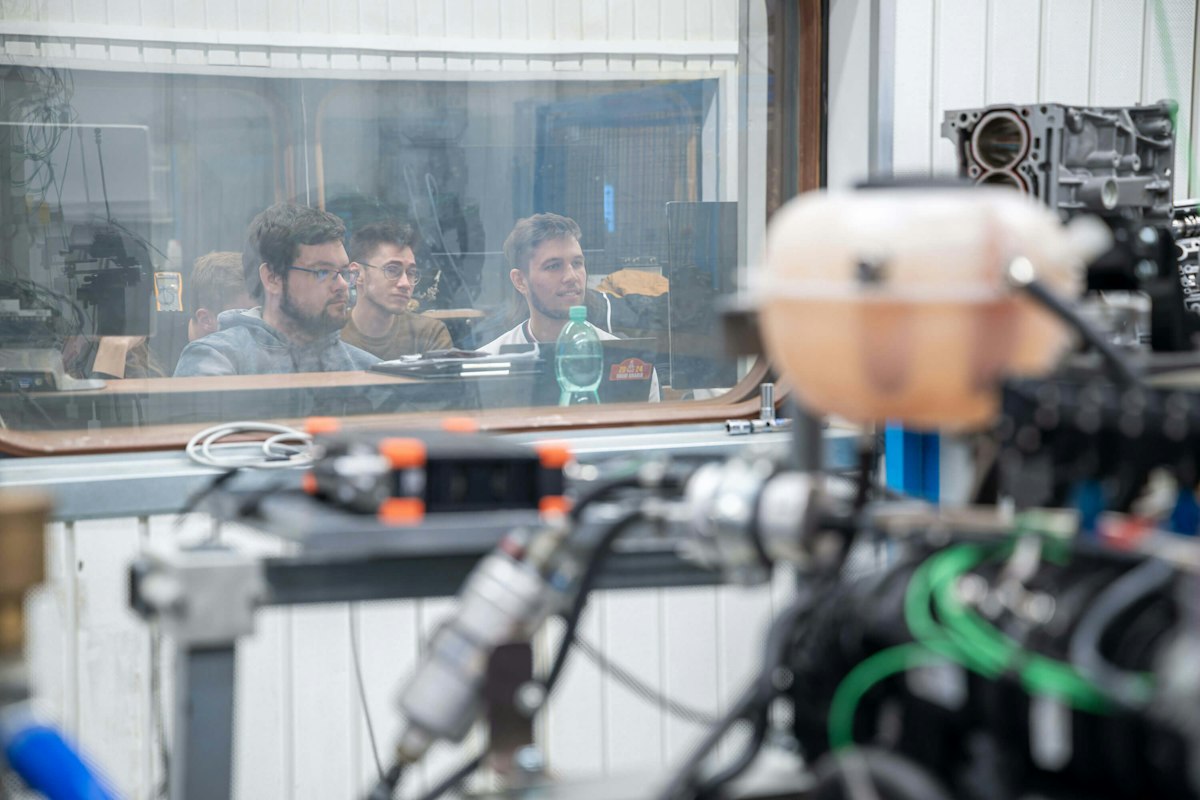
Why hands-on engine testing matters in engineering education
Why should automotive engineering students disassemble and reassemble an engine? While universities prepare future engineers rather than mechanics, understanding how an internal combustion engine works requires more than theoretical knowledge. Hands-on experience helps students connect engineering principles with the physical components and mechanical processes involved in engine operation.
Over the past two decades, the practical experience of students entering engineering programs has changed significantly. In the past, many students had already spent hundreds of hours repairing motorcycles, cars, and other machinery before starting university. This experience gave them a practical understanding of mechanical systems and engineering principles.
Today, many students arrive with strong theoretical knowledge but limited hands-on experience. They understand how internal combustion engines operate and are familiar with animations, CAD models, and technical demonstrations. However, these resources cannot fully replace working with actual engine components.
Disassembling and reassembling an engine introduces students to practical aspects of automotive engineering that are difficult to appreciate through theory alone. Using a torque wrench, following assembly procedures, understanding tightening sequences, and examining component dimensions, clearances, and weights all deepen understanding of engine design and operation.
This practical foundation is essential for more advanced activities such as engine testing, combustion analysis, and calibration, where understanding the relationship between mechanical components and measured engine behavior becomes particularly important.
Teaching automotive engineering through practical engine testing
Modern automotive engineering education combines theoretical knowledge with practical experience in engine testing, measurement, and analysis. At Brno University of Technology, we have integrated the Dewesoft SIRIUS data acquisition (DAQ) system into our combustion engine laboratories, enabling students to apply engineering principles through hands-on experiments and real-time measurements.
As the automotive industry pursues greater engine efficiency, lower emissions, and more advanced control systems, future engineers need strong analytical and practical skills. Understanding internal combustion engines (ICEs), their electronic control systems, and the relationships between operating parameters and engine performance requires direct experience with modern testing and measurement technologies. Advanced DAQ systems play an important role in developing these competencies.
The Institute of Automotive Engineering at Brno University of Technology is the largest educational and research institute specializing in automotive and transport engineering in the Czech Republic. Our activities cover vehicle design, numerical simulation, experimental testing, and validation, as well as optimizing suspension systems, wheels, and complete drivetrains.
Our research and teaching also address the environmental impact of vehicle operation, including emissions, noise, and vibration. Additional areas of expertise include road construction machinery, transport logistics, and material handling systems. To support these activities, we have equipped our institute with modern laboratories featuring advanced testing facilities, reverse engineering technologies, and additive manufacturing capabilities.


Improving engine testing education with Dewesoft SIRIUS DAQ
For many years, we relied on an older Kistler measurement system for teaching combustion engine testing and analysis. However, as the system was no longer being developed and compatibility with newer Windows operating systems became limited, upgrading was no longer a viable option. These limitations increasingly affected our laboratory operations and teaching capabilities.
When evaluating replacement solutions from AVL, Kistler, and Dewesoft, we considered several factors beyond cost. The openness, flexibility, and versatility of the DewesoftX software environment were particularly important, as they would allow students to participate more actively in engine testing, data acquisition, and analysis.
Previously, students received processed measurement results and analyzed them independently after laboratory sessions. With the Dewesoft SIRIUS data acquisition (DAQ) system, they can now participate directly in measurements, observe key engine parameters in real time, and immediately see how changes in operating conditions affect engine behavior. This interactive approach makes complex combustion processes easier to understand and brings laboratory exercises closer to real-world engineering practice.
Dewesoft SIRIUS combines high-speed data acquisition, modular hardware, and real-time signal visualization [1]. Together with DewesoftX Professional software, included with Dewesoft DAQ hardware, the system provides an integrated environment for measurement, data processing, and analysis. These capabilities help students investigate combustion phenomena, engine control unit (ECU) strategies, and the relationships between engine operating parameters, performance, and emissions [2].
We integrated the Dewesoft SIRIUS system into a VW 1.5 TSI engine test bench equipped with an open ECU, allowing students to explore engine calibration and control strategies through practical experiments. By combining high-speed measurements with real-time visualization, students can observe combustion behavior, evaluate the effects of calibration changes, and better understand the factors influencing engine efficiency and emissions.
The transition to Dewesoft SIRIUS has significantly improved the practical aspects of our automotive engineering courses. Students are now directly involved in the measurement process rather than simply analyzing predefined results, helping them develop the technical and analytical skills required for modern engine testing and development.
Real-time engine testing setup at Brno University
The Institute of Automotive Engineering at Brno University of Technology features a comprehensive laboratory station with a modern 1.5 TSI EA211 Evo2 spark-ignition engine, operated via a fully open ECU platform.
As with any new software and hardware, it is essential to adopt a new way of working and avoid forcing old habits into the new environment. Because we built the entire data flow and engine measurement setup around a bus-based architecture and CAN communication, we encountered no major technical issues during integration.
The more practical challenge is teaching itself: we need to display the DewesoftX interface and the live measurements on two large LCD TVs so that, even in a group of around 15 students, everyone can clearly see the current values and real-time changes, and respond immediately.
Figure 1 shows the setup that enables modification of ignition timing, injection parameters, turbocharging behavior, and EGR control.


To support students' understanding of physical hardware, the course displays components such as intake manifolds, cylinder heads, sensors, and actuators separately, enabling interactive learning. The ECU source code is custom-built in-house and aligned with exercise modules covering topics such as:
Engine torque and speed maps
Lambda control and mixture formation
Knock detection and suppression
Emission formation and aftertreatment
Real-time engine testing setup at Brno University
The Dewesoft SIRIUS DAQ system, SIRIUSi-HS-6xCHG-2xCHG, is a cornerstone of the testbed. It enables:
High-speed data sampling (up to 1 MHz/channel)
Real-time visualization of critical combustion parameters
Seamless integration with CAN bus data from ECU and other subsystems
By observing cylinder pressure, intake/exhaust temperatures, knock signals, and exhaust gas composition, students link calibration decisions with measurable outcomes. DewesoftX software supports intuitive visualization, including:
Pressure Volume (PV) diagrams
MFB (Mass Fraction Burned) curves
Performance vs. emissions trade-offs
Live lambda, injection timing, and fuel flow maps

Practical skills gained through engine testing
The teaching framework ensures students achieve the following core competencies:
Theoretical mastery of Internal Combustion Engine (ICE) thermodynamics, combustion cycles, and control strategies.
Practical skills in measuring engine parameters, interpreting sensor data, and conducting test procedures.
System-level understanding of control loops (Engine Control Unit (ECU) → actuator → process → sensor → ECU).
Experience with embedded calibration tools like DewesoftX + Matlab/Simulink interfaces.
Data interpretation and visualization, empowering students to understand complex cause-and-effect relations (e.g., knock → ignition retard → torque drop → NOx reduction).
Using Dewesoft measurement technology, students gain hands-on experience with industrial engine testing procedures while deepening their understanding of combustion processes, engine control, and performance analysis.
The engine test bench features an open engine control unit (ECU) programmable in MATLAB/Simulink, allowing students to modify key calibration parameters and observe their effects on engine behavior. By adjusting ignition timing, fuel injection timing, and intake and exhaust camshaft phasing, students can investigate how these changes influence engine torque, fuel consumption, exhaust emissions, and overall efficiency.
The Dewesoft SIRIUS data acquisition system measures in-cylinder pressure as a function of crankshaft angle, using a digital crankshaft encoder for precise angular reference. Through the DewesoftX CAN interface, the system simultaneously acquires additional engine operating parameters, including engine speed, torque, temperatures, pressures, and emissions data from the exhaust gas analyzer.
DewesoftX software combines these measurements into synchronized, real-time dashboards that display live values, trends, and engine performance data. Students can immediately observe how advancing or retarding ignition timing, changing fuel injection timing, or adjusting intake camshaft phasing affects combustion behavior and engine performance. These changes are reflected in the measurement graphs and can often be heard directly during engine operation.
The system automatically records all measurement data, allowing students to compare operating conditions, perform further combustion analysis, and prepare detailed laboratory reports. This approach connects theoretical knowledge with practical engine calibration and measurement, helping students understand the relationships between control parameters, combustion characteristics, and engine performance.
Advanced combustion engine analysis
In-cylinder pressure measurement and analysis
Researchers and students use piezoelectric sensors and Dewesoft SIRIUS to record high-resolution pressure traces, enabling analysis of:
Indicated Mean Effective Pressure (IMEP)
Maximum pressure and rate of pressure rise
Heat release rates and combustion phasing (Crank Angle (CA): CA10, CA50, CA90)
Engine knock detection and analysis
Knocking phenomena are visualized and quantified through high-frequency filtering and comparison with the Mass Fraction Burned (MFB) profile. The system enables validation of ECU knock control algorithms.
Pressure-volume diagrams and combustion analysis
Students use real-time plotted data to examine:
Efficiency trends
Combustion stability
The effect of mixture richness or ignition advance on heat release
Engine emissions measurement and analysis
The DAQ system interfaces with exhaust gas analyzers (NOx, CO, HC) to support students' understanding of legal emission thresholds and aftertreatment calibration strategies.

Benefits of Dewesoft DAQ systems for engineering education
Dewesoft’s user-centric design and real-time feedback are ideally suited to academic environments. Features particularly beneficial to students include:
Intuitive graphical user interface (GUI): Enables rapid setup and focus on the physics, not configuration.
Scalability: From basic analog channels to full vehicle networks (CAN, LIN, FlexRay).
Modularity: Systems grow with course complexity (e.g., combustion → hybridization).
Cross-discipline compatibility: Applicable in courses from mechanical design to AI-based diagnostics.
These features make Dewesoft an essential partner in educational excellence.

Bringing real-time engine testing into the classroom
Integrating the Dewesoft SIRIUS data acquisition system into the combustion engine laboratory at Brno University of Technology has significantly improved how students learn engine testing, measurement, and analysis. By combining high-speed data acquisition, real-time visualization, and advanced signal processing, the system lets students move beyond theory and gain hands-on experience with modern automotive testing technologies.
Compared to the previous Kistler measurement system, Dewesoft SIRIUS and DewesoftX provide a more flexible and accessible environment for acquiring and analyzing engine data. Previously, students primarily worked with exported text files, with limited opportunities for further processing or thermodynamic analysis. They can now independently evaluate measurement data directly in DewesoftX, applying the same analysis tools used during laboratory experiments.
One of the most important improvements is integrating in-cylinder pressure measurement into regular laboratory exercises. Previously, combustion pressure analysis was limited to occasional demonstrations. With Dewesoft SIRIUS, students routinely measure and analyze combustion pressure, gaining practical experience with engine indication and the thermodynamic processes occurring inside internal combustion engines.
The integration of CAN communication further enhances the laboratory’s capabilities by combining combustion pressure measurements with engine operating parameters, including speed, torque, temperatures, and other sensor signals. The system records all synchronized measurement data in a single file, eliminating the need to work with multiple software environments or manually combine different data formats. Students can visualize, compare, and analyze these measurements within DewesoftX.
By handling the technical complexities of data acquisition, synchronization, and initial signal processing, the measurement system lets students focus on understanding engine behavior. They can investigate relationships between cylinder pressure, volume, and crankshaft angle; calculate indicated work and indicated mean effective pressure (IMEP); and evaluate how combustion characteristics influence engine performance.
The result is a more practical and interactive approach to automotive engineering education, where students actively participate in engine testing, independently analyze real measurement data, and develop the skills needed for modern combustion engine research and development.
References
Dewesoft. SIRIUS Data Acquisition System. Dewesoft d.o.o., 2024. [cit. 2025-06-19].
SARKAR, Saikat. Combustion Analysis with In-Cylinder Pressure Measurement. SAE Technical Paper, 2023. [cit. 2025-06-19].
KIRCHNER, Manfred. Practical Aspects of Knock Detection and Control. Graz: AVL List GmbH, 2022. ISBN 978-3-9505037-2-1.
Acknowledgements
The Faculty of Mechanical Engineering, Brno University of Technology, supported our work. The authors gratefully acknowledge funding for this specific research under BUT FSI-S-23-8235.
The project "Innovative Technologies for Smart Low Emission Mobilities" supported this publication and was funded as project No. CZ.02.01.01/00/23_020/0008528 by the Program Johannes Amos Comenius, under the call "Intersectoral cooperation".