




Structural Health Monitoring of Railway Bridges in Extreme Arctic Conditions

At the Arctic Test Arena in Northern Norway, railway bridges are becoming intelligent infrastructure. Equipped with advanced Dewesoft monitoring technology, the structures continuously generate data that helps engineers understand their behavior under extreme Arctic conditions. The project demonstrates how digital monitoring can improve safety, reduce maintenance costs, and extend the life of vital railway assets.
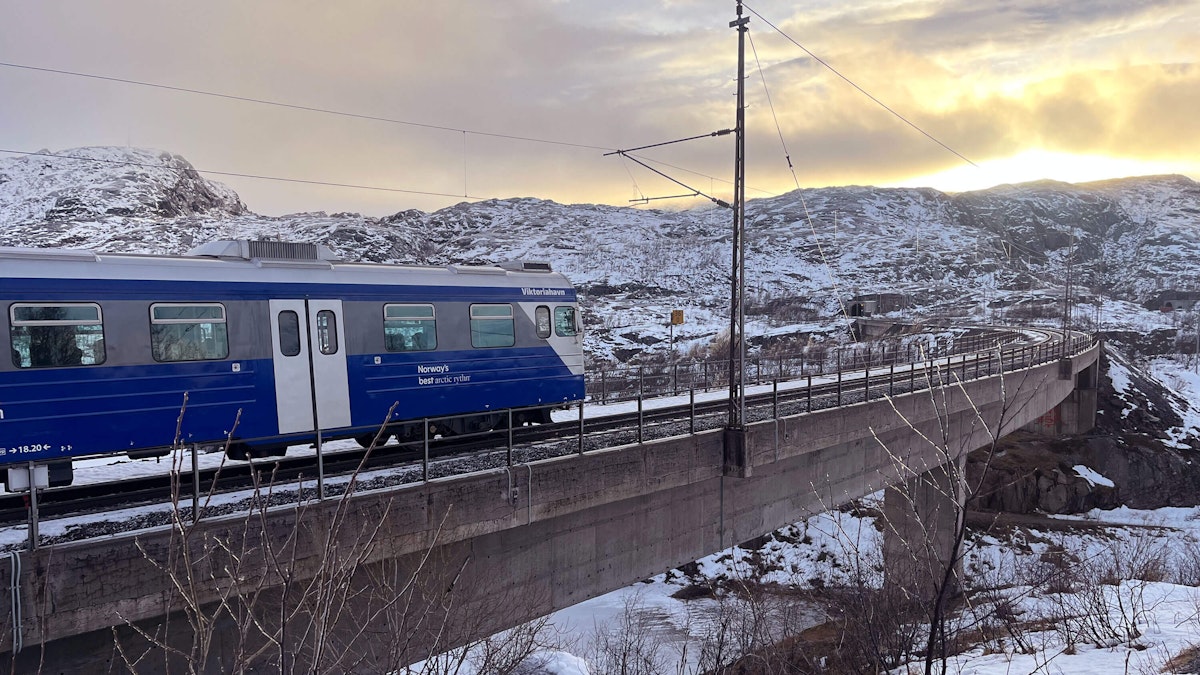
Railway bridge structural health monitoring in the Arctic
Near Narvik in Northern Norway, two concrete railway bridges are being used to test a new approach to infrastructure monitoring. Located near Søsterbekk station on the Ofoten Line, close to the Swedish border, both bridges are fully instrumented as part of the Arctic Test Arena.
Monitoring bridges in the Arctic is difficult due to remote access, extreme weather, limited maintenance windows, and increasing traffic loads. Conventional inspections provide only periodic snapshots and often require costly site visits. This project sought a scalable monitoring solution that could deliver continuous structural insights with minimal installation effort.
Why the Arctic test arena matters
The Arctic Test Arena brings together researchers, infrastructure owners, universities, and technology companies from Norway and Sweden. Together, they are creating one of Europe’s most advanced environments for structural health monitoring.
At Søsterbekk, two concrete railway bridges have been equipped with sensors and high-speed data acquisition systems. Instead of relying only on periodic inspections, engineers can now monitor the bridges continuously and study how they respond to trains, temperature changes, snow, ice, and other Arctic conditions.
Nordal Bridge No. 1 is a 50-meter single-span prestressed concrete bridge. Bridge No. 2 has two spans, measuring 44 and 41 meters, and follows a 350-meter curve. Both bridges were built in 1988 and are typical of many railway bridges found across Norway and Europe.
The work is part of IAM4RAIL, a European initiative involving 94 partners. In Norway, the project is led by the Norwegian Railway Directorate together with NORCE, SINTEF, and NTNU.
The goal is simple:
By understanding how infrastructure behaves in the Arctic, engineers can design safer and smarter railway systems everywhere.
“Extreme weather is usually a challenge for the railway, but when we are testing new technology, heavy snowfall and Arctic cold are actually an advantage,” says Acting Railway Director Marit Rønning. “The Nordic region gives us a unique testing environment.”
A unique railway test corridor
The Ofoten Line in Norway and the Iron Ore Line, known as Malmbanan, in Sweden connect the mining regions of northern Sweden with the ice-free Port of Narvik, as shown in Figure 1.
Søsterbekk is difficult to access for most of the year. The nearest parking area is about one kilometer away, and the access road is open only during the summer. Reindeer also pass beneath the bridges on their way to seasonal grazing areas. The steep terrain makes construction work especially demanding, and even the use of scaffolding is impractical.
Despite its remote location, the railway is strategically important. Some of the world’s heaviest freight trains use the route every day to transport iron ore for European industry and the transition to fossil-free steel production. The line also supports passenger transport, regional development, and supply chain resilience. Keeping it operational is therefore important not only for the region, but for Europe as a whole.


Challenges of monitoring railway bridges in Arctic conditions
Few railway lines face conditions as severe as those in the Arctic. Temperatures can fall below −40°C (see Figure 2), while snow, ice, freeze-thaw cycles, strong winds, and changing climate patterns place constant stress on bridges, tracks, and surrounding structures.


Traditional inspections show only the condition of a structure at a specific moment. Structural health monitoring provides continuous data, allowing engineers to see how the infrastructure changes over time. By measuring vibration, strain, displacement, temperature, and acceleration, they can identify small changes before visible damage develops.
The system also had to synchronize measurements across multiple bridge spans, withstand harsh outdoor conditions, and remain easy to expand. Dewesoft’s distributed EtherCAT architecture met these requirements while reducing cabling, installation time, and overall complexity.
Distributed DAQ for structural health monitoring
IOLITEicw 3xMEMS-ACC is a family of data acquisition devices with an embedded triaxial MEMS accelerometer, analog-to-digital conversion, and EtherCAT interface based on the IOLITE modular DAQ device platform (See Figure 3).
The devices can gather acceleration data as well as inclination and temperature data.


The Dewesoft IOLITEicw-3xMEMS-ACC devices provide very low-noise measurements, which is essential for detecting small structural vibrations. The standard version has a spectral noise density of 25 µg/√Hz, while the IOLITEicw 3xMEMS-ACC-S reaches an ultralow 0.7 µg/√Hz. This performance is comparable to leading force-balance accelerometers.
Because the devices use EtherCAT, measurements from different units can be synchronized to within 1 µs. This precise timing is especially important for operational modal analysis, where engineers evaluate natural frequencies, mode shapes, and damping ratios.
The devices can be distributed across large structures and connected with a single CAT6 cable. Each cable segment can extend up to 100 meters between nodes. With optical converters, devices can be placed more than 20 kilometers apart while maintaining the same 1 µs synchronization.
Each unit is housed in a waterproof IP67 aluminum enclosure for reliable outdoor operation. Other enclosure designs and protection levels are also available on request. Figure 4 shows an example system configuration.


The daisy-chained technology allows users to keep adding sensors to the measurement chain for future instrumentation campaigns. If we add another power injector, a completely new measurement chain becomes possible, with power, signal, and synchronization in a single cable, as shown in Figure 5 for daisy-chained and star configurations, respectively.


This is a huge contrast to the centralized system approach, as shown below (See Figure 6):


Showcasing the added value for the system integrator, i.e., using the Dewesoft Monitoring solution, minimizes:
The installation time
Installation cost
Downtime of the structure
Figure 7 shows how we can further adapt to any system configuration by using an EtherCAT switch to deploy multiple measurement chains on the structure.


Finally, Figure 8 shows that combining different sensors on the same measurement line is also possible and suitable for the project, reducing installation time by daisy-chaining sensors in any order.


The IOLITEicw MEMS devices are available in several configurations:
IOLITEicw-3xMEMS-ACC-8g: Triaxial MEMS accelerometer with EtherCAT interface, ±2g to ±8g measurement range, 0 - 1000 Hz bandwidth, 4 kS/s sampling rate, 96 dB dynamic range, and 25 µg/√Hz spectral noise density. Aluminum housing, plastic cable glands, IP67
IOLITEicw-3xMEMS-ACC-40g: Triaxial MEMS accelerometer with EtherCAT interface, ±10g to ±40g measurement range, 0-1000 Hz bandwidth, 4 kS/s sampling rate, 96 dB dynamic range, and 25 µg/√Hz spectral noise density. Aluminum housing, plastic cable glands, IP67
IOLITEicw-3xMEMS-ACC-S: Low-noise triaxial MEMS accelerometer with EtherCAT interface, ±15g measurement range, 0-460 Hz bandwidth, 1 kS/s sampling rate, 137 dB dynamic range, and 0.7 µg/√Hz spectral noise density. Aluminum housing, plastic cable glands, IP67
IOLITEicw-1xMEMS-ACC-Z-8g: Uniaxial MEMS accelerometer with EtherCAT interface and ±2g, ±4g, and ±8g measurement ranges, 0-1000 Hz bandwidth, 4 kS/s sampling rate, 96 dB dynamic range, and 25 µg/√Hz spectral noise density. Aluminum housing, plastic cable glands, IP67
IOLITEicw-1xMEMS-ACC-Z-40g: Uniaxial MEMS accelerometer with EtherCAT interface and ±10g to ±40g measurement range, 0-1000 Hz bandwidth, 4 kS/s sampling rate, 96 dB dynamic range, and 25 µg/√Hz spectral noise density. Aluminum housing, plastic cable glands, IP67
IOLITEicw-2xMEMS-INC: Static bi-axial inclinometer with Measurement range: +-15 deg, resolution: 0,001 deg, relative accuracy: 0,01 deg. Aluminum housing, plastic cable glands, IP67
IOLITEicw-3xMEMS-ACC-8g-INC: The same specs as IOLITEicw-3xMEMS-ACC-8g with an integrated inclinometer.
Additionally, the IOLITEicw-3xMEMS-ACC-T version features an additional M8 connector at the front to which a temperature sensor can be connected. This enables the simple, inexpensive addition of a temperature-measurement point for monitoring applications on bridges, wind turbines, and other structures.
Only a dedicated temperature sensor is compatible and must be ordered separately. It is a digitized temperature sensor with the following specs:
Measurement accuracy: +-0.5 °C
Measurement range: -55 to 125 °C
Environmental protection: IP66.
The 1-wire protocol is used to communicate between the sensor and the 3xMEMS-ACC device. Maximum cable length is 10 m. And with potential upgrades:
T - additional input (1-wire, M8 connector) for external temperature sensor (sensor needs to be ordered separately). NOTE: Applicable to all above devices except the IOLITEicw 3xMEMS-ACC-S.
INC - temperature calibration for accurate static inclination measurements. NOTE: Applicable to all above devices except the IOLITEicw 3xMEMS-ACC-S.
SSG - stainless steel cable glands (inox 316) added to the Aluminum housing (instead of plastic cable glands), IP67. Applicable to all the above devices
PP - Harting push pull connectors added to the Aluminum housing (instead of plastic cable glands), IP67. Applicable to all the above devices
316 - Inox 316 housing, inox 316 cable glands, IP67, suitable for marine/harsh environment. Applicable to all the above devices.
Turning SHM data into predictive maintenance
The Arctic Test Arena is more than a sensor network—it's a platform for developing the next generation of digital infrastructure management.
Researchers combine:
Structural Health Monitoring (SHM)
Operational Modal Analysis (OMA)
Artificial Intelligence
Digital Twins
Advanced data analytics
Together, these technologies help distinguish normal environmental effects from early signs of deterioration, enabling predictive maintenance instead of reactive repairs. The result is improved safety, fewer unexpected failures, lower maintenance costs, and longer infrastructure life.
From the DAQ perspective, this is possible due to the Dewesoft Monitoring solution's 1-microsecond synchronization level, which enables advanced SHM techniques such as modal tracking and anomaly detection.
Project results and key findings
These are the main conclusions of the project:
Environmental effects dominate structural response
Temperature is the largest source of variability in vibration-based bridge monitoring in Arctic environments. Researchers found that:
Natural frequencies vary significantly with seasonal temperature changes
Thermal gradients can produce larger changes than small structural damage
Ignoring environmental variability leads to both false alarms and missed damage
Consequently, temperature compensation is not simply beneficial—it is essential for a reliable SHM system.
The Arctic Test Arena promotes moving from scheduled inspections towards continuous condition assessment.
Continuous sensing provides:
deterioration trends
event detection
seasonal baseline evolution
remaining life estimation
Instead of isolated inspection snapshots. This is particularly valuable in northern regions where bridge access is difficult during winter.
Multi-sensor fusion is considerably more reliable than single-sensor systems
One consistent finding is that no individual sensor type is sufficient. Successful deployments combine
accelerometers
strain gauges
temperature sensors
weather measurements
train or traffic information and more
Rather than relying only on vibration measurements. This is particularly easy in the Dewesoft X monitoring environment.
Machine learning is promising—but only when physics is incorporated
Another important outcome is that purely data-driven AI models are not sufficiently robust in Arctic environments because they struggle with:
seasonal temperature shifts
snow loading
ice accumulation
varying operational loads
Instead, the best performance has come from hybrid SHM, combining:
finite element models
operational modal analysis
statistical learning
machine learning classifiers
This hybrid approach reduced uncertainty in identifying real damage versus environmental effects.
Digital twins are becoming practical maintenance tools
The Arctic Test Arena has increasingly focused on integrating SHM with digital infrastructure management. Rather than simply collecting sensor data, the workflow aims to:
Sensor data
Damage indicators (selection is key)
Modal updating (both statics and dynamics)
Digital twin (both from the construction and structural perspectives)
Maintenance support (decision-making for both infrastructure operators and owners)
This aligns with broader Norwegian work demonstrating how digital twins can support early detection and maintenance planning for bridges, as shown in [4].
Conclusion: smarter railway bridge monitoring
Continuous monitoring provides more than real-time data. It builds a long-term picture of how infrastructure behaves under changing environmental and operational conditions.
This information can support digital twins, virtual models that are continuously updated with sensor data. Engineers can use them to predict future performance, identify developing problems, and plan maintenance more effectively. Artificial intelligence adds another layer by finding patterns across large datasets and providing earlier warnings.
For the railway sector, this marks a shift from fixed maintenance schedules to condition-based maintenance. Infrastructure owners can intervene when the data shows that action is needed, rather than relying only on routine inspection intervals.
The Arctic Test Arena shows how traditional engineering, continuous monitoring, digital twins, and artificial intelligence can work together to improve infrastructure management. The lessons learned in one of the world’s harshest railway environments can also be applied to bridges and rail networks far beyond the Arctic.
The future of railway infrastructure is not simply stronger—it is smarter, continuously monitored, and increasingly predictive (See Figure 9). With Dewesoft Monitoring technology, the Arctic Test Arena is helping make that future a reality.
Although the project is located above the Arctic Circle, its significance extends far beyond Northern Norway. The technologies and monitoring strategies being developed here can be applied to railway bridges worldwide, helping infrastructure owners transition from reactive inspections to data-driven, predictive asset management.
References
Norwegian Railway Directorate (Jernbanedirektoratet): Arctic test arena on Ofotbanen and Malmbanan.
Norwegian Railway Directorate (Jernbanedirektoratet): Ofotbanen and Malmbanan will become international test arenas. 27. October, 2025.
Bane NOR: Fremtidens jernbane testes i arktisk klima. 19. November, 2025.