




Laminated Glass Damage Assessment Using Modal Analysis
Chiara Bedon and Nicola Cella
University of Trieste
October 8, 2026
Repeated impacts can reduce the residual stiffness and mechanical performance of fractured laminated glass, making reliable post-breakage assessment essential for structural safety. This study investigates through-cracked laminated glass subjected to repeated hard-body impacts and experimental modal analysis. Changes in fundamental vibration frequency reveal how damage progresses and show the potential of vibration-based monitoring for assessing residual stiffness and structural degradation.
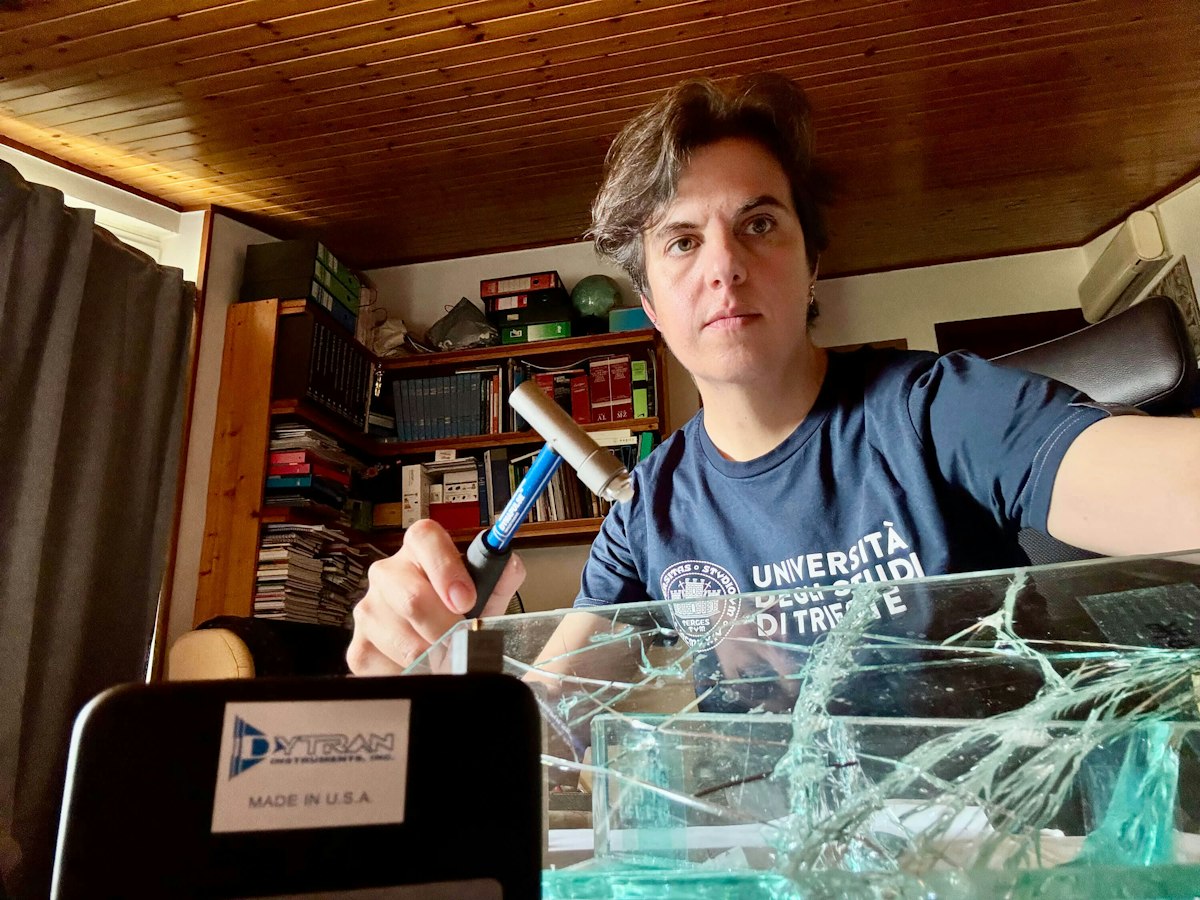
Assessing damage in fractured laminated glass
Assessing the post-breakage performance of fractured laminated glass (LG) is challenging because damage can evolve in different ways depending on the glass configuration and interlayer properties. This study investigates the dynamic behavior of small-scale, through-cracked LG specimens composed of two annealed glass layers bonded with different interlayers.
The specimens were tested in a three-point bending setup and subjected to 10 repeated hard-body impacts. Experimental modal analyses using roving hammer tests were performed before the first impact and after each subsequent impact to evaluate changes in residual bending stiffness as damage progressed. The fundamental vibration frequency was used as the main diagnostic parameter, revealing distinctly different degradation patterns between the tested configurations.
Understanding the post-breakage behavior of laminated glass is important for structural safety because its residual mechanical capacity can change significantly as damage develops [1,2]. Quantifying how this capacity evolves with increasing damage severity therefore provides valuable information for assessing the remaining structural performance of fractured glass elements [3].
The experimental study, carried out at the University of Trieste, focused on small-scale pre-fractured laminated glass specimens and aimed to dynamically characterize changes in their residual mechanical capacity [4]. By combining repeated hard-body impacts with experimental modal analysis, the study tracked damage propagation and stiffness reduction over successive impact cycles.
Changes in fundamental vibration frequency were used as a key indicator of structural degradation, since variations in frequency reflect changes in the mechanical properties and stiffness of the tested specimens.
Repeated impact and modal testing of laminated glass
The experimental investigation reported in [4] comprised a series of low-velocity, hard-body impacts on LG samples in a three-point bending setup, alternating with roving hammer tests for dynamic characterization. Table 1 and Figure 1 summarize the main features of the tested specimens.
|
Specimen label |
Length |
Width |
Glass thickness Nominal / Measured |
Interlayer thickness |
Interlayer type / Commercial product |
|
EVA |
200 |
50 |
4 / 3.814 |
1.52 |
Evalam Visual® |
|
SG |
200 |
50 |
10 / 9.766 |
0.76 |
SentryGlas® SG5000 |
With the technical support of Seretti Srl, we produced the samples with a mid-span disconnection to replicate a through-cracked sample and assess the bonding capacity of interlayers [5, 6].
The series of n = 10 impact tests was carried out by positioning the sample on two rigid blocks, ensuring a free total span of Lb = 190 mm. As shown in Figure 1(a), we dropped a steel sphere with a diameter d = 35 mm and mass m = 0.18 kg from a fixed height of h = 190 mm to strike the mid-span section of the sample. The setup in Figure. 1(a) corresponded to an impact energy Eimp = 0.328 J.


To quantify potential damage propagation from the repeated hard-body testing protocol, experimental modal analyses were performed on each LG specimen, both before the impact tests and after each impact [4].
Using a Dewesoft data acquisition suite, we performed modal analysis. To excite the structure, we used a DYTRAN® instrumented modal hammer (Figure 2(a)) with a 440 N force range to deliver three impacts to each of the 14 control points (see Figure 1(b)).
Resulting vibrations were captured by a DYTRAN® single-axis IEPE accelerometer (50 g range, 100 mV/g sensitivity) rigidly bonded to the glass near the mid-span. Because of its miniature size (10.2 mm cube) and light weight (4.3 g), the sensor's mass did not interfere with the dynamic response of the LG specimens.
We acquired data at a sampling rate of 5000 Hz using a 4-channel, USB-powered SIRIUS Mini acquisition system (Figure 2(b)). We conducted post-processing using DewesoftX data acquisition and signal-processing software (v. 2025.2) equipped with a dedicated modal-analysis plugin.


Laminated glass impact and modal analysis results
Overall, the EVA-bonded specimen appeared severely affected by the imposed impacts, with clear crack propagation in the impact region. Conversely, no cracks were visually detected in the SG specimen, following hard-body impacts. In both cases, we observed no damage phenomena in the EVA or SG interlayers. Figure 3(a) and (b) show selected examples.


The post-processing of experimental data collected from the roving hammer tests focused on examining the fundamental vibration frequency, which is notoriously a preliminary monitoring parameter. Assuming f1,0 as the vibration frequency of the through-cracked specimen before the first impact test (n = 0), we can expect that:
Figure 4 depicts the experimental fundamental frequencies, confirming this trend, showing a different progression of damage in the EVA- and SG-bonded specimens. Specifically, the latter exhibits a rather stable trend, with a slight reduction in frequency as n increases. Given that the glass layers did not exhibit major cracks, this reduction is likely attributable to deterioration of the SG interlayer in the mid-span section.
Conversely, the EVA specimen exhibits a greater reduction in frequency as n increases. We can explain both phenomena by considering the thicker glass layers and the stiffer interlayer used in the SG specimen.
The trend of experimental data for the EVA specimen also differs from the general expectation summarized by Eq. (1), highlighting the occurrence of a relevant interlocking phenomenon with n.


Finally, Figure 5 shows the variation in the fundamental modal shape n for the sample bonded with EVA. The increase in damage severity with n is clearly evident in the selected normalized displacements recorded during the series of repeated impact tests. Notably, we did not observe the same behavior in the SG sample.


Evaluating laminated glass damage with modal analysis
The study showed that experimental modal analysis can help assess damage progression in fractured laminated glass after repeated low-velocity impacts.
Tests on specimens with Evalam Visual® and SentryGlas® SG5000 interlayers revealed clearly different changes in fundamental vibration frequency, reflecting differences in residual stiffness and damage evolution.
These results highlight the potential of vibration-based monitoring as a practical method for evaluating the post-breakage behavior of laminated glass.
Acknowledgements
The Italian Ministry of University and Research (MUR) provides financial support for these research activities through the FIS2021 Starting Grant (FIS00000609), see www.hopglaz.it.
References
C. Bedon, M. Kozłowski, and N. Cella, “Gaps in the post-breakage out-of-plane bending stiffness assessment of 2-ply partially damaged laminated glass elements under short-term quasi-static loads,” Engineering Structures vol. 327, p. 119617, Mar. 2025, doi: 10.1016/J.ENGSTRUCT.2025.119617.
C. Bedon, R. del Bello, N. Cella, L. Cozzarini, and M. Fasan, “Residual mechanical capacity of small-scale partially fractured annealed laminated glass elements subjected to a quasi-static cyclic protocol,” Engineering Failure Analysis, vol. 186, no. 3, p. 110462, Mar. 2026, doi: 10.1016/j.engfailanal.2025.110462.
M. Feldmann et al., “The new CEN/TS 19100: Design of glass structures,” Glass Structures & Engineering 2023 8:3, vol. 8, no. 3, pp. 317–337, Mar. 2023, doi: 10.1007/s40940-023-00219-y.
C. Bedon, N. Cella, and R. del Bello, “Damage assessment of through-cracked-bending laminated glass elements under low-velocity hard-body impacts,” Materials 2025, Vol. 18, Page 4454, vol. 18, no. 19, p. 4454, Sep. 2025, doi: 10.3390/MA18194454.
S. Chen, Z. Chen, X. Chen, and J. Schneider, “Evaluation of the delamination performance of polyvinyl-butyral laminated glass by through-cracked tensile tests,” Construction and Building Materials, vol. 341, Jul. 2022, doi: 10.1016/j.conbuildmat.2022.127914.
D. Ferretti, M. Rossi, and G. Royer-Carfagni, “Through-Cracked Tensile Delamination Tests with Photo-elastic Measurements,” Challenging Glass 3: Conference on Architectural and Structural Applications of Glass, CGC 2012, pp. 641–652, 2012, doi: 10.3233/978-1-61499-061-1-641.