




Grid-Forming and Grid-Following Converters: Testing and Validating Power Grid Stability

August 28, 2026
As renewable energy transforms power grids from centralized systems into converter-dominated networks, maintaining stable voltage and frequency is becoming a major engineering challenge.
The “Fuchstal Lights Up” project in Germany is investigating how grid-forming and grid-following converters can work together in a stable, fully converter-based island grid without centralized control. Researchers are isolating a real section of the grid from the main transmission network to test whether it can operate autonomously.
High-speed, synchronized measurements from Dewesoft capture real-world converter behavior and provide data for validating simulation models. This helps researchers develop and validate the control strategies needed for future power systems.
Grid stability in converter-based power systems
Rising electricity demand from data centers, e-mobility, and electrified heating is accelerating the transformation of power generation. Large centralized power plants with synchronous generators are being complemented, and in some applications replaced, by decentralized renewable and converter-based generation.
Solar and wind power are central to this transformation, with battery energy storage systems (BESS) providing local energy storage and grid support. Power conversion systems (PCS) convert the DC output of photovoltaic systems and batteries into AC power for grid-connected or islanded networks. These converter-based systems must meet applicable national and international grid codes and power quality requirements.
This changing generation mix also creates a fundamental technical challenge. Conventional synchronous generators naturally contribute to voltage and frequency stability. Converter-based generation behaves differently, and interactions between converter controls can become critical when no conventional generator is available to provide a stable grid reference.
This is where grid-forming and grid-following converters play different roles. Grid-following converters synchronize to an existing grid voltage, while grid-forming converters can establish and regulate voltage and frequency themselves. Understanding how these technologies interact is essential for maintaining power grid stability as the share of converter-based generation continues to grow.
The Fuchstal converter-based island grid project
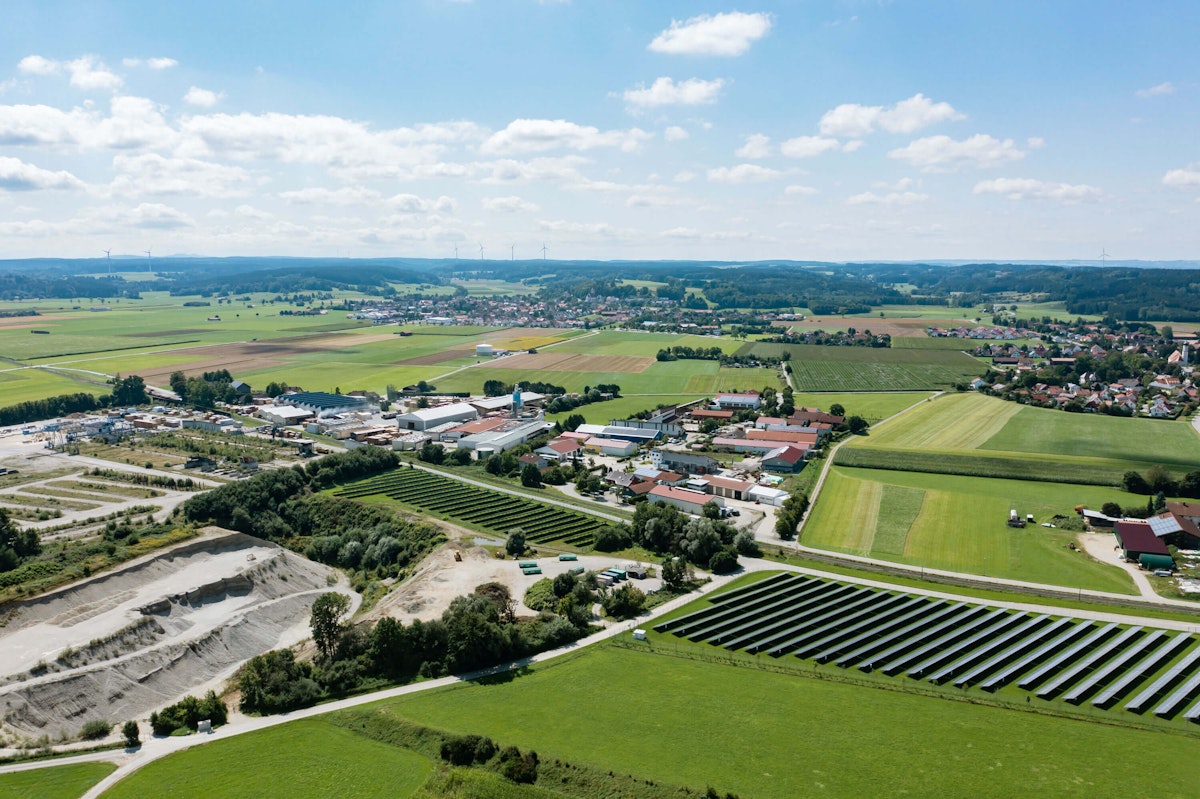
Based in the energy-self-sufficient municipality of Fuchstal, Bavaria, the “Fuchstal Lights Up” project investigates how a converter-based island grid can maintain stable operation using renewable energy sources and power converters without centralized control.
Fuchstal is a municipality of just over 4,200 residents in the Landsberg district of Bavaria, Germany. It consists of three villages: Leeder, the administrative center, Asch, and Seestall. Since August 2023, energy suppliers, research institutions, and the local community have been working together on the “Fuchstal Lights Up” project, known in German as “Fuchstal leuchtet.”
The initiative is part of the Fuchstal Energy Future Living Lab and is funded by the German Federal Ministry for Economic Affairs and Climate Action. Its goal is to determine whether modern converter-based systems can maintain stable grid operation without centralized communication or control.
Project partners include the Elenia Institute at the Technical University of Braunschweig, the Universities of Applied Sciences in Munich and Augsburg, the municipality of Fuchstal, and LEW Distribution Network.


At the heart of the research is a fundamental question:
How can stable grid operation be achieved in a network without centralized control, supplied and loaded exclusively by power converters?
Answering this question requires realistic field testing. The researchers are investigating wind turbines together with grid-forming and grid-following converters under practical operating conditions. Precise measurements of instantaneous voltage and current are essential because they provide the data required to characterize the system’s dynamic behavior and validate simulation models.
As project manager Prof. Dr. Georg Kerber from Munich University of Applied Sciences explains:
To investigate these aspects, we combine systematically interlinked field tests with practical simulation models in the Fuchstal Energy Future real-world laboratory.
The project addresses several closely related objectives:
Development of control strategies for grid-forming converters with integrated battery storage.
Investigation of undesired interactions and the interplay of converter controls.
Examination of system stability in response to load changes.
Investigation of protection techniques and selective shutdown mechanisms for island-grid operation.
Critical review of existing parameters for parallel grid operation and assessment of potential adjustments to applicable connection rules.
Design and evaluation of a control concept for converter-based composite networks.
Field testing a converter-based island grid
In fall 2024, the project successfully demonstrated island-grid operation using two 2.5 MW grid-forming battery inverters. The inverters operated alongside reactive loads, including a power-to-heat system, an inductive load bank, and a capacitive cable section.
A subsequent field trial in October 2024 collected measurement data on wind farm behavior under different grid-forming and grid-following inverter settings. Further testing will expand the island grid and investigate whether it can supply the municipality in island mode. The project ultimately aims to establish an island grid incorporating four 3 MW wind turbines and supply the entire municipality of Fuchstal during a grid failure.
These field tests create a demanding measurement challenge. Researchers need to capture not only the system’s steady-state behavior but also fast transient events and dynamic interactions as converter controls respond to changing operating conditions.
High-speed measurement of converter dynamics
Understanding these interactions requires more than conventional RMS power measurements.
The researchers need synchronized, instantaneous voltage and current waveforms with sufficient bandwidth to capture fast transients and converter-control dynamics.
To meet these requirements, the project uses a Dewesoft SIRIUSi-XHS-4xHV-4xLV high-speed power analyzer.
The system synchronously measures three-phase AC power systems and DC components, and can perform continuous or triggered recording at sampling rates up to 15 MHz.


The electrical power analysis module in the DewesoftX data acquisition software provides online calculation of power and power-quality parameters as well as post-processing capabilities.
This allows the same measurement system to serve multiple purposes, from high-speed waveform recording and oscilloscope-style analysis to power and power-quality measurements.
For the Fuchstal project, the measurement system had to meet three key requirements:
Distributed and synchronized measurements of instantaneous voltage, current, and frequency at distributed measurement points.
High signal quality to capture the behavior of sensitive inverter controls without introducing measurement artifacts.
High sampling rates to resolve fast transient events and converter interactions.
These requirements are particularly important when measurements from several locations must be combined to create a coherent picture of the island grid. Accurate synchronization allows researchers to relate events at different measurement points and analyze how converter behavior propagates through the system.


Validating power system simulations with field measurements
Field measurements provide the link between the physical island grid and the project’s simulation models.
During the second field trial in October 2024, the measurement system collected critical data on wind farm behavior under different parameter settings for the grid-forming and grid-following inverters.
These measurements provide real-world reference data for evaluating and validating PSCAD simulation models using RMS and electromagnetic transient (EMT) analysis. Instead of relying solely on idealized or simulated converter behavior, researchers can compare the models with measurements from the actual operating system.
This is particularly important for converter-dominated power grids, where small differences in converter control behavior can influence overall system dynamics. High-resolution instantaneous measurements help researchers investigate these effects, improve simulation models, and refine operating strategies based on real-world data.
Scaling up converter-based island grid operation
The third field trial will extend the measurement campaign to the wind turbine measurement points. The Dewesoft Power Analyzer will monitor the long-term stability of the island grid, including its ability to supply the participating communities.
The initial tests demonstrated island-grid operation with grid-forming battery inverters. Subsequent trials introduce more complex converter interactions, including grid-following wind turbines. The ultimate goal is to determine whether a larger, predominantly converter-based network can maintain stable operation without relying on a conventional synchronous generator or centralized control.
Synchronized measurement data will provide a common reference for evaluating system behavior as these operating conditions become increasingly complex.
Measurement and validation for future converter-based power grids
The Fuchstal Lights Up project demonstrates why detailed measurement is becoming more important as power systems evolve. In conventional power grids, large synchronous generators provide much of the physical foundation for voltage and frequency stability. In converter-dominated grids, stability depends more heavily on the behavior and interactions of electronic control systems.
The Dewesoft measurement system provides the high-resolution instantaneous data needed to investigate these interactions under real operating conditions. The resulting data supports simulation model validation, converter behavior analysis, and the development of operating strategies for grid-forming and grid-following systems. Grids.pdf
As field testing progresses, the project will provide further insight into how converter-based systems can operate together in island mode and how renewable-dominated power grids can remain stable under changing loads and operating conditions.
Ultimately, the work at Fuchstal addresses a growing challenge for future power systems: maintaining reliable grid operation as power electronics take on a greater role in controlling the grid.
By combining real-world field tests, high-speed synchronized measurements, and simulation models, the project is helping develop and validate the control strategies needed for stable converter-based power grids.
Project partners and further reading
Grid-forming inverters as a cornerstone of future power system stability, Federal Ministry for Economic Affairs and Energy, 20.08.2025.