




Bicycle Fork Vibration Testing During Front Braking
Matteo Formentini, Enrico Giolo, Edoardo Marconi, and Alessandro Rovarin
Dynamotion s.r.l.
July 22, 2026
Dynamotion combined on-road testing, modal analysis, Dewesoft KRYPTON DAQ, and numerical modeling to identify what causes bicycle fork vibrations during disk braking and how to reduce them.
Front disk braking can trigger uncomfortable longitudinal vibrations in bicycle forks, affecting rider confidence and braking performance. To investigate the phenomenon, Dynamotion combined on-road testing, laboratory modal analysis, and Dewesoft-powered data acquisition with a validated numerical model. The study identifies the key roles of brake friction material, wheel dynamics, and fork stiffness, and provides practical design strategies to reduce vibration and improve braking performance.
Introduction
The study was conducted by Dynamotion s.r.l., an engineering company founded in 2010 as a spin-off of the University of Padua. Dynamotion provides engineering services and software for the mechanical, motorcycle, cycling, automotive, and racing industries.
The work was presented at the Bicycle and Motorcycle Dynamics 2023 Symposium (BMD 2023) at Delft University of Technology in the Netherlands and published in The Evolving Scholar.
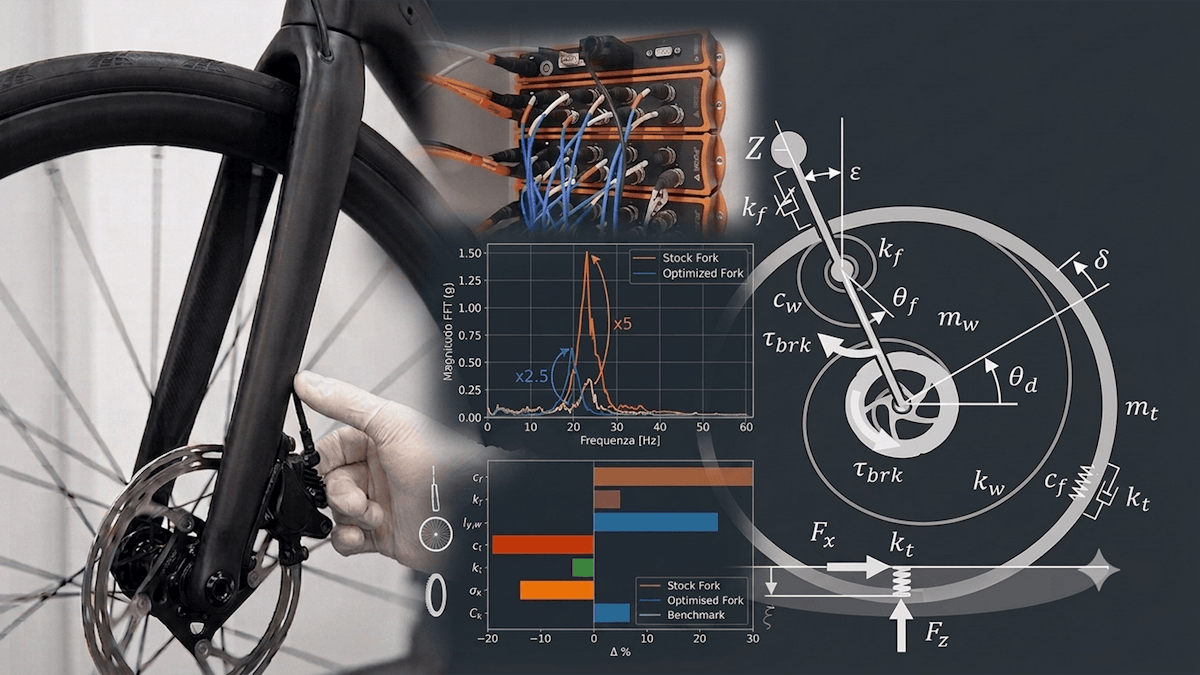
Dynamotion s.r.l. has investigated the longitudinal vibrations of bicycle front forks occurring during front braking with disk brakes. We combined on-road testing with Dewesoft data acquisition systems, laboratory modal analysis, and a four-degree-of-freedom numerical model to identify the root causes and key influencing parameters.
The study reveals how brake friction material, wheel properties, and fork stiffness govern the onset of vibration and provides practical design guidelines to mitigate the phenomenon and improve braking performance.
The problem: self-excited fork vibrations during disk braking
The adoption of disk brakes in the cycling industry has brought significant improvements in braking power and modulation. However, it has also introduced a dynamic phenomenon not present with traditional rim brakes.
One such issue is the longitudinal vibration of the front fork during braking, a relatively recent problem with limited coverage in scientific literature.
Unlike rim brakes, where the braking force is applied near the wheel hub, disk brakes generate a higher bending moment in the fork due to the lower point of application.
This moment, combined with reduced relative velocities at the pad–disk interface, which promote stick-slip behavior, and the interaction with the wheel's torsional flexibility, creates conditions for self-excited oscillations.


Cyclists experience uncomfortable and sometimes alarming fork vibrations during front braking when disk brakes are used. These vibrations are felt through the handlebars and can reduce braking efficiency by up to 10% and diminish rider confidence.
The phenomenon occurs even under moderate, gradual braking — not only in emergency stops — making it a relevant comfort and safety concern for everyday riding.
Bicycle and component manufacturers need to understand the key parameters to address this issue at the design stage.
Testing bicycle fork vibrations on the road
The investigation followed a structured approach combining road testing, laboratory characterization, and numerical modeling.
Road tests were conducted on a downhill slope at speeds between 10 and 20 km/h, using a steel-framed bicycle with a carbon fork.
A piezoelectric accelerometer was mounted on the front wheel axle to capture the fork’s longitudinal acceleration during braking events.
Two different front wheels and two brake disks were tested in all four combinations, enabling isolation of individual component effects.
Time and frequency analysis showed a clear difference between the two brake disks. With Disk A, vibration amplitudes were 3 to 5 times higher than with Disk B on both wheels. This shows that the brake friction material has a strong effect on fork vibration.
The peak vibration frequency also changed depending on which wheel was used. This suggests that the wheel’s structural dynamics also play an important role.


Modal analysis of the bicycle fork and wheel
To go beyond road testing, we also performed laboratory modal analysis. The goal was to identify the natural frequencies of the bicycle’s front-end components.
For the test, we suspended the bicycle and used an impact hammer to excite the structure. Accelerometers measured the response at several points.
The analysis identified the longitudinal fork-bending mode at about 26 Hz for Wheel A and 24 Hz for Wheel B. It also identified wheel-torsion modes at 44 Hz and 32 Hz. These results matched the vibration frequencies observed during the on-road tests.


Based on these findings, we developed a four-degree-of-freedom lumped-parameter model. The model includes fork bending, wheel torsion, disk rotation, and vertical movement.
It also calculates the forces between the tire and the ground using Pacejka’s Magic Formula with relaxation. This tire model describes forces and moments under different slip conditions.
The braking torque is used as the model input and is applied over time between the fork and the disk. The model successfully reproduced the main vibration behavior observed during the track tests.


Implementation
We structured the experimental campaign in two phases:
Road tests on a downhill slope with front brake application at 20–10 km/h, recording fork acceleration with a piezoelectric sensor across four wheel-disk configurations.
Laboratory modal testing with hammer excitation to characterize fork bending and wheel torsion natural frequencies, providing parameters for the numerical model.
Dewesoft KRYPTON DAQ setup
Steel-frame bicycle with carbon front fork
Two front wheels with different dynamic properties (mass, torsional stiffness)
Two disk brakes with different friction materials (Disk A and Disk B)
Piezoelectric accelerometer mounted on the front wheel axle
Dewesoft KRYPTON data acquisition system for high-frequency vibration measurement
Impact hammer and multi-point accelerometer setup for modal analysis
Key measurements and test results
The Dewesoft Krypton recorded the fork’s longitudinal acceleration during braking at high sampling rates.
The time-domain data showed clear vibration bursts during braking. In the worst case, with Wheel A and Disk A, peak accelerations reached ±15 g.
FFT frequency analysis showed dominant peaks between 19.5 and 23 Hz, depending on the wheel. These peaks matched the fork-bending natural frequencies identified during modal testing.
Disk A consistently produced vibration levels 3 to 5 times higher than Disk B on both wheels. This confirmed that the brake friction material has a strong influence on fork vibration.


How to reduce bicycle fork vibrations
The numerical model was validated against experimental data and then used for a comprehensive sensitivity analysis. Key findings include:
Fork stiffness and damping: Increasing fork bending stiffness and damping are the most effective ways to suppress vibrations. A 120% increase in fork damping alone eliminates oscillations.
Wheel properties: Higher wheel inertia reduces vibration frequency and amplitude. Lightweight wheels worsen the problem, consistent with observations from track tests.
Tire properties: High slip stiffness, low relaxation length, and low vertical stiffness/damping (influenced by inflation pressure) help reduce vibrations.
Brake application: Gradual brake application (with a longer time constant) prevents the onset of vibration. A 10% reduction in steady-state piston force yields the same braking force as the baseline, without oscillations.


Conclusion
Our study shows that front-braking fork vibrations are caused by several interacting factors. These include the fork and wheel structure, brake friction material, brake application rate, and tire properties.
By combining high-frequency road and laboratory measurements with Dewesoft Krypton and a validated lumped-parameter model, we gained a clear understanding of the vibration behavior. The sensitivity analysis also provided practical design guidelines for component manufacturers, helping them reduce vibration onset and improve rider comfort and braking performance.
References
Publication: Formentini, M., Giolo, E., Marconi, E., & Rovarin, A. (2023). Bicycle fork longitudinal vibrations induced by front braking—the Evolving Scholar – BMD 2023.