




Motorsport Testing: Vehicle Performance Testing and Data Acquisition

May 12, 2026
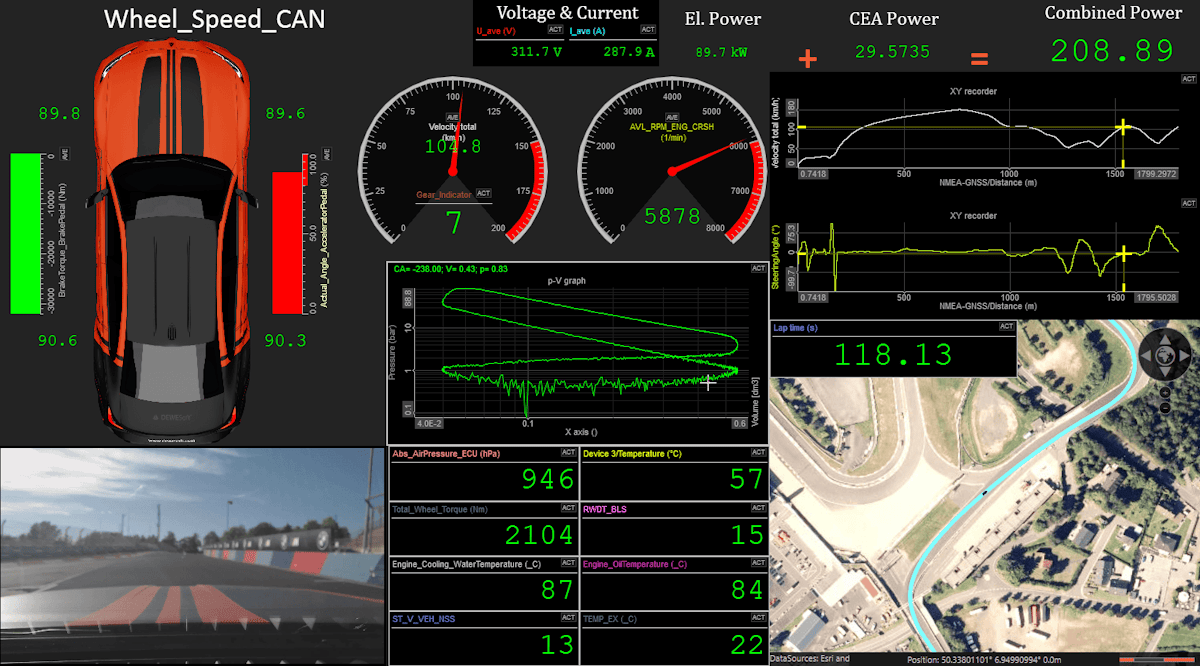
What is motorsport testing?
Motorsport testing is a critical discipline that drives competitive advantage through precise vehicle performance testing and continuous validation. Teams rely on advanced DAQ (data acquisition) systems and high-speed telemetry to capture, transmit, and analyze data from every subsystem in real time. From aerodynamics and powertrain efficiency to suspension dynamics and tire behavior, motorsport testing enables engineers to optimize performance under extreme conditions. By combining track testing, simulation, and data-driven validation, teams can refine designs, improve reliability, and gain the marginal gains that define success in modern racing.
The evolution of motorsport testing
Motorsport has always been a laboratory on wheels. From the earliest Grand Prix races to today’s hybrid and electric championships, competition has accelerated innovation in materials, powertrains, aerodynamics, control systems, and telemetry. For motorsport engineers, however, the common denominator remains: data wins races.
Today’s challenge is not simply about testing more. It is about more intelligently correlating virtual simulation with physical testing, measurement, and data analysis, under tighter regulations, with increasingly electrified components and shrinking timeframes.
Testing has become both more sophisticated and more constrained across championships, such as:
The Formula One World Championship
The ABB FIA Formula E World Championship
For test engineers working in this space, the question is how to orchestrate a validation and testing strategy that aligns with regulatory requirements, logistical constraints, and rapidly evolving vehicle architectures. It’s not only about function or vehicle dynamics. It’s a multi-physics and multi-attribute challenge that needs to be solved and continually improved from race to race, from vehicle to vehicle, and across different race tracks.
Motorsport is expanding and electrifying
The UK remains a global epicenter of motorsport engineering. Teams such as Red Bull Racing, Mercedes-AMG Petronas F1 Team, Aston Martin F1 Team, Alpine F1 Team, and the incoming Cadillac Formula 1 Team are preparing to compete at the highest level. Meanwhile, manufacturers such as the Porsche Formula E Team are advancing electric racing.
Electrification has fundamentally changed the testing landscape:
Electric power systems require contact safe and isolated measurements,
High-performance battery cells and packs need to undergo a comprehensive test regimen, including multi-physics and misuse physical testing, as well as Power-HiL for BMS testing.
Electrochemical impedance analysis (EIS) helps to evaluate internal kinematics and State of Health (SoH) of single battery cells or even complete battery packs.
Wide-band inverter-controlled electric motors require precise, high-speed power analyzers that sample electrical currents and voltages at up to 15 MS/s.
Motors can operate at rotational speeds up to 30 kRPM. Torque flanges and rotational-speed encoders or resolvers, which enable mechanical power analysis and efficiency mapping, are often connected digitally to the power analyzer.
Regenerative braking introduces a bidirectional energy flow, in which the electric drive acts as a power generator, intelligently charging the battery pack.
Thermal management becomes a central performance, reliability, and safety differentiator, with extensive sensing: thermal tactile sensors (built-in and additional), IR cameras, humidity, flow, and pressure. Internal BMS-connected NTC sensors are added via XCP. On-shaft multi-physics sensor telemetry adds additional information towards demagnetization.
In electrified racing series, it is not just about electrical optimization: it’s about validating and optimizing a complex system under race-representative loads, combining several engineering domains, including:
Aerodynamics
Mechanical
Materials science
Electrochemistry
Electrical
Powertrain
Vehicle dynamics
Electronics
Software
Functionality
High-speed endurance racing
Dewesoft has partnered with the Alpine Endurance Racing Team. The team uses Dewesoft instruments across Europe to support its advanced testing regimen. Alpine conducted instrumented testing and analysis of critical vehicle components, including tire testing, brake performance, calipers, and the driver’s cockpit.
For advanced temperature testing, the Alpine Team used a thermal camera and DewesoftX software to profile the car under various conditions. DewesoftX interfaces directly with Optris thermal cameras, displaying the thermographic data in perfect sync with analog sensor and digital bus data. Engineers measured the average, maximum, and minimum temperatures to determine the source of the temperature variation. They used this data to modify the vehicle's airflow to dissipate excess heat.


More in-depth information:
The most essential motorsport tests
In the following sections, we will outline the specific tests performed across virtually all of motorsport testing, but before delving too deeply, let’s take a top-level look at the most essential ones:
Vehicle dynamics and track performance
Powertrain performance (controller, ICE/hybrid / full electric)
Battery performance
Brake and tire testing
Durability and NVH (strain, load, vibration, noise)
Aerodynamics
Homologation and compliance
High-speed video synchronization
Vehicle dynamics and track performance testing
Vehicle dynamics testing in motorsport assesses how a race car behaves on the track, focusing on the interplay among tires, suspension, aerodynamics, and chassis to maximize speed and control. By instrumented testing, teams tune aerodynamics, powertrain, suspension geometry, steering, braking, tire management, and stability to optimize cornering and powertrain performance.
Engineers measure and analyze parameters such as digital vehicle bus data, speed, acceleration, lap timing, trajectory, and kinematics supported by a GNSS sensor or Inertial Measurement Unit. Further transducers measure wheel forces, angles, and accelerations, as well as pedal operation, with support from cameras. "Balance of Performance" (BoP) to ensure parity. This enables engineers to analyze racing lines, cornering speeds, braking points, and driver consistency, supporting performance improvements through precise spatial and temporal data correlation.
Powertrain dyno testing
Powertrain dynamometer testing allows engineers to evaluate engine and/or gearbox performance, as well as electric powertrain and drivetrain performance, under controlled, repeatable conditions.
Engineers measure and analyze electric input power, power output (torque, rotational speed), efficiency, fuel or energy consumption, vibration, noise, and thermal behavior across emulated operating ranges, enabling detailed system and software optimization, a durability and e-NVH assessment, and optimization before on-track deployment.
Battery testing
Battery testing focuses on verifying the performance, efficiency, safety, durability, lifetime, and reliability of high-performance battery packs in electrified powertrains. Engineers analyze parameters such as voltage, current, switching behavior, thermal response, and efficiency under all environmental conditions (ambient conditions, dynamic mechanical and electrical loads, recuperation/charging) to ensure safe operation and optimal performance in racing environments.
Brake and tire testing
Brake and tire testing is essential for understanding the thermomechanical dynamics that directly affect grip, wear, performance, safety, and durability, often using simulation platforms first and rigorous physical testing in a lab or on track last. Using multi-component transducers (forces and moments), acceleration transducers, thermocouples (direct, sensor telemetry), and infrared cameras, engineers monitor temperature distribution and transient behavior to optimize braking performance, tire-pressure strategies, and overall vehicle balance.
Durability and NVH testing
Durability and NVH (Noise, Vibration, and Harshness) testing in motorsport ensures high-performance components withstand extreme structural loads while optimizing driver comfort and vehicle performance.
Engineers instrument chassis, body, axles, and damping with mainly strain gages, wheel force transducers, displacement, acceleration transducers, and microphones, to identify mechanical stress, fatigue, dynamic response and resonance, and acoustic issues early, improving reliability without sacrificing weight. This testing method helps identify stress concentrations, fatigue risks, and vibration modes, ensuring component durability and supporting lightweight design optimization.
Aerodynamics - Wind Tunnel Testing
Aerodynamics testing optimizes race car performance by maximizing downforce (grip) and minimizing drag (resistance) using Computational Fluid Dynamics (CFD) and wind tunnels. Wind tunnels test scaled models or even full-size vehicles on moving ground planes to simulate track conditions.
Engineers use instrumented wind-tunnel platforms and vehicles to analyze airflow, forces/loads, strain, and temperature.
Homologation and compliance testing
Homologation in motorsport is the mandatory certification process by which governing bodies such as the FIA or FIM approve vehicles, components, and equipment, ensuring they meet strict safety and technical standards for competition. Compliance testing verifies these standards through virtual and physical tests, safety evaluations, and manufacturing audits.
High-speed video synchronization
High-speed video synchronized with tactile sensing and data acquisition provides visual context to measured signals. Engineers can correlate physical events - such as tire deformation, suspension movement, or component failure - with precise data timestamps, improving root cause analysis and system understanding.
The modern development pyramid: where testing really happens and Dewesoft supports
At the elite level, on-track testing is heavily restricted by governing bodies. FIA cost caps and sporting regulations severely limit the number of available track days. The result? A development pyramid that heavily favors bench and laboratory testing over track validation.
Component & subsystem testing
Common bench and laboratory tests mainly include vehicle dynamics, battery, powertrain, electronics, functionality, structural design and setup, aerodynamics, transmission, and drivetrain durability. All types of testing take place in environments that are controlled, repeatable, and instrumentation-heavy.
Today’s multi-physics and multi-domain approach positions Dewesoft as one of the top providers delivering a single measurement and analysis ecosystem with many benefits:
Acquires all types of data in a time-synchronized way, including direct sensor connection, telemetered channels, vehicle bus digital signals, GNSS/INS outputs, video, and more.
Allows multiple test runs in parallel, reducing testing time and expense.
Optimizes the correlation between real drive data and the virtual testing world.
A single, integrated data acquisition and analysis software.
Records multi-physics data channels alongside and synchronized with power parameters, doing the work of multiple instruments.
Isolated inputs and connectors that ensure operator safety and noise-free signals.
Flexible integration and interoperability with other systems.
System integration and chassis homologation
During chassis homologation, teams conduct extensive structural and load validation. For example, engineers at a major F1 team have used SIRIUS R8 systems with multiple force measurement slices and synchronized high-speed video during homologation campaigns. Here, synchronized strain, load, and video data can provide insight into micro-deflections and structural compliance under FIA-prescribed loads.
On-track validation

This is where things become complicated. Race cars in championships like Formula One typically run FIA-spec loggers and homologated telemetry systems. Weight, packaging, and regulatory compliance leave little room for third-party acquisition systems.
Competing suppliers have built ultra-light, high-channel-count loggers specifically for permanent installation in race vehicles. For example, Toyota Gazoo Racing uses loggers and ECUs tightly integrated into the race telemetry system.
In R&D testing, a DewesoftX-based recorder acquires all of the elements listed above. In addition, the Polygon plugin revolutionizes track and road testing by adding powerful real-time 3D visualization and motion analysis. It allows engineers to track and analyze the movement of moving vehicles, track features, and other static objects in a fully interactive virtual environment.
Find out more about automotive proving grounds:
DewesoftX polygon plugin
The Polygon plugin is a tool for measuring distances between objects using GNSS data. It offers enhanced accuracy, flexibility, and simplicity - crucial improvements for automotive field applications. With DewesoftX Polygon, vehicles are tracked in real time in a highly accurate 3D environment.
The Polygon module now offers separate geometry and visualization tabs, making navigation smoother and more intuitive. In the Geometry section, we now provide "Edit mode," a powerful tool that lets you easily define point, polyline, and polygon geometries. When combined with bitmap import, this feature saves time and enhances accuracy.
Real-Time 3D Visualization – Simulate and analyze complex ADAS scenarios with moving and stationary objects.
High-Precision Tracking – Uses RTK GNSS and IMU data to achieve sub-2 cm accuracy.
Definition of static and moving objects – free definition of track features and objects, and real-time calculation of several parameters between them automatically.
Advanced Motion Analysis – Calculate relative distances, angles, speeds, and collision points in real-time.
Seamless Sensor Integration – Syncs with analog data, LiDAR, GNSS, INS, cameras, CAN BUS, FlexRay, and other data sources.
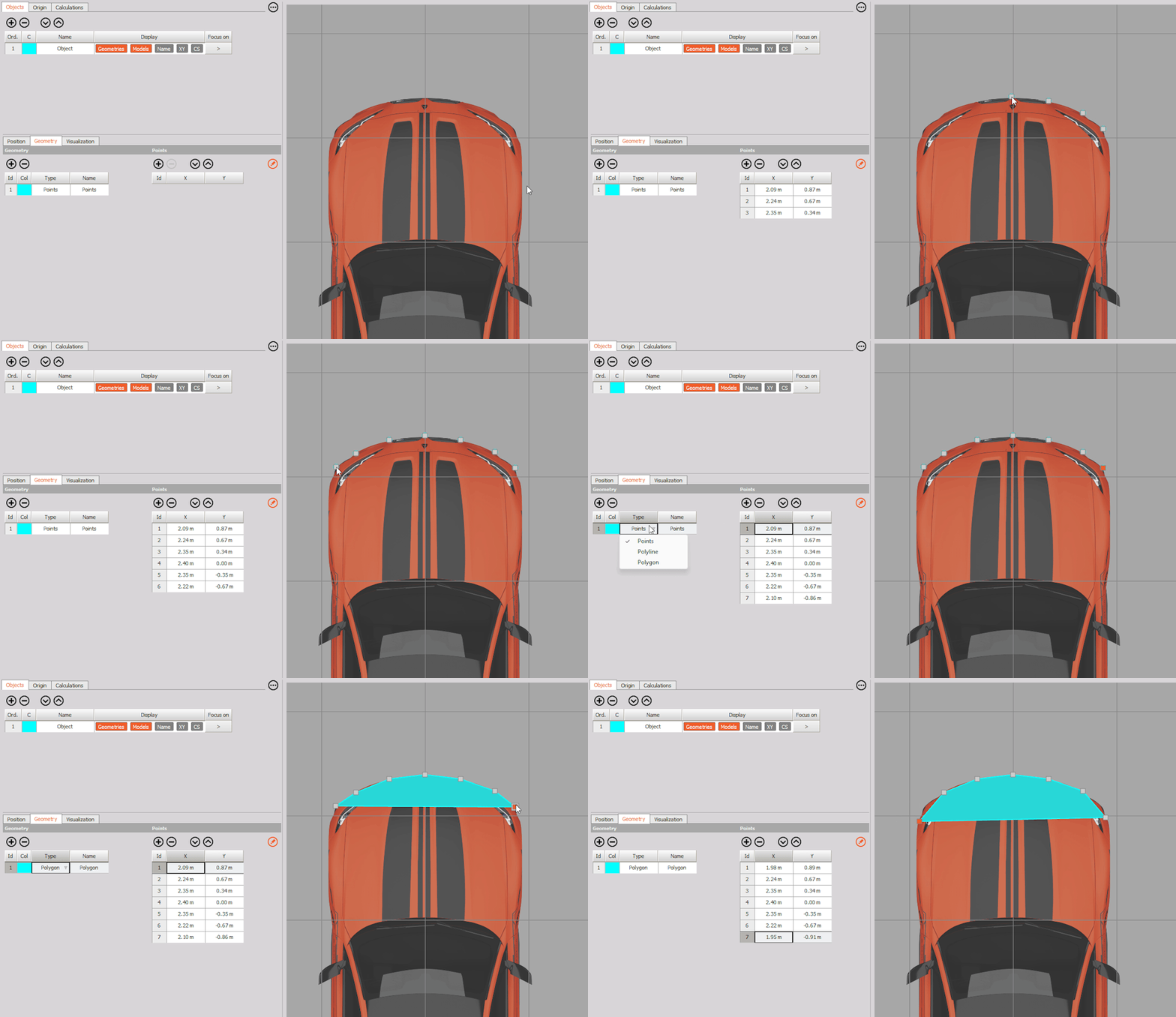
Under the Calculation tab, Polygon offers several time-related calculations. Engineers can add multiple custom calculations to compute sector and lap times. Additionally, the software counts all completed laps. These capabilities are crucial for vehicle performance testing.


NAVION i2 inertial navigation system


NAVION i2 is an inertial navigation system (INS) that measures the vehicle’s GNSS position, acceleration on multiple axes, and angular velocities. A Kalman-based algorithm combines GNSS and IMU measurements, providing high accuracy and stability. The built-in IMU sensor has very low drift and helps maintain position determination even when multipath or weak GNSS signals interfere with the data. A GNSS outage of 10 s will only cause an error of ≤30 cm.
NAVION i2 Features
High-accuracy 100 Hz GNSS receiver (1.2 m horizontal and 1.9 m vertical positioning accuracy).
Built-in MEMS-based inertial measurement unit (IMU) with accelerometer, gyroscope, magnetometer, and pressure sensor.
A Kalman filter circuit.
Support for GPS (L1, L2, L5), GLONASS (L1, L2, L3), BeiDou (B1, B2), Galileo (E1), AltBOC, E5a, E5b, NavlC (IRNSS) L5 satellite constellations.
Dual antennae are included by default.
RTK (Real-time kinematics) support.
For deeper troubleshooting, structural vibration analysis, and non-standard diagnostics, teams have deployed portable systems such as SIRIUS and DEWE-43A units with modular signal adapters, particularly when investigating frame resonance or durability anomalies.
The hardware reality: why bench testing favors modular systems
In motorsport applications, mobile data recording helps to analyse real track performance.
By contrast, laboratory and test bench systems operate under a different set of priorities. Freed from the strict mass, space, and aerodynamic limitations of on-track installations, bench-based data acquisition (DAQ) systems can focus on performance and scalability. Higher channel counts are often required to capture detailed subsystem behavior across powertrain, chassis, and aerodynamic components simultaneously.
For example, the Testing Department at Pankl Racing Systems in Austria performs advanced internal combustion engine analysis on racecar and sports car engine components. These include connecting rods, pistons, and crankshafts. Components are designed in-house, from initial design and prototyping through the FEM (Finite Element Method) calculation of the entire system. They employ Dewesoft SIRIUS DAQ instrumentation, DewesoftX software, and the CEA (Combustion Engine Analyzer) plugin.


Advanced signal conditioning is essential for supporting precision sensors for force, strain, pressure, torque, and temperature measurements. Modular expansion capabilities allow engineers to reconfigure setups as development programs evolve, adding or reassigning channels without redesigning the entire system.
High-resolution force and strain measurement is particularly important in durability and structural testing, where small changes can signal material fatigue or failure modes. Additionally, synchronized high-speed video is frequently integrated with measurement data to provide visual correlation with dynamic events, enabling engineers to align physical behavior with quantitative signals in a single, time-aligned dataset.
This is why most high-level teams invest heavily in static rigs, K&C (Kinematics and Compliance) rigs, powertrain dynos, and structural durability systems.
For many measurement providers, a persistent problem is on-road race validation. However, everything below that layer of the pyramid, from subsystem development to homologation testing, is rich with opportunity.
Bench testing vs. track testing in motorsport
| Aspect | Bench Testing (Lab & Dyno Testing) | Track Testing (On-Track Validation & Telemetry) |
|---|---|---|
| Aspect | Bench Testing (Lab & Dyno Testing) | Track Testing (On-Track Validation & Telemetry) |
| Primary Purpose | Focused on controlled vehicle performance testing, subsystem development, and repeatable validation of components. | Focused on real-world motorsport testing to validate full vehicle performance under actual race and track conditions. |
| Environment | Highly controlled laboratory or dyno environment with stable temperature, load, and operating conditions. | Uncontrolled, dynamic race-track environment with varying weather, track surface, and driver inputs. |
| Repeatability | Extremely high: tests can be repeated under identical conditions for precise comparison and validation. | Limited: conditions change constantly, making exact repetition difficult. |
| DAQ Capabilities | Advanced DAQ systems with high channel counts, precision signal conditioning, and modular expansion. | Lightweight, compact DAQ and telemetry systems optimized for real-time data transmission and minimal impact on vehicle performance. |
| Instrumentation Freedom | Minimal constraints on size, weight, and power consumption, allowing extensive sensor deployment. | Strict constraints imposed by regulations (e.g., FIA) and vehicle packaging mean sensors must be minimal and non-intrusive. |
| Data Depth and Resolution | Very high: supports detailed analysis of strain, load, vibration, power, and thermal behavior. | Moderate to high: focused on critical parameters due to bandwidth and hardware limitations. |
| Real-Time Feedback | Primarily post-processing, though real-time monitoring is possible in controlled setups. | Strong emphasis on real-time telemetry for immediate performance feedback and decision-making. |
| System Complexity | High: supports multi-physics testing across electrical, mechanical, and thermal domains. | Integrated but constrained: must work within vehicle ECUs and homologated data systems. |
| Typical Applications | Powertrain dyno testing, battery and inverter validation, structural testing, aerodynamic development, and homologation. | Lap timing, trajectory analysis, driver behavior, tire performance, and final system validation under race conditions. |
| Regulatory Constraints | Minimal: testing is largely unrestricted and driven by engineering needs. | Significant: governed by racing bodies such as the Fédération Internationale de l'Automobile, limiting track time and hardware usage. |
| Cost Efficiency | More cost-effective for iterative development due to greater repeatability and reduced logistics overhead. | Expensive: limited track access, high operational costs, and time constraints. |
| Role in Development Cycle | The foundation of the development pyramid: most testing occurs here. | Final validation stage: confirms performance before and during competition. |
| High-Speed Video | Frequently integrated with DAQ for synchronized structural and motion analysis. | Used selectively due to bandwidth and storage constraints. |
| Key Advantage | Precision, repeatability, and deep insight into subsystem behavior. | Real-world validation of complete vehicle performance and driver interaction. |
| Key Limitation | May not fully replicate real-world racing conditions. | Limited instrumentation and reduced ability to isolate variables. |
Case studies across motorsport disciplines
Formula One and high-level single-seaters
A major F1 team has deployed KRYPTON STG strain-gauge modules and IOLITE R8 units, along with LVe voltage amplifiers, digital SuperCounters, and CAN FD slices, for distributed acquisition.
Another F1 Team uses Dewesoft instruments for various testing applications.
These engagements illustrate a consistent theme: teams turn to external measurement providers when specialized capabilities are required, such as force measurement, high-speed synchronized video, HV isolation, or structural diagnostics.
NASCAR: restricted track testing, heavy bench emphasis
A major NASCAR racing team used a Dewesoft DAQ system to perform a variety of performance tests. Because NASCAR Cup Series regulations restrict testing on official tracks, teams often test on tracks like “Little Rock,” a half-mile track just outside the famous Rockingham Speedway in North Carolina. The DEWE-101 shown below has since been replaced by the SIRIUS R2 model.


Measurement played a decisive role in linking mechanical design to operational performance. Track time is expensive and therefore limited, which makes ease of installation and reliability essential advantages. Off-track validation and controlled-condition testing are performance multipliers.
Rally & endurance
Rally programs operate under severe environmental conditions. For example, Toyota Gazoo Racing has a hybrid approach, using FIA-compliant in-car systems for race telemetry while leveraging external DAQ tools for troubleshooting and vibration diagnostics.
In endurance racing, such as the World Endurance Championship, hybrid systems, energy recovery, and thermal durability require extensive bench validation before a car enters a 24-hour event.
Formula Student: the innovation sandbox


Formula Student (FS) is an engineering design competition – the biggest in the world for students of engineering sciences. Every year, they compete using their knowledge and experience, with the help of universities and sponsors, in the manufacture of racing cars and in racing on various road stages. Students gain valuable practical experience by participating in the conception, design, production, testing, and racing of a car, as well as by preparing a business plan and a cost report.
The concept behind Formula Student is that a fictional manufacturing company has contracted a student design team to develop a small Formula-style race car. The prototype race car is to be evaluated for its production potential.
Each student team designs, builds, and tests a prototype based on a set of rules, whose purpose is both to ensure on-track safety (the cars are driven by the students) and to promote creative problem-solving.
While elite teams operate under regulatory constraints, Formula Student teams provide a uniquely agile environment for product validation and usability feedback.
These student programs:
Act as early adopters of emerging DAQ solutions
Provide real-world on-track testing feedback
Stress usability under tight engineering timelines
Dewesoft has partnered with and supported numerous FS teams over the years, helping them with a wide range of testing applications that cover the entire gamut of vehicle design and performance.
With SIRIUS and SBOX installed in competition vehicles, student teams demonstrate how compact, synchronized acquisition can significantly enhance understanding of vehicle dynamics - even at the university level.
Formula Student serves as both an educational platform and a proving ground for next-generation testing workflows.


Figure 11. Image courtesy of UNI Maribor GPE, the Official Website of Maribor's Formula Student team
More in-depth information:
Formula Student - The UNI Maribor Grand Prix Engineering Team (2023)
Formula Student: Playground for Measurement Technologies (2023)
The turnkey expectation challenge


One of the core realities in motorsport sales is that teams rarely purchase hardware alone. They seek turnkey solutions:
System configuration
Sensor integration
Calibration
On-site support during critical tests
Immediate data interpretation
High-performance EV manufacturers such as Rimac Automobili have repeatedly turned to Dewesoft for performance testing over the past few years. This is largely because Dewesoft automotive application engineers were eager to configure, implement, and support Rimac’s record-smashing measurement campaigns on-site.
In 2023, Dewesoft validated 23 world speed records set by Rimac’s Nevera electric supercar. Using Dewesoft measurement equipment and support from the on-site team, Dewesoft captured and verified all data for top-speed, acceleration, and deceleration runs.
Two years later, Dewesoft returned to the high-speed oval test track at ATP Papenburg, Germany, to test the upgraded, sportier version of the classic Nevera, the Nevera R. The Nevera R set a new benchmark by breaking 24 performance records. Among the most notable was its dramatic improvement in the 0–400–0 km/h acceleration-and-braking test. It also achieved faster acceleration across various speed milestones and set a new top-speed record for electric vehicles. In motorsport, credibility is earned in the pit lane and the testing facility, not in a marketing brochure.

More in-depth information:
Rimac Nevera R Breaks 24 New World Records, Verified by Dewesoft Measuring Instruments (2025)
Record-setting World Time Attack Racing Using Live Telemetry (2025)
Measuring and Verifying Speed Records of Rimac Nevera Electric Hypercar (2023)
Measuring a New Guinness World Record for the Fastest Reverse-Driving (2023)
Looking forward: electrification, data density, and integration
As electrification accelerates across championships such as Formula E and hybrid long-term endurance racing, test engineers face increasing demands:
Accurate HV power measurement up to hundreds of volts and kiloamps
CAN FD and high-speed network logging
Real-time slip angle, vehicle dynamics, and torque vectoring analysis
Seamless integration with ECU and telemetry ecosystems
Meanwhile, compact, rugged computing platforms like OBSIDIAN-class systems are emerging to bridge the gap between lab-grade acquisition and track-ready robustness.
The future of motorsport testing will likely depend less on standalone loggers and more on integrated data ecosystems – systems that feed calculations to external user interfaces, telemetry platforms, and simulation pipelines in real time.
Conclusion: motorsport as a measurement catalyst
One principle remains constant across the entire motorsport playing field: Extensive bench testing underpins limited on-track validation.
For motorsport test engineers, the competitive advantage lies in:
High-fidelity force and strain measurement
Robust high-voltage electrical acquisition
Modular expansion capability
Seamless integration with existing telemetry infrastructure
Rapid deployment and expert on-site support
While FIA-spec loggers may dominate race-day telemetry, the laboratory, dyno cell, and homologation rig remain fertile ground for engineering improvements via testing with advanced DAQ systems.
Motorsport is unforgiving. The margin between pole position and midfield can be measured in hundredths of a second. In that environment, test engineers do not merely collect data: they engineer confidence.
Motorsport FAQ frequently-asked questions
What is motorsport testing?
Motorsport testing is the process of evaluating and optimizing race vehicles through vehicle performance testing, simulation, and real-world validation. Engineers use advanced DAQ (data acquisition) systems and telemetry to measure parameters such as speed, torque, temperature, and vehicle dynamics. The goal is to improve performance, reliability, and safety under race conditions.
Why is motorsport testing important?
Motorsport testing is essential because it enables teams to validate designs, optimize performance, and identify potential failures before competition. With limited track time and strict regulations, effective testing ensures that every component—from powertrain to aerodynamics—performs reliably and efficiently during a race.
What is the difference between bench testing and track testing in motorsport?
Bench testing is performed in controlled environments such as laboratories or dynamometers, allowing for repeatable and high-precision measurements. Track testing, on the other hand, involves real-world validation under racing conditions using telemetry systems. While bench testing provides detailed insights, track testing confirms actual vehicle behavior and performance.
What is DAQ in motorsport testing?
DAQ, or data acquisition, refers to the systems used to collect, process, and analyze data from sensors installed on the vehicle. In motorsport testing, DAQ systems measure parameters such as strain, vibration, temperature, voltage, and speed. These systems are critical for understanding vehicle behavior and making data-driven engineering decisions.
How does telemetry work in motorsport?
Telemetry systems transmit data wirelessly from the race car to engineers in real time. This allows teams to monitor vehicle performance, diagnose issues, and make strategic decisions during testing and races. Telemetry is especially important in track testing, where immediate feedback can influence setup changes and race strategy.
What types of tests are performed in motorsport?
Common motorsport testing activities include powertrain dyno testing, battery and inverter validation, brake and tire temperature testing, GNSS/INS trajectory analysis, strain and vibration testing, and high-speed video synchronization. These tests cover mechanical, electrical, and thermal aspects of vehicle performance.
How is vehicle performance testing conducted in motorsport?
Vehicle performance testing combines bench testing, simulation, and on-track validation. Engineers first test individual components in controlled environments, then integrate systems and validate them on the track using DAQ and telemetry. This layered approach ensures accuracy, reliability, and optimal performance.
What role does validation play in motorsport testing?
Validation ensures that vehicle systems perform as expected under real-world conditions. It involves comparing measured data against design targets and simulation results. In motorsport, validation is critical to confirming reliability, regulatory compliance, and overall race readiness.
How has electrification changed motorsport testing?
Electrification has introduced new challenges in motorsport testing, including high-voltage measurement, battery performance validation, inverter efficiency analysis, and thermal management. Engineers now rely on high-speed DAQ systems and specialized sensors to capture fast electrical signals and ensure safe, efficient operation.
What are the biggest challenges in motorsport testing?
Key challenges include limited track time, strict regulatory constraints, increasing system complexity, and the need to correlate simulation with real-world data. Engineers must also manage large volumes of data while ensuring accurate, synchronized measurements across multiple systems.
What tools are used in modern motorsport testing?
Modern motorsport testing relies on advanced tools such as high-speed DAQ systems, real-time telemetry, GNSS/INS positioning systems, thermal cameras, strain gauges, and simulation software. These tools enable engineers to capture, analyze, and act on data with high precision and speed.
How do motorsport teams gain a competitive advantage through testing?
Teams gain a competitive advantage by using data-driven insights from testing to optimize every aspect of the vehicle. This includes improving aerodynamics, maximizing powertrain efficiency, refining suspension setup, and enhancing driver performance. In motorsport, even small gains identified through testing can make a significant difference on race day.