



Pushing the Edge: Insights from the Dewesoft Measurement Conference 2026
Carsten Frederiksen & Grant Maloy Smith
May 22, 2026
From April 21 to 24, more than 500 engineers, scientists, software developers, systems architects, and measurement specialists from around the world gathered in Laško, Slovenia, for Dewesoft’s 7th Measurement Conference.
Over four days of technical sessions, live demonstrations, and industry discussions, the conference focused on how edge computing, embedded analytics, and open measurement architectures are changing the way engineers work. The event showed an industry moving quickly toward distributed, software-defined systems that turn raw sensor data into real-time operational insight.
Pushing the edge - more than a slogan
The conference theme was “Pushing the Edge,” a phrase that captured the event's central focus: edge-embedded systems, distributed intelligence, real-time analytics, and the future of data acquisition in increasingly complex engineering environments.
The conference was more than a showcase of new hardware and software products: it was a meeting point for aerospace engineers seeking ultra-reliable telemetry systems, automotive developers designing next-generation electric and autonomous vehicles, industrial monitoring specialists responsible for critical infrastructure, and software architects seeking to create open ecosystems for interoperable measurement technologies.
These once disparate industries are overlapping and converging like never before, and the Measurement Conference reflected this trend. Technical depth coexisted with practical demonstrations, while conversations about embedded system architecture naturally flowed into discussions of sustainability, predictive maintenance, and the role of open standards in future engineering workflows.
The grand opening event
The opening ceremony at the Workers' Home in Trbovlje, Dewesoft's hometown, set an energetic tone for the week. Participants gathered not only to celebrate technological achievements but also to reinforce professional relationships developed across previous conferences and collaborative projects. Hosted by Dewesoft co-founder and President, Dr. Jure Knez, the event featured a multinational parade of guests and employees who presented use cases and new products.
The ceremony was honored by the participation of the President of the Republic of Slovenia, Dr. Nataša Pirc Musar. She addressed the participants on the history of the decline of heavy industry in the Zasavje region, whose coal mines have been replaced by a high-tech “Silicon Valley” in this vibrant country, and on a greener, more sustainable future.


The company Dewesoft from Trbovlje inspires because of its unique business philosophy. It's a self-funded company – it has never taken out a bank loan in 25 years. Instead, it invests almost all of its profits back into development, infrastructure, and the local community. The founders, Dr. Jure Knez and Andrej Orožen, also included employees as owners. We need more success stories like this that empower and connect society.


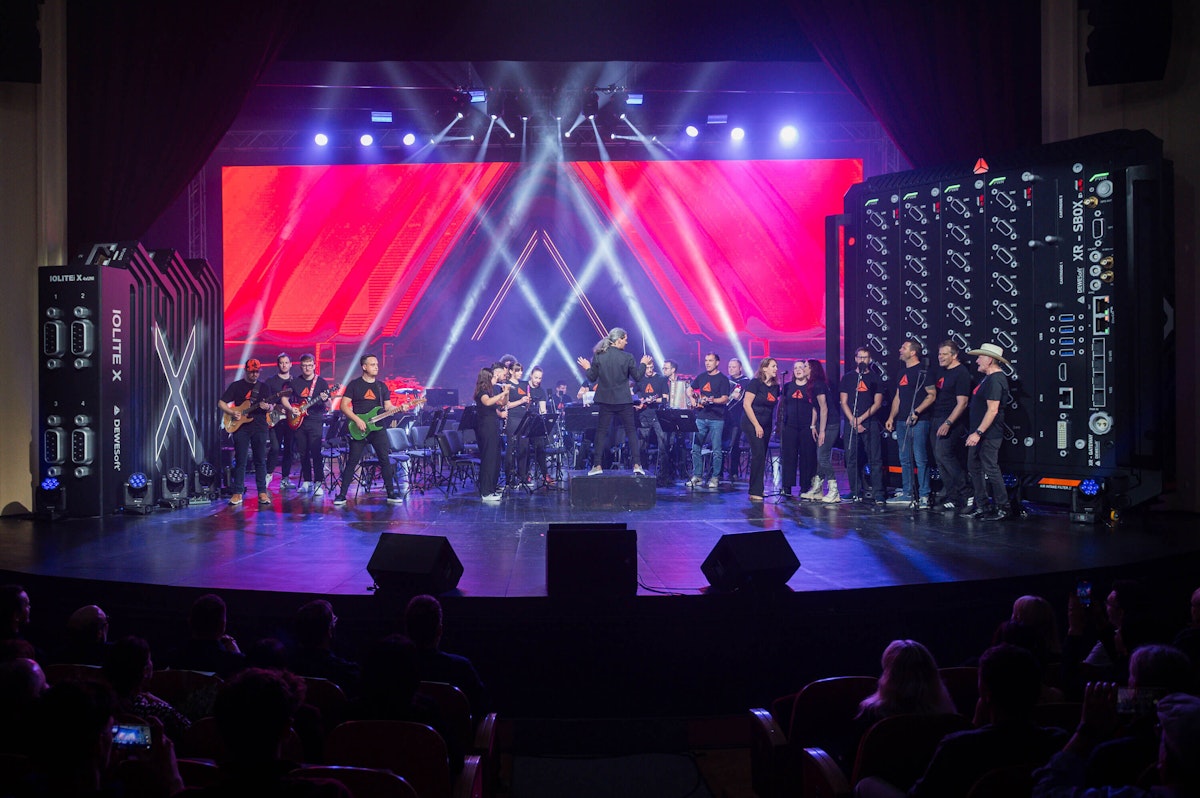
In the ceremony’s grand finale, a band of more than 30 Dewesoft employees, playing a wide range of instruments, performed a rock medley that included the Rolling Stones’ “Satisfaction,” sending everyone away smiling.
See all photos from the Opening Event.
The conference center in Laško
Then the conference moved to the Thermana Park Congress Center in nearby Laško. The town is known for its healthy waters, beekeeping, herbalism, and a very popular 200-year-old brewery. Situated on the tranquil Savinja River, surrounded by lush, forested hills with occasional green fields and historical hilltop churches, Thermana Park was the perfect complement to the highly technical subject matter discussed in the conference halls.


Industry insights - three themed days
Each day began with a keynote focused on an industry and technology track:
Day 1 - Monitoring and openDAQ
Day 2 - Aerospace and DAQ hardware innovations
Day 3 - Automotive and DAQ software
Presentations from industry experts at various companies followed the opening keynotes. Cases that described how customers solved real-world problems using Dewesoft DAQ and monitoring hardware and software in creative new ways.
Presentations featured experts from leading organizations across Europe and the United States, including:
Austria: AIT-Austrian Institute of Technology, HyCenta, Revotec
Chile: Hochbau Engineering
Croatia: Veski
France: Vibratec, Eiffage Énergie Systèmes, and Wormsensing
Italy: ESSEBI Srl, Leane International, Radio6ense, Mavel Powertrain, and Reinova
Slovenia: Pipistrel, ZAG Slovenian National Building and Civil Engineering Institute, and Cestel d.o.o.
USA: Honda Aircraft Company and Kulite
Also, academia hosted presentations by researchers and engineers from the University of Maribor and University of Ljubljana (Slovenia) and the University of Pisa (UNIPI) (Italy), the University of Salerno (Italy), the University Institute of Technology (IUT) of Le Creusot (France), and Faraday Rocketry UPV, the University of Valencia (Spain).


Dewesoft engineers gave detailed presentations and demonstrations of the latest hardware and software innovations, as well as application-specific seminars covering NVH, combustion analysis, orbit analysis, power quality analysis, strain and stress measurement, monitoring, and more.
Experts from several Dewesoft-owned companies also presented their technologies, each focused on specific measurement applications:
Croatia: Veski
Slovenia: Dewesoft Inspiretech, GRID Instruments, and Dewesoft Monitoring
In addition, Dewesoft introduced a new service, Data Acquisition Rental. This service offers the rental of Dewesoft DAQ systems for testing, validation, and measurement projects. Renting provides flexible access to high-performance DAQ hardware and software without incurring capital expenses.
Across nearly every keynote and technical presentation, speakers emphasized that modern engineering systems require faster decision-making, lower latency, greater resilience, and more intelligent data filtering before information even reaches centralized servers or cloud infrastructure.
The conference combined rigorous engineering dialogue with community building and informal discussions. Participants moved between technical sessions and outdoor conversations, networking over coffee breaks before returning to detailed presentations on high-speed data acquisition, edge processing, and synchronization technologies.
Real-world and hands-on
Presenters emphasized practical engineering solutions over abstract technical theory. Consistently grounding discussions in real-world challenges. Engineers related problems encountered during field deployments, how they solved them, and the lessons learned. This practical orientation resonated with participants. Coffee break discussions often centered on implementation challenges, synchronization issues, integration workflows, and system reliability.
Day 1 - monitoring and openDAQ
The conference also devoted substantial attention to monitoring applications beyond the transportation sector. Structural health monitoring, energy infrastructure monitoring, environmental sensing, and predictive maintenance systems all appeared prominently in technical presentations.

Monitoring specialists discussed how edge intelligence enables continuous surveillance of infrastructure systems without overwhelming communication networks. Bridges, industrial facilities, pipelines, and renewable energy installations increasingly rely on distributed sensing architectures that can analyze conditions locally and transmit only relevant events or compressed summaries.
One presentation examined predictive maintenance strategies in industrial facilities, where vibration analysis and machine condition monitoring enable engineers to detect developing failures before catastrophic breakdowns. Edge processing enables continuous analysis directly at monitoring nodes, reducing latency and enabling faster interventions.
Renewable energy applications also appeared throughout the conference. Engineers discussed monitoring challenges related to wind turbines, solar infrastructure, and power system integration. As renewable energy systems become more geographically distributed, edge-based monitoring architectures offer advantages in reliability and operational efficiency.

MC 2026 has been a truly insightful experience. Advanced monitoring systems are taking prevention and risk anticipation to a level we had not seen before, across a wide range of structures and working environments. We’re taking back valuable knowledge to continue driving development in Mexico and Latin America.
Day 2 - aerospace and DAQ hardware innovations
The conference's aerospace track clearly illustrated the requirements of Aerospace testing, which include high reliability and handling of enormous volumes of sensor data. Presentations examined structural dynamics testing, telemetry integration, propulsion analysis, and vibration monitoring systems used in aircraft development and space-related research.
As an instrumentation engineer, it’s my job to research and develop and find solutions for testing and measurement for certification and development programs…I come to conferences to learn how to take these measurements safely.
One aerospace presentation focused on the challenge of maintaining synchronization accuracy across distributed acquisition systems operating under extreme environmental conditions. Engineers explained how timing precision remains essential when analyzing structural responses in flight testing or propulsion systems. Even small timing discrepancies can distort analysis results in high-speed dynamic environments.
Another session explored telemetry integration in modern aerospace testing programs. Speakers described how next-generation telemetry systems increasingly combine high-bandwidth acquisition with embedded preprocessing to reduce communication loads and improve operational reliability. The integration of intelligent filtering and local analysis within acquisition hardware represented a recurring theme across these discussions.

New SIRIUS XR data acquisition systems announced
Dewesoft revealed a new SIRIUS platform: the XR. These high-performance, high-channel-count systems combine SIRIUS XHS and SIRIUS X DAQ modules in a single enclosed rack chassis.

The XR9 enclosure can host up to 288 analog channels and 72 counter channels in a single chassis, while the XR5 supports up to 160 analog channels and 40 counter channels. With their sampling rates up to 15 MS/s per channel and enormous channel count, SIRIUS XR systems are ideal for large, scalable measurement setups.
Find out more about SIRIUS XR systems:

UNI universal amplifiers unveiled
Dewesoft also announced new UNI amplifier models. These universal signal conditioners can handle nearly all major sensor types used in DAQ applications today, including voltage and current sensors, strain gages, accelerometers, resistance (ohmic) sensors, RTDs, and more.
UNI amplifiers are available in several series, including the SIRIUS XHS UNI, which supports sampling rates up to 15 MS/s. The all-new SIRIUS-X-UNI is available in an 8-channel version with sampling up to 500 kS/s and a 16-channel version with sampling up to 200 kS/s.
Day 3 - automotive and DAQ software
Automotive engineering formed another major pillar of the conference program. As vehicle systems become more electrified, connected, and autonomous, the complexity of testing and validation processes continues to increase dramatically. Presenters described how automotive developers now face unprecedented volumes of sensor data generated during testing of electric drivetrains, advanced driver assistance systems, battery technologies, and vehicle dynamics.

The automotive sessions reflected the industry’s transition toward software-defined vehicles. Engineers discussed challenges related to high-speed bus communication analysis, synchronized video acquisition, radar and lidar integration, and real-time validation environments. Several presentations examined testing methodologies for electric mobility systems, especially battery performance analysis and thermal monitoring.

A particularly engaging discussion centered on the increasing overlap between automotive testing and embedded software development. Speakers argued that future validation environments must support continuous integration methodologies similar to those used in software engineering. Measurement systems are therefore evolving into integrated development platforms that interact directly with simulation environments, automated test frameworks, and machine learning systems.

Emerging technologies
In addition to the industries mentioned above, the Measurement Conference focused heavily on emerging technologies that are already impacting the measurement world and growing rapidly.
Edge intelligence
Traditional data acquisition systems have long focused on collecting large quantities of information from sensors and instrumentation. But today, engineers are turning to edge intelligence, or “Edge AI,” to process data directly on local devices, including sensors and DAQ instruments, rather than in centralized computers or cloud databases.

Presenters described how industries ranging from aerospace to renewable energy are deploying distributed sensing systems capable of local processing and autonomous response. In these environments, the ability to process signals near the point of acquisition can reduce bandwidth requirements, improve reliability, and enable real-time interventions.
Dewesoft designs products like SIRIUS X, IOLITE X, and OBSIDIAN with the edge in mind. Rather than recording data for later analysis, they can actively participate in operational decision-making.
Embedded real-time systems
Another major area of focus was embedded real-time systems. Across the conference, speakers argued that measurement hardware is evolving into a hybrid category that combines sensing, computation, synchronization, and intelligent control. Rather than acting merely as passive acquisition devices, next-generation systems increasingly function as intelligent processing nodes capable of executing algorithms locally.

Demonstrations of embedded processing platforms attracted significant interest. Engineers discussed applications involving vibration analysis, predictive maintenance, autonomous systems validation, and industrial safety monitoring. In many of these applications, milliseconds matter. Real-time processing at the edge allows systems to identify anomalies immediately rather than after post-processing in centralized environments.
openDAQ
One of the most discussed technological themes at the conference was openDAQ, an open-architecture approach intended to improve interoperability among measurement systems, devices, and software platforms from multiple companies. The emphasis on openness reflected growing industry frustration with isolated proprietary ecosystems that make integration difficult and expensive.

Multiple sessions explored how openDAQ principles could simplify integrating sensors, synchronization systems, and software applications across diverse engineering environments.
openDAQ represents a significant philosophical shift in the measurement industry. Historically, instrumentation vendors often locked users into highly specialized proprietary systems.
However, openDAQ is an SDK that allows interoperability across commercial boundaries. DAQ competitors HBK and Dewesoft founded openDAQ to remove these barriers and enable engineers to integrate their products into a unified test system. Both companies are designing their products to be openDAQ compliant. More and more companies are joining openDAQ, strengthening the initiative and benefiting DAQ users everywhere.
The technical sessions devoted to openDAQ drew a large number of attendees, as openDAQ developers demonstrated methods for device discovery, streaming architectures, configuration workflows, and synchronized acquisition across distributed systems. These presentations strongly appealed to engineers working in large-scale industrial operations, where instrumentation systems frequently evolve over many years and incorporate equipment from multiple vendors.
We are natively integrated into DewesoftX by exploiting openDAQ, so now our device… (is) the first third-party device that is natively integrated into Dewesoft thanks to openDAQ!
Artificial intelligence and machine learning
Artificial intelligence and machine learning also appeared as emerging themes, though discussions generally remained grounded in practical engineering realities rather than speculative hype. Presenters explored applications involving anomaly detection, automated pattern recognition, and predictive maintenance analytics.
Importantly, many speakers cautioned that successful machine learning applications depend heavily on the quality of measurements and data integrity. Poorly synchronized or noisy data can undermine even sophisticated analytical models. Consequently, foundational measurement accuracy remained central to discussions about future intelligent systems.
The Measurement Conference expo

Beyond the technical sessions themselves, the exhibition area served as an important focal point for interaction between attendees and technology providers.
More than two dozen exhibitors presented hardware systems, sensors, software tools, telemetry solutions, and specialized engineering services, including:
Intempora SAS (dSpace)
Also, more student teams exhibited: Superior Engineering Formula student Ljubljana, UNI Maribor Grand Prix Engineering formula student team, DBF Edvard Rusjan aviation team Ljubljana, and E-Team Squadra Corse, University of Pisa.
The tourist organizations, I feel Slovenia and the Taste of Laško, ensured a proper introduction to local delights.


(The Dewesoft Measurement Conference’s) technical level is quite high… (but) it’s not just technological updates; it’s also to see the global trends in the field of data acquisition, measurement, and innovation.
The exhibition environment highlighted the increasingly interdisciplinary nature of measurement technology. Sensor manufacturers displayed high-precision vibration and pressure sensing systems, while software developers demonstrated analytics platforms and embedded processing frameworks.
Cable manufacturers discussed challenges associated with harsh-environment signal transmission, while telemetry specialists presented wireless data-transfer technologies for rotating machinery.
Several exhibitors emphasized applications in electric mobility and high-voltage systems. As electric vehicles and energy systems proliferate, instrumentation requirements for safety isolation, electromagnetic compatibility, and high-speed, synchronized acquisition continue to grow in complexity.
The Engineering Excellence Awards
The Engineering Excellence Award added another dimension to the conference by highlighting customer-driven innovation. Selected authors presented papers on engineering projects demonstrating creative applications of measurement technology across various industries. These presentations reinforced the conference’s broader message that innovation often arises from close collaboration between technology providers and end users.
All the winners presented their papers to a rapt audience during the conference. The award presentations illustrated how modern measurement systems increasingly support multidisciplinary engineering workflows. Projects combined sensing technologies, embedded processing, software integration, simulation tools, and advanced analytics in highly customized solutions.
The engineers Sara Amendola and Carolina Miozzi of Radio6ense, Italy, took home the first Dewesoft Engineering Excellence Award for their paper titled “Wireless, Battery-Free Measurement of Bearing Temperature for High-Performance Powertrains.”

Second place went to Dr. Luz Elizabeth Vasquez Munoz, REVOTEC zt gmbh, Austria, for her paper on “Vibration Monitoring Eliminates the Need for a Tuned Mass Damper in Vienna’s DC Tower 2 Building.”


Control engineers Babak Sedghi and Ulrich Lampater from the European Southern Observatory (ESO), Germany, won third place with their paper, “Structural Vibration Monitoring of an Extremely Large Telescope Using Low-Noise MEMS Sensors.”
Dewesoft Academy

Every day, numerous students from universities, in all more than 200, visited the conference, which provided an opportunity to introduce the newly established Dewesoft Academy.
This program supports engineering students by providing access to professional measurement tools and real-world experience and aims to strengthen the company’s overall cooperation with educational institutions.
Dewesoft Academic Program Manager Tomasz Kachnic gave presentations on the program at both the opening ceremony and the conference.

For four years, Dewesoft has organized an annual Summer Camp. In this hands-on learning event, students and young engineers work on real projects using Dewesoft measurement and data acquisition tools. Now, the Academy program is fostering stronger student connections through a network of Student Ambassadors, empowering passionate students to bridge the gap between classroom learning and real-world engineering practice.
At the conference, the Dewesoft Academy introduced the first Dewesoft Academy Excellence Award. The students Francesco Giuseppe Quilici, Salvatore Mastrangelo, Matteo Raffaelli, and Leonardo Bove, E-Team Squadra Corse, University of Pisa, Italy, received this new award for their paper, “Electro-Thermal Powertrain Model Validation of a Formula SAE Race Car.”

Finally, during the Day 3 keynote, Dewesoft officially announced the new Dewesoft Academy University Partnership Program. Tallinn University of Technology (TalTech) became the first university to sign a partnership agreement, marking an important step in strengthening hands-on engineering education and collaboration between academia and industry.

For us, cooperation with one of the world’s leading manufacturers of data acquisition software and hardware is extremely important. It means that our students will be able to use top-level equipment in laboratories, the same equipment that is used at NASA, Airbus, BMW, and many other laboratories.
Going beyond technology
The social dimensions of the conference contributed significantly to its overall character. The opening event on Monday night and mixer with hundreds of people in the foyer afterward set the stage for the Conference. And then, an evening event was held after each day of the conference. These events provided informal networking opportunities for conversations that extended well beyond the presentations, and for friendships to form and deepen.

After day one, a “Heroes of Dewesoft” event recognized individuals and teams from Dewesoft who contributed significantly to the broader measurement community. A wonderful traditional Slovenian meal was available at the buffet, and local dancers and musicians provided entertainment. These moments highlighted the conference’s emphasis on shared identity and long-term collaboration within the engineering ecosystem.

After day two, the same venue in a new configuration hosted the popular conference football (soccer) tournament. Guests and Dewesoft employees formed nine international and regional teams and donned jerseys for spirited games, including a thrilling final between the Latin American and Italian teams. Even Dewesoft co-founder Jure Knez took to the pitch to demonstrate his skills.
After day three, a poolside gathering allowed the attendees to form and strengthen personal bonds and continue their discussions in a relaxed setting. All four evening events, including the opening ceremony, offered an abundance of food and beverages.
“I can't wait for the next one!”
Attendees arrived from numerous countries and industries, bringing their unique perspectives and engineering cultures. For many attendees, the conference's value likely extended beyond specific technologies or product announcements.


We have returned from the #MC2026 in Slovenia fully recharged and inspired by the incredible atmosphere. Beyond the high-end technical sessions, the real highlight was the depth of the conversations. Exchanging ideas with fellow experts and seeing the sheer passion behind global engineering projects was a fantastic experience.
The Dewesoft Measurement Conference 2026 ultimately stood as both a technical gathering and a reflection of a rapidly evolving engineering landscape. It revealed an industry moving toward more intelligent, interconnected, and adaptive measurement ecosystems while remaining deeply rooted in the practical realities of applied engineering.
For those who attended, the conference provided a deep dive into the future of measurement technology: distributed, open-source, collaborative, and increasingly capable of transforming raw data into actionable intelligence at the very edge.

