



NASA’s Artemis Program: How the SLS Rocket Was Tested

May 14, 2026
Introduction: a new era of lunar exploration
NASA’s Artemis program represents the most ambitious human spaceflight initiative since Apollo during the 1970s, aiming not merely to return astronauts to the Moon but to establish a sustained human presence well past low Earth orbit. Central to this effort is the Space Launch System (SLS), the most powerful rocket NASA has ever flown, offering more payload mass, volume, and departure energy than any other single rocket of its architecture. The SLS is paired with the Orion spacecraft, which is designed to carry astronauts safely through deep space. Together, these systems form the technological backbone of a long-term exploration strategy that extends from lunar orbit to eventual human missions to Mars.
Unlike earlier lunar programs, Artemis is structured as a sequence of increasingly complex missions. Each flight builds on the data, testing, and operational experience of the previous one. As a result, testing and verification have become as important to Artemis as launch and exploration themselves.
Artemis I: proving the system in flight
The first full-scale test of the Artemis system came with Artemis I. This was an unmanned mission launched in November 2022. This mission marked the first time the Space Launch System and Orion spacecraft flew together as an integrated system.
Artemis I sent Orion on a multi-week journey beyond the Moon, including a distant retrograde orbit that carried the spacecraft farther from Earth than any human-rated vehicle had ever traveled. The mission successfully demonstrated launch performance, deep-space navigation, power generation, thermal control, and Orion’s heat shield during high-speed atmospheric reentry.
During re-entry, Orion endured temperatures about half as hot as the surface of the Sun at about 5,000° F (2760° C). Orion had to decelerate from nearly 25,000 mph to about 20 mph (40,233 kph to 32 kph) for its parachute-assisted splashdown in the Pacific Ocean.


Data returned from Artemis I provided NASA with unprecedented insight into system performance. Engineers analyzed sensor data related to structural loads, thermal behavior, and propulsion efficiency. Particular attention was given to Orion’s heat shield, which experienced slightly different ablation characteristics than predicted. These findings informed updates to thermal models and flight procedures for Artemis II and beyond.
Artemis II: the return of human beings to space
NASA designed Artemis II to be the first crewed test flight of NASA’s deep-space exploration system, sending astronauts aboard the Orion spacecraft on a journey around the Moon and back to Earth. The purpose was to verify that all critical systems, including life support, navigation, communication, and crew operations, would perform safely in the harsh environment beyond low Earth orbit. The mission was designed to demonstrate that humans could travel to and from lunar distances reliably, paving the way for future missions that will land astronauts on the lunar surface and establish a sustained human presence there for scientific discovery and preparation for eventual missions to Mars.
Successfully launched on April 1, 2026, the mission sent a four-person crew on a lunar flyby to test Orion’s life support systems, crew interfaces, and operational procedures in deep space. The nine-day mission ended with a perfectly executed splashdown and ORION capsule recovery in the Pacific Ocean on April 10, 2026. Artemis II was a major milestone for the program and validated key systems needed for future lunar landing missions and eventual human exploration of Mars.


Artemis II focused heavily on human factors. The flight tested the full integrated performance of the Orion spacecraft with astronauts aboard, including life support, navigation, propulsion maneuvers, and deep-space communications, while sending the crew farther from Earth than any humans have traveled since the Apollo missions of the 1960s and 1970s.
The SLS rocket
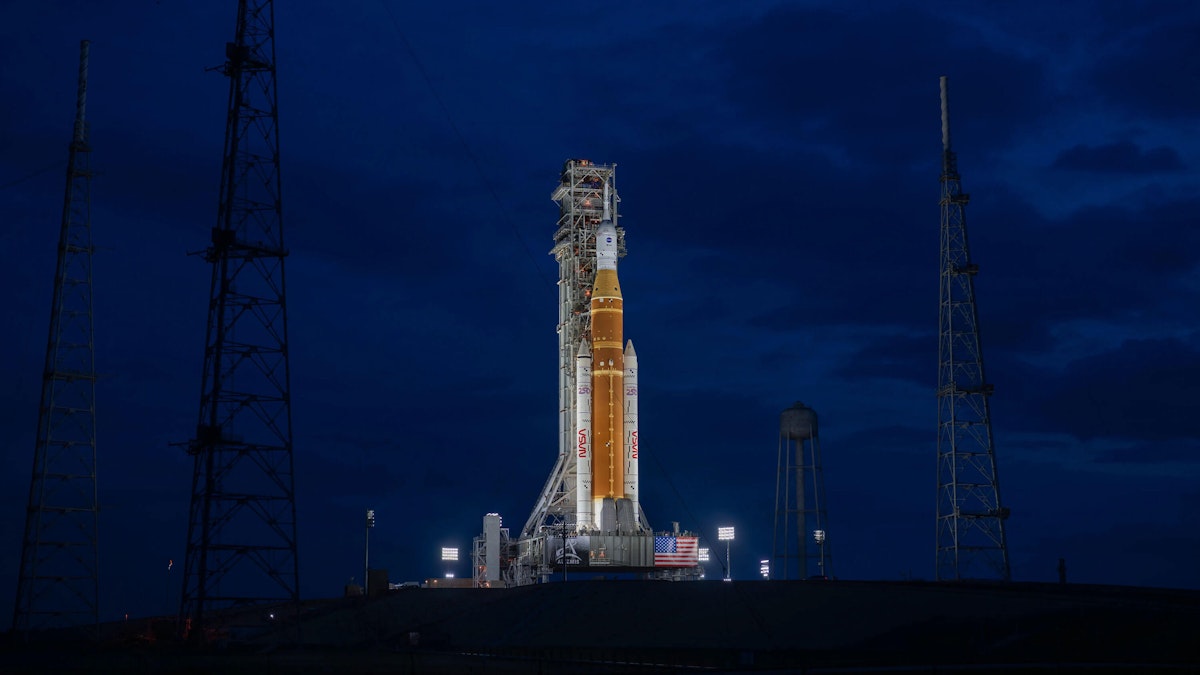
When people refer to the “Artemis rocket,” they are typically referring to NASA’s Space Launch System. SLS is a super-heavy-lift launch vehicle designed specifically for missions beyond the capabilities of existing rockets. Its purpose is not only to launch astronauts but also to deliver large, heavy payloads directly into lunar trajectories without requiring complex in-space assembly.


The core stage of SLS is powered by four RS-25 liquid-fueled engines, extensively modernized from their use under the Space Shuttle program. These engines are supplemented at liftoff by two five-segment solid rocket boosters, which together generate more thrust than any launch vehicle in history. Above the core stage is the Orion spacecraft, a deep-space capsule designed to withstand long-duration missions, intense radiation environments, and high-speed reentry at lunar-return velocities.
The SLS enables direct-to-Moon missions, reducing the need for complex orbital assembly. This simplifies mission architecture and increases reliability – critical factors for crewed exploration.
The ORION crew capsule
The Orion spacecraft comprises two main elements: the crew module, built by NASA and its prime contractor, Lockheed Martin, and the service module, built by ESA (European Space Agency) and its prime contractor, Airbus Space and Defense. According to NASA, ORION is the only spacecraft capable of crewed deep-space flight and high-speed return to Earth from the vicinity of the Moon.


Testing the Artemis rocket: from components to full-system validation
Testing the Artemis rocket was a multi-year effort involving thousands of engineers, technicians, and scientists. Because the SLS is a human-rated launch system, NASA applied verification standards that exceed those used for uncrewed launch vehicles. Individual components were tested first, followed by progressively more integrated system-level tests. The following sections outline these important tests.
Assembly and test at NASA Michoud
Engineers constructed qualification structural test articles for the core stage at NASA's Michoud Assembly Facility in New Orleans. Operated by NASA Marshall in Alabama, Michoud is NASA’s primary assembly center. After assembly, primers were applied for corrosion protection, and the units were shipped to NASA Marshall for structural load testing. NASA Michoud engineers performed extensive friction-stir welding of large propellant tanks, followed by non-destructive inspections (such as X-ray and ultrasonic inspections) to verify weld integrity, as well as cryogenic proof testing, in which the tanks are filled with super-cold liquid oxygen and hydrogen simulants to confirm they can withstand flight pressures and temperature extremes.
Michoud also conducted structural load validation and acceptance testing of the completed core-stage hardware before it was shipped for final integrated testing, ensuring the vehicle could withstand launch stresses. In parallel, the facility supported assembly and pressure testing of the Orion crew module’s primary structure, including leak checks and system fit verification, helping certify that the spacecraft was structurally sound and ready for integration into the broader Artemis II launch stack


Structural, thermal, and acoustic testing at NASA Marshall
Beyond propulsion, NASA’s Marshall Space Flight Center subjected the SLS structure to rigorous environmental testing. Cryogenic tanks were pressurized to verify structural margins, while vibration and acoustic tests simulated the intense noise and dynamic forces experienced during launch. These tests ensured that avionics, wiring harnesses, and structural joints could survive the harsh launch environment without degradation.
A test version of the SLS Block 1B universal stage adapter is moved into a test fixture at NASA’s Marshall Space Flight Center in Huntsville, Alabama, to be subjected to simulated launch stresses. Photo by NASA/Brandon Hancock
Thermal testing was equally critical. The rocket and spacecraft were exposed to temperature extremes ranging from cryogenic propellant loading on the launch pad to solar heating in deep space. This testing verified insulation performance, material behavior, and system stability across the mission profile.
NASA’s Marshall Space Flight Center led structural qualification and cryogenic testing of the SLS core stage. Test articles were subjected to extreme pressure loads simulating liquid hydrogen and liquid oxygen conditions, and structural test stands applied millions of pounds of force to replicate flight stresses. They used test devices like Dewesoft SIRIUS DAQ instruments to record data from strain gauges, load cells, force sensors, and displacement sensors. These tests verified safety margins and structural integrity under both nominal and off-nominal conditions.
Engine and propulsion testing at NASA Stennis


The RS-25 engines were tested extensively at NASA’s Stennis Space Center in Mississippi, simulating full mission durations under extreme thermal and pressure conditions. These tests validated performance margins and ensured long-term reliability. Their B-2 Test Stand was used for full-duration “Green Run” hot-fire tests of the integrated SLS core stage, during which the RS-25 engines were fired for more than 500 seconds, simulating a complete ascent profile. Instrumentation included thousands of sensors measuring combustion pressure, propellant flow rates, thermal gradients, and structural strain.
The Green Run campaign validated not just engine performance, but stage-level integration, including avionics, thrust vector control, and propellant systems.
Environmental testing at NASA Armstrong test station (Plum Brook)
The Orion spacecraft underwent environmental testing at NASA’s Armstrong Test Station, now part of NASA’s nearby Glenn Research Center, one of the world’s most powerful space simulation facilities. They have one of the largest shaker tables and the most powerful reverberation chambers in the world. Combined with its atmospheric chamber, which can replicate the vacuum and temperature of deep space, the station provided essential environmental tests.
Armstrong’s Space Environment Simulation Chamber (SESC) was used to emulate the vacuum conditions of deep space and perform thermal cycling tests from extreme cold to solar temperatures. In addition, the Reverberant Acoustic Test Facility (RATF) was used to generate sound pressure levels up to 163 dB to simulate the acoustics of an actual launch. Mechanical Vibration Testing simulated launch and ascent loads. These tests ensured Orion could withstand the extreme environments of launch, spaceflight, and reentry.
Mass and load testing at NASA Armstrong flight test center (Edwards)
Engineers and technicians at NASA Armstrong at Edwards Air Force Base in California tested the Orion launch abort system development test article. Mass and load testing are often overlooked compared to propulsion or flight tests, but they are foundational to mission success. In the case of Orion, they ensured that the spacecraft’s most critical safety system, the ability to escape a failing rocket, would operate with precision and reliability.


By combining high-fidelity measurements, advanced simulation, and rigorous structural validation, NASA ensured that the Orion launch abort system met the stringent requirements of human spaceflight. Human spaceflight demands that every component is designed not only for performance but exhaustively verified before leaving the ground.
Avionics and software testing at NASA Johnson
At NASA’s Johnson Space Center in Houston, Texas, Artemis II testing focused on integrated avionics validation, crew systems, and mission operations through high-fidelity simulation environments. NASA conducted hardware-in-the-loop (HIL) simulations using Orion flight software running on representative avionics systems, connected to real-time vehicle dynamics models. Astronauts interacted directly with Orion cockpit simulators, enabling validation of guidance, navigation, and control (GNC), fault detection and recovery procedures, and human-machine interfaces under realistic mission conditions.

Astronauts participated in simulated missions to validate human-machine interaction and operational workflows.
Spacecraft monitoring, launch, recovery, and battery resting at NASA Kennedy
Monitoring spacecraft at the LCC


For the Artemis program, NASA upgraded its telemetry systems to an Ethernet packet-based system, using USGS DEM-standard spatial file format headers to decode all messages. They installed 11 Dewesoft R3 rack-mounting DAQ and telemetry recorders at the RPS (Realtime & Playback Subsystem Laboratory) inside the LCC (Launch Control Center) building. Each R3 can process thousands of PCM channels from the spacecraft before, during, and after each mission.


Multiple Dewesoft processing stations decommutate raw Ethernet channels into parameters (channels) and scaled into the proper engineering units. The entire system can process more than 200,000 parameters in real time. DewesoftX DAQ software can read and decode IRIG 106 Chapter 10 data from any telemetry data recorder in real time over Ethernet, or from a pre-recorded Chapter 10 file.
Mobile launch platform monitoring DAQ systems


The SDAS (Sensors and Data Acquisition) group at NASA Kennedy is responsible for the DAQ system installed on the Mobile Launch Platform. As with previous programs such as Apollo and the US Space Shuttle, the Artemis SLS rocket is assembled on this platform in the VAB. The platform is actually an enormous “crawler” that then slowly moves the rocket out to the launch pad several miles away.
Multiple Dewesoft R8rt rack-mounting DAQ systems equipped with STG (strain gage) modules are installed inside each of the two Mobile Launch Platforms. Each R8rt records 30 IEPE accelerometers for structural vibration analysis, 16 hydraulic pressure channels, and numerous temperature channels. The data is correlated in real-time with other SDAS systems.


EDL battery testing
In addition to providing final rocket assembly and check-out at its massive Vehicle Assembly Building (VAB), NASA Kennedy performed numerous tests using Dewesoft instruments to monitor voltage and current in SLS and Orion capsule battery cells. The Electrical Development Laboratory (EDL) is the primary hub for testing mission-critical electrical systems. The EDL uses specialized tools like milliohm meters, electrostatic discharge (ESD) workstations, and low- and high-speed data acquisition (DAQ) systems to evaluate battery performance under launch-like conditions.
Orion capsule recovery tests
The NASA Recovery Team at Kennedy Space Center was responsible for developing and executing Orion ocean recovery procedures. These tests were conducted in partnership with the U.S. Navy, using amphibious ships such as the USS Anchorage and the USS Arlington. Dewesoft DAQ instruments were used onboard these vessels to monitor the forces experienced by the spacecraft during recovery.


During Underway Recovery Tests (URTs), Dewesoft systems were used to collect data from:
Load cells on rigging lines and winches
Accelerometers on the capsule and cradle
Strain gauges on structural elements
Motion sensors measuring ship and capsule movement
This allowed engineers to quantify the forces during capsule capture, loads while winching Orion into the well deck, and dynamic behavior in rough seas


Final assembly, integration, and test at Kennedy
Final assembly, integration, and launch testing took place at NASA’s Kennedy Space Center, including stacking of the SLS core stage, boosters, and Orion inside the Vehicle Assembly Building (VAB).
A few miles away at Launch Complex 39B, NASA conducted “wet dress rehearsals” with full cryogenic fueling. These tests were designed to test and validate fueling procedures, ground support equipment, launch countdown timelines, countdown simulations, and launch operations testing

By the time Artemis II reached the VAB, it was already qualified at component and subsystem levels. However, integration testing, verification, and validation of the fully assembled launch vehicle as a complete system were performed throughout the assembly process. Inside the Vehicle Assembly Building, Artemis II underwent mechanical integration verification, electrical and avionics system testing, full vehicle functional simulations, communication and telemetry validation, and flight software and mission sequence testing
ESM design, assembly, and testing in Europe
While NASA leads the overall Artemis program, the European Space Agency (ESA) contributed the European Service Module (ESM), a core element of the Orion spacecraft that enables the mission to function in space. The ESM provided the main propulsion engine for orbital maneuvers and trajectory corrections, as well as solar arrays that generated power for the entire spacecraft. It also provided thrusters for orientation, temperature regulation, and water and oxygen for the crew.


The ESM was designed and built by ESA, with prime contractor Airbus Defense and Space, and assembled primarily in Bremen, Germany. It was later shipped to the USA for integration at NASA’s Kennedy Space Center. The ESM underwent extensive testing across multiple facilities in Europe and the USA.
At ESA and Airbus facilities in Europe, the ESM underwent structural testing (load cases and vibration), thermal-vacuum testing (space-environment simulation), Propulsion system validation, electrical integration, and avionics testing. These tests ensured compliance with both ESA and NASA human spaceflight standards.
In the USA, the ESM underwent further validation during integration with the Orion crew module, including interface testing with the Orion Crew Module, end-to-end avionics verification, and integrated system testing with the rest of the spaceship. This testing ensured that ESA’s systems function seamlessly within the overall Artemis II architecture.
Integrated testing and countdown simulations
As Artemis neared flight, NASA shifted its focus to integrated system testing. Electrical, software, and communication interfaces between the rocket, spacecraft, and ground systems were validated through repeated simulations. These tests ensured that data flowed correctly from sensors to flight computers and that command sequences executed reliably under both nominal and off-nominal conditions.

A key milestone in this phase was the “wet dress rehearsal,” during which the fully assembled rocket was rolled out to the launch pad and loaded with cryogenic propellants. These rehearsals tested fueling procedures, countdown timelines, and ground support equipment, providing NASA with critical insights into launch-day operations.
Conclusion: Artemis as a foundation for the future
Artemis II represented a shift toward international and commercial collaboration. Partner agencies and private companies contributed hardware, expertise, and services, creating a broader and more sustainable exploration ecosystem.


Enhanced life support systems, radiation protection strategies, propulsion technologies, and operational concepts developed for lunar missions will be adapted for travel to Mars. Unlike the moon, which can be reached in a few days, a trip to Mars will take between six and nine months, depending on the launch window. The distance between Earth and Mars is constantly changing because of the different orbits each planet has around the Sun.
NASA’s Artemis rocket and missions represent a fundamental shift in how humanity approaches deep-space exploration. Through exhaustive testing, careful validation, and progressively more ambitious missions, Artemis is transforming the Moon into a stepping stone rather than a final destination. With the Space Launch System and Orion spacecraft at its core, the program is laying the groundwork for a future in which human presence extends beyond Earth orbit and eventually reaches Mars.