




Revolutionizing Rocket Testing with a Cost-Efficient, Modular, and Adaptable Testing Infrastructure
Rime Hamadeh
Eiffage Énergie Systèmes
April 7, 2026
Eu-BEST is reshaping rocket testing in Europe by replacing expensive, dedicated facilities with a shared, modular infrastructure built for multiple launchers and different stages of development.
The project targets the ground segment, where more than 99.9% of a launcher’s lifecycle cost and risk are concentrated. By turning this major bottleneck into a scalable, interoperable service, Eu-BEST helps make testing more efficient, flexible, and accessible.
The result is a cost-effective testing ecosystem that strengthens Europe’s competitiveness, lowers barriers for emerging space companies, and supports a future of more frequent launches.
Introduction
In the space sector, most public attention goes to launches, the few dramatic minutes when a rocket rises into orbit. But more than 99.9% of a launcher’s lifecycle takes place on the ground, through engine development, stage qualification, system integration, and launch preparation. These activities account for most of the time, cost, and operational effort behind a launcher, and they largely determine its reliability, safety, and commercial viability.
Today, launcher developers usually need to build and operate their own dedicated ground testing infrastructure. That model is expensive, slow, and inefficient. It requires major capital investment, creates high operating costs, duplicates infrastructure across Europe, and leaves many facilities underused outside peak test periods. Suitable testing sites are also scarce and costly to develop, especially for newer private companies without access to established national infrastructure.
While institutional programs have traditionally carried these costs, the growth of commercial micro-launchers is making that model harder to sustain. The ground segment has become a serious bottleneck in Europe’s space ecosystem.
With several private launcher operators expected in Europe by 2030, along with higher launch rates and more frequent test campaigns, a new approach is needed. Europe must make ground infrastructure more efficient, more accessible, and more scalable.
That is the goal of the European Bench for Engine and Stage Testing, Eu-BEST. Backed by €5 million from Horizon Europe, the project brings together launchers, spaceports, industry partners, and public agencies to develop a shared network of modular and standardized testing facilities.
The objective is interoperability: enabling different launchers to access equivalent services across locations and lifecycle stages. We pursue this aim through two main approaches:
Horizontal interoperability: A given launcher should experience consistent support throughout all phases - from component testing to stage validation - using modular and mobile infrastructure.
Vertical interoperability: Different launchers should be able to use the same facility without requiring custom adaptations, reducing costs and increasing efficiency.
This paper presents the Eu-BEST concept, from the initial problem analysis to the proposed technical and operational solution, its implementation strategy, and the role of advanced technologies, including real-time control systems, digital twins, and high-speed data acquisition.
By developing a shared and efficient testing infrastructure, Eu-BEST aims to transform ground testing from a limiting factor into a strategic enabler for the next generation of European launchers.
Background
Over the last decade, Europe’s space transportation landscape has been reshaped by the rise of private small-launcher companies alongside long-established institutional programs. This shift has been fueled by the growth of the small-satellite market, demand for more responsive launch services, and the need for more flexible and affordable access to space.
That growth has brought a sharp increase in development programs, test campaigns, and qualification activities across Europe. But while launches attract most of the attention, the real work of launcher development happens on the ground. Engine testing, stage qualification, system integration, acceptance testing, and launch preparation make up the vast majority of development time and cost.
Supporting these activities requires complex and highly specialized infrastructure, from thrust stands and cryogenic propellant systems to safety systems, high-speed data acquisition, and advanced control software. Building and operating such facilities is expensive, resource-intensive, and slow, often taking years before testing can even begin.
Traditionally, each launcher developer has built and operated its own dedicated facilities. Although this model offers control and confidentiality, it also leads to high capital costs, duplicated infrastructure, long setup timelines, limited flexibility, and poor utilization outside peak development phases.
Creating new test sites has also become more difficult due to stricter regulatory, environmental, and safety requirements. In many parts of Europe, permitting and public acceptance now present major barriers.
At the same time, global competition is accelerating. In 2022, SpaceX reportedly performed more than 900 engine tests, illustrating the level of testing needed to sustain rapid development and frequent launches. If Europe wants to remain competitive, it must increase testing capacity while lowering costs, speeding up development, and using infrastructure more efficiently.
These pressures make one thing clear: the traditional model of dedicated ground infrastructure is no longer sustainable for Europe’s launcher ecosystem.
Stakeholders
The Eu-BEST project is coordinated by Eiffage Énergie Systèmes - Clemessy and supported by a consortium of key actors across the European space sector, each contributing complementary expertise. The core consortium includes:
Eiffage Énergie Systèmes – Clemessy (France): European system integrator specializing in control-command, testing, and complex industrial systems, is responsible for overall management, the engine's measurement acquisition system, and the implementation of a control system to interface the various fluid and mechanical subsystems.
SpaceDreamS (France): A French startup specialized in space launch ground infrastructure and digital engineering. It is the technical leader of the test stand and the development of the Eu-BEST digital twin, which supports virtual commissioning, system optimization, and operator training.
OHB Digital Connect (Germany): A part of the OHB group and expert in ground systems and satellite operations, control solutions, and digital engineering for space applications, contributes to the mechanical design, system architecture, and the definition of the business and exploitation model of the future test infrastructure.
PANGEA Propulsion (Spain): A European space propulsion manufacturer that represents both an end user and a technology contributor. In addition to providing input on engine integration requirements and operational constraints, the first hot-fire test will use the PANGEA engine.
SUAS Aerospace (Ireland): An emerging spaceport operator contributing its expertise in launch and ground operations, and plays a key role in demonstrating the test bench's mobility and re-localizability across different sites.
The Institute of Space Studies of Catalonia (IEEC) (Spain): A leading research institute in space engineering, which primarily supports the project on standards, regulations, and compliance aspects. IEEC contributes to the definition of applicable technical standards, safety rules, and regulatory frameworks, ensuring that the Eu-BEST facility fully aligns with European and national regulatory requirements.
Aeroports de Catalunya (Spain): An experienced infrastructure and airport operator that acts as the first hosting site of the Eu-BEST bench and is responsible for site preparation, regulatory interfaces, and the integration of the test facility within an operational airport environment.


In addition to the core consortium, a group of potential end users supports the project. These include:
These organizations represent future customers of the infrastructure and actively contribute to defining technical, operational, and economic requirements, ensuring that the Eu-BEST solution remains closely aligned with real market needs.
Together, these stakeholders represent the full value chain of the European launcher ecosystem:
launcher developers,
infrastructure operators,
system integrators,
technology providers, and
research institutions,
working jointly toward a shared, interoperable ground testing capability.
The issue
The core issue addressed by Eu-BEST is the lack of a shared, standardized, and cost-efficient ground testing infrastructure in Europe.
Launcher developers face several recurring challenges:
High upfront investment to build dedicated test benches
Long lead times before testing can begin
Difficulty scaling test capacity with development pace
Limited access to suitable and permitted sites
High operational and maintenance costs
For emerging private companies, these constraints can delay development programs, increase financial risk, and limit their ability to compete with well-funded international actors.
At the European level, the absence of shared infrastructure leads to redundant investments, inefficient use of public funding, and fragmented capabilities that are difficult to coordinate.
Analysis
A close analysis of the ground segment reveals three core weaknesses.
First, it is fragmented. Launcher developers continue to build separate facilities for similar thrust ranges, fuels, and test profiles, leading to repeated investment and unnecessary duplication.
Second, it is underused. Test benches are critical during development, but many remain idle outside peak campaign periods, limiting efficiency and reducing return on investment.
Third, it lacks interoperability. Most facilities are built around the needs of a single launcher, which makes shared use difficult and costly.
This model is not suited to the growth Europe is expecting. By 2030, demand could rise to several hundred engine and stage tests per year.
To meet that demand, ground testing must be treated less as a proprietary asset and more as a shared service.
Solution
Eu-BEST proposes a new business and technical model based on shared, modular, and interoperable test infrastructure.
Instead of each launcher building its own facility, standardized ground services are offered to multiple users. The same bench can be used across different development phases and by different launchers, with minimal reconfiguration.
Two forms of interoperability are central:
Horizontal interoperability: consistent services across the full lifecycle, from component testing to stage qualification.
Vertical interoperability: multiple launchers using the same facility without custom mechanical or software adaptations.
We achieve these through modular mechanical design, universal interface frames, flexible fluidic interfaces, and configurable control and acquisition systems.
Implementation
Test bench architecture
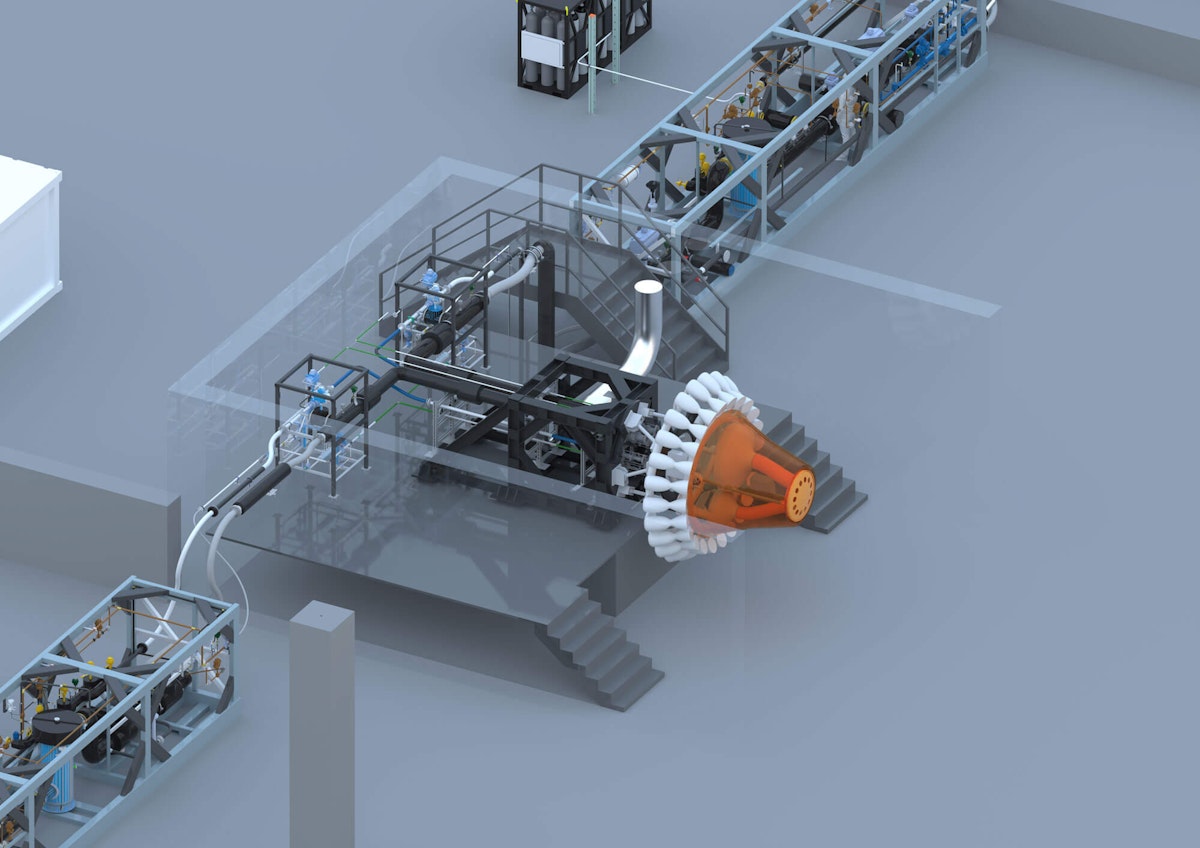
The Eu-BEST bench is a horizontal test bench designed for:
Engine thrust up to 500kN
LOX and LCH4 propellants
Test durations exceeding 300 seconds
Up to 200 tests per year
Key features include an integrated thrust measurement system, an enclosed structure for environmental protection, a common mechanical interface frame, on-site and remote mission control, and full compliance with environmental regulations.
Two phases are defined:
Demo Bench (2026) – first engine test with the PANGEA Propulsion ARCOS engine.
Full Operational Capacity Bench (October 2027) – higher flows, longer tests, additional fuels.


Technologies
Real-time control and supervision
The control-command system builds on Syclone Real-Time software developed by Clemessy. It provides real-time process control, automated test procedures, per-test user configuration, remote supervision, and full data traceability.
Virtual platform
The digital twin enables virtual commissioning, training, and configuration management. Systems are tested and optimized virtually before physical deployment, reducing on-site setup time and increasing operational efficiency.
Universal interfaces and thrust measurement
Universal interfaces enable integration of engines up to 3.5 m in diameter and 2000 kg in weight with minimal adaptation. A full six-component thrust measurement system provides accurate force and moment vectors.


Data acquisition equipment
We built the measurement architecture of the Eu-BEST test bench around the Dewesoft IOLITE R12 rack DAQ system. This data acquisition and real-time control front-end system has dual EtherCAT buses and is an all-in-one solution for real-time control and feedback monitoring.
Key characteristics include:
Acquisition rates up to 20 kHz.
Integration in an EtherCAT real-time loop.
Direct interface with the Syclone Real-Time control system.
We equipped the system with:
Six 6xSTG amplifier modules for 4-20 mA and 0-10 V analog signals.
One 8xACC amplifier module for vibration and acceleration monitoring.
One 8xDI/4xDO amplifier module for digital command-and-control.
Dewesoft equipment is also integrated into the ATEX measurement chain, enabling safe and reliable acquisition of signals from sensors located in hazardous areas, while keeping the acquisition system outside the ATEX zone in compliance with safety and regulatory requirements.


This Dewesoft-based measurement architecture provides several key benefits:
High-accuracy, high-precision measurements adapted to demanding test conditions.
Flexible sensor excitation, powering, and configuration directly within the acquisition system.
Reliable data recording and archiving through DewesoftX data acquisition and signal processing software.
Measurements
As the Eu-BEST project is still under development, no experimental results are available at this stage. However, we designed the measurement architecture to support a comprehensive set of data outputs during future test campaigns.
The test bench will enable the acquisition and analysis of:
Thrust vector measurements (6 components: forces and moments).
High-frequency vibration and dynamic behavior of engines and structures.
Propellant flow rates, pressures, and temperatures.
System states and operational parameters throughout the test sequence.
All measurements will be:
Acquired in real time at sampling rates up to 20 kHz.
Synchronized with the control-command system.
Recorded and archived for post-processing, performance assessment, and model validation.
These data will provide quantitative evidence to assess engine performance, structural behavior, and system reliability.
The first hot-fire engine test on the Eu-BEST bench is currently planned for the end of 2027, marking the start of operational data generation.
Measurement results
While we will obtain final results once testing activities begin, we expect the Eu-BEST concept to deliver several structural and operational outcomes for the European launcher ecosystem:
Reduced capital expenditure by replacing dedicated test benches with shared infrastructure
Shorter integration and setup phases through standardized interfaces and modular design
Improved infrastructure utilization across multiple users and development phases
Higher test throughput, with a target capacity of up to 200 tests per year
Improved data consistency and repeatability enabled by a unified measurement and control framework
By transforming ground testing into a shared and interoperable service, we expect the Eu-BEST to significantly increase European testing capacity while lowering barriers to entry for emerging launcher companies.
Conclusion
Eu-BEST demonstrates that ground infrastructure can evolve from a bottleneck into a strategic enabler.
By combining modular design, interoperable interfaces, advanced real-time control, high-speed data acquisition, and digital twin, the project establishes a new standard for shared testing facilities.
This approach strengthens European competitiveness, reduces barriers to entry, and supports the sustainable growth of the space transportation ecosystem.