




Electric Motor Testing: From Test Bench Data to Smarter Design
Roberto Lavorgna
Mavel Powertrain
May 15, 2026
Modern electric machine development is rapidly shifting toward data-driven engineering, where testing must do more than validate performance. It must generate actionable knowledge.
Mavel has redefined the role of the test bench, transforming it from an isolated validation tool into a connected engineering platform that links measurement, data infrastructure, and advanced analytics. By integrating high-quality Dewesoft data acquisition with centralized data management and AI-enabled services, testing becomes an active driver of faster, more reliable electric motor and inverter design.
Introduction
The development of modern electric machines across automotive, aerospace, civil, and defense applications is becoming increasingly complex, data-driven, and time-critical. Traditional test benches, designed primarily for performance validation, are no longer sufficient to support this evolution.
Mavel Powertrain is an Italian engineering company specializing in electric motors, inverters, and complete electric drive systems for high-performance mobility applications. The company develops compact, lightweight, and high-power-density electric drives designed for demanding applications such as automotive and aerospace.
The company’s name comes from the Italian words “Macchina” (machine) and “Veloci” (fast)—essentially meaning “high-speed machine.”
Mavel has shifted its perspective: from test benches as standalone tools to an engineering ecosystem that connects knowledge to data and generates a permanent asset for the company.
By combining high-quality measurement systems, centralized data management, compute infrastructure, and AI-powered SW services, testing becomes an active part of the engineering process rather than its final step.
The result is a development environment that enables faster, more reliable motor and inverter design, reduces physical testing effort, and supports the transfer of engineering knowledge across R&D teams.
The company approach
Founded in 1999 as a research and development company for industrial applications, Mavel has evolved into a recognized technology enabler in advanced electric propulsion. Over the years, by operating across multiple industries, the Czech-American engineering and manufacturing company has built extensive cross-sector expertise and developed internationally patented, high-value technological solutions.
Today, Mavel delivers applied research, engineering, development, testing, and manufacturing services for electric propulsion and e-powertrain systems across the marine, aerospace, government, and high-speed sectors. Its engineering approach combines:
Simulation-driven design
Advanced testing and validation
System-level optimization of motor, inverter, and controls
Mavel’s approach bridges theoretical engineering knowledge with real-world validation and industrial deployment. The company operates at the intersection of advanced simulation, experimental validation, and industrialization, enabling customers to transition from concept to production with reduced technical risk and improved predictability.
By maintaining direct control over design, testing, and system integration, Mavel ensures full traceability of engineering decisions across the entire product lifecycle.


This approach reflects a broader transition across advanced engineering industries, in which data is becoming a strategic design driver rather than a by-product of validation activities. Organizations that can structure, contextualize, and reuse test data gain a significant competitive advantage in development speed, product reliability, and long-term knowledge preservation.
The integration of test environments with digital engineering workflows enables continuous feedback between physical validation and virtual design environments, creating a closed-loop development methodology.
Background
Electric machines are evolving rapidly in power density, speed, efficiency, and integration. As a result, the amount of data generated during testing has increased dramatically, while the ability to exploit it fully often remains limited.
In many organizations, testing is still treated as a separate activity, physically and conceptually disconnected from research and development. This separation leads to inefficiencies, longer development cycles, and a strong dependency on individual expertise rather than shared engineering knowledge.
At the same time, engineering organizations are facing increasing pressure to reduce development time while maintaining or improving product reliability and certification readiness. This challenge requires new methodologies to extract the maximum value from every test campaign.
The transition from experience-driven development to data-driven engineering does not replace domain expertise, but enhances it by making engineering insights scalable, traceable, and transferable across teams and projects.

Stakeholders
The main stakeholders involved in this paradigm shift include:
R&D engineers, responsible for motor and inverter design
Test engineers, managing measurements, diagnostics, and validation
System architects, defining development workflows and data infrastructure
Technology partners, providing reliable measurement and acquisition platforms
Organizations, seeking faster and more cost-effective development processes
The effectiveness of this transformation depends on creating a shared data language among these stakeholders to ensure that you can interpret, reuse, and extend information generated during testing across different engineering domains.


The issue
How can you transform test data from isolated measurements into a long-term engineering asset?
How can development teams reduce physical test time without compromising reliability?
And how can engineering knowledge, traditionally stored in the experience of individuals, be made available across the entire R&D organization?
These challenges are becoming critical as product complexity increases and development cycles continue to shrink across competitive industrial sectors.
The ever-increasing performance and capabilities of data acquisition systems unlock new use cases, making data use a key differentiator for companies.
Without proper contextualization, historical traceability, and integration with simulation models, test data remains under-exploited. Such a deficit limits the potential of advanced techniques such as AI-driven virtual simulations, which rely on structured, high-quality datasets to deliver meaningful results.
Companies that fail to structure and contextualize test data risk losing valuable engineering knowledge over time, especially when personnel changes or when programs span multiple years.
A structured data strategy enables long-term traceability, allowing engineering teams to compare current development programs with historical performance baselines and accelerate root-cause investigations.
Solution
The proposed solution is not a product, but a platform that changes the engineering approach.
The testing environment and, in our specific case, e-motor test benches, are enablers that feed the ecosystem with high-quality, synchronized data and integrate with:
Centralized data storage and contextualization
Simulation and virtualization tools
Optimization and design algorithms, generated with a modern AI approach
In this framework, artificial intelligence is not the goal; rather, it is one of the technologies that you can enable once you have properly designed the data infrastructure.
This platform-oriented approach allows engineering organizations to progressively build a digital backbone that connects test environments, simulation tools, and engineering decision processes.
Over time, this enables the creation of reusable engineering models validated with real-world test data and supports predictive design methodologies in which physical testing focuses on validation rather than discovery.
Test systems as technology enablers within the digital engineering architecture
In this context, the test bench is no longer considered only a validation tool but a fundamental technology enabler within the company's broader digital engineering architecture.
Its role evolves into a vertical integration point where multidisciplinary engineering competencies converge. This includes power electronics, control algorithms, mechanical design, thermal management, and system validation. By structuring the test environment within the enterprise data ecosystem, the test bench becomes a primary source of high-quality engineering data and a key interface between physical testing and digital engineering workflows.
In this paradigm, the test system serves as the physical link between the virtual engineering domain — including simulation environments, digital twins, and predictive models — and the machine's real-world behavior. Measurement data is continuously contextualized, stored, and correlated with historical datasets and simulation models, enabling a closed-loop engineering process in which physical validation and virtual design operate as complementary, interconnected activities.
This transformation allows companies to move from project-based knowledge generation to company-wide engineering intelligence. Knowledge generated during testing is no longer limited to a specific program or engineering team. Still, it becomes part of a continuously growing digital knowledge base that supports future development programs, design decisions, and validation strategies.
Over time, this architecture enables the progressive virtualization of testing activities. Future test environments will not only execute predefined validation procedures but also process measurement data in real time, correlate it with historical datasets and simulation models, and support engineering teams with data-driven design improvement suggestions during test execution.
This evolution does not replace physical testing. Instead, it amplifies its value, progressively transforming test systems from validation tools into active nodes of engineering intelligence embedded within the company's digital infrastructure.
Implementation (high-level, no IP)
The implementation follows an incremental approach:
Integration of measurement and diagnostics within a unified test system
Centralization of test data into a structured lakehouse
Progressive coupling of historical data with simulation scripts and optimization techniques
Incremental introduction of AI-based approaches for virtual testing and decision support
This approach allows measurable benefits without disrupting existing engineering workflows.
This phased implementation ensures controlled adoption and minimizes disruption to existing engineering processes. Each step generates measurable technical and operational benefits, enabling organizations to validate the return on investment before expanding to the next maturity level.
The incremental methodology also allows engineering teams to build confidence in data-driven and AI-supported tools while maintaining full engineering control over design decisions.


Data acquisition equipment
Reliable measurement is a fundamental requirement for enabling data-driven engineering workflows.
High-performance data acquisition and power analysis systems, such as those provided by Dewesoft, form the backbone of the engineering test system, ensuring data quality, synchronization, and traceability across different test scenarios and operating conditions.
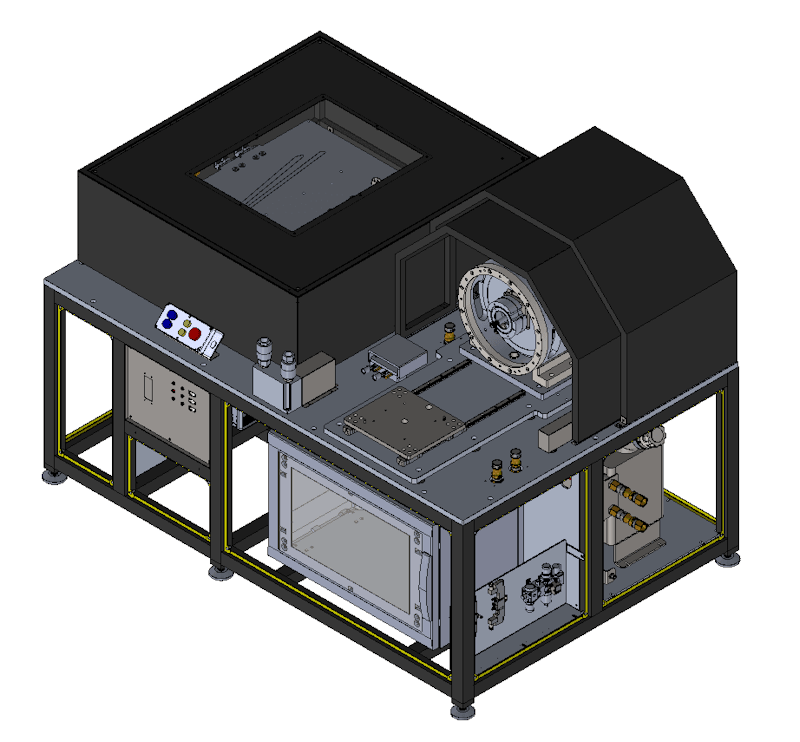
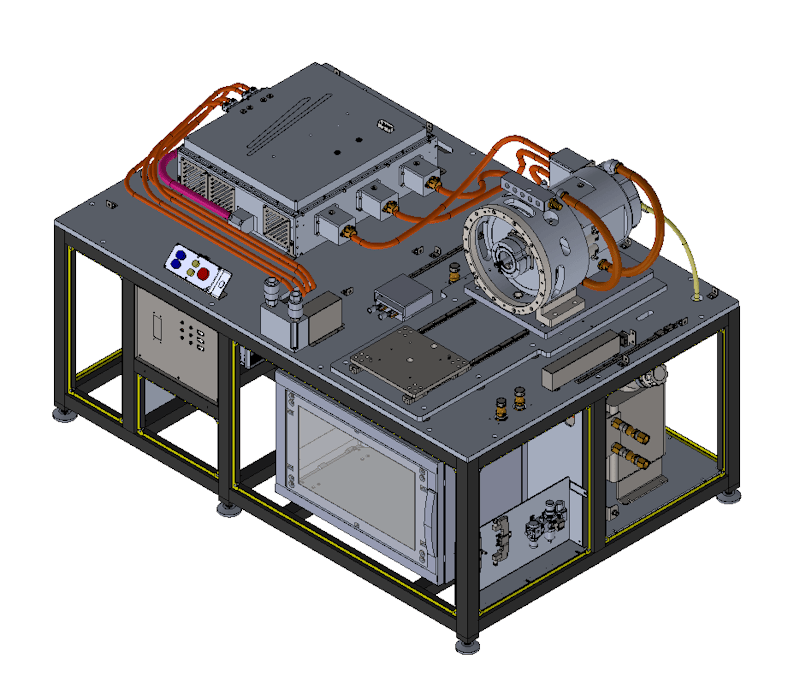
A modern Mavel eMotor test system is an integrated multi-domain validation platform that combines mechanical robustness, electrical power control, thermal management, and advanced measurement infrastructure.
Typical Mavel eMotor test bench system architecture

Mechanical structure
Bench structure: solid stainless steel frame for high stiffness and vibration stability
Bench base: solid aluminum base for optimal structural damping and precision alignment
Torque decoupling: silent-block decoupled aluminum base to isolate external vibration sources
DUT eMotor to Brake mechanical fixture with integrated torque meter and vibration sensors
Power and energy management
Brake inverter for dynamic load simulation
High Power Battery Simulator or High Power Supply
Regenerative DC Bus for energy recovery and system efficiency
Thermal management
Integrated cooling systems for DUT, brake system, and power electronics
Measurement and control
Advanced DAQ System (Dewesoft SIRIUS + IOLITE modules)
PLC and I/O modules for automation and safety control
Safety sensors and monitoring systems
Supervisory control software — ViMotion, developed by Mavel, enabling real-time test orchestration, data visualization, diagnostics, and integration with the company's digital engineering environment.
Instrumentation rack
Industrial PC for test management and data processing
UPS for system continuity and data integrity
Auxiliary power supplies
Insulation monitoring and leakage current testing systems
HVDC Bus Constant leakage monitor
High-speed LAN connection for real-time test data transfer and integration with the company data infrastructure
This modular architecture enables scalable system configurations, allowing test benches to be adapted to different power ranges, machine topologies, and validation scenarios while maintaining measurement consistency and data quality.
Beyond high-speed and high-accuracy data acquisition, the measurement platform enables continuous monitoring of system health and advanced self-diagnostic capabilities across the entire test environment. These features enable early detection of measurement-chain anomalies, sensor degradation, or synchronization issues, ensuring the long-term reliability of both test data and the test system.


Test Systems as Core Elements of the Digital Engineering Architecture
In modern engineering environments, the test bench is no longer a standalone protagonist, but an integrated element of the company's digital architecture.
The test system becomes part of the enterprise data ecosystem, serving as a physical data source that connects simulation models, digital engineering tools, and real-machine behavior.
In this role, the test bench serves as the junction point between virtual engineering and physical validation, enabling continuous feedback between simulation and real-world testing and supporting future test virtualization and real-time design optimization workflows.
Measurements
Measurements extend beyond traditional KPIs such as torque, speed, and power.
Multi-signal diagnostics, high-sample-rate acquisition, and contextual metadata enable reuse of test data for correlation, simulation, and optimization.
The availability of high-resolution, time-synchronized multi-domain signals enables deeper insight into system behavior, allowing engineering teams to detect early indicators of performance deviation, component stress, or efficiency degradation.
This level of measurement capability is essential to support advanced simulation model calibration and predictive maintenance strategies.


In industrial development scenarios, this approach enables:
Faster development cycles
Reduced physical testing effort (up to 30% in selected cases)
Creation of a permanent, knowledge-based asset for the company
Better integration between simulation, design, and testing
These benefits translate directly into improved program predictability, reduced technical risk, and more efficient allocation of engineering resources across development phases.
Conclusion
The future of testing is not only about measuring better, but about learning faster.
Engineering test systems are evolving from validation tools into platforms for knowledge creation and decision support.
By enabling this transformation, testing becomes an integral part of engineering intelligence — supporting the next generation of electric machines and the teams that develop them.
Organizations that adopt this evolution in testing philosophy will be able to transform engineering data into a strategic asset, supporting continuous innovation and long-term competitiveness.
In this context, test systems become part of the company's engineering intelligence layer, enabling faster decision cycles and more robust product development processes.