




Optimizing EV Battery Management by AI-Driven Data Transformation
Philipp Sven
ETAS
April 17, 2026
AI-driven data transformation is becoming essential for improving the reliability and performance of electric vehicle battery management systems. By combining Dewesoft’s high-precision data acquisition with ETAS’s advanced calibration and modeling tools, engineers can turn vast amounts of raw measurement data into accurate predictive models. The integrated toolchain enables precise State of Charge estimation and more reliable range predictions, helping address EV range anxiety and build greater confidence in electric mobility.

The ETAS and Dewesoft toolchain leverages AI to transform measurement data into precise EV battery management models, turning the data into actionable intelligence.
In the rapidly evolving automotive industry, particularly within Electric Vehicles (EVs), the accurate management and interpretation of vast amounts of measurement data are paramount. ETAS, a leading automotive software and hardware provider, collaborated with Dewesoft, a specialist in high-precision data acquisition, to address a critical data dilemma impacting EV range anxiety: the inconsistent and often misleading nature of raw battery State of Charge (SoC) data.
By deploying a sophisticated toolchain, deeply integrated with Dewesoft's advanced measurement capabilities, and incorporating advanced data acquisition, processing, and AI-driven modeling, ETAS significantly enhanced the precision of battery management systems, enabling more reliable range predictions and fostering greater trust in EV technology. This endeavor highlights the power of transforming complex, diverse, and exponentially growing raw data into relevant, actionable information.
The customer
Founded in 1994 as a wholly-owned subsidiary of Robert Bosch GmbH, ETAS has grown into a global leader in automotive embedded systems, representing Automotive OEMs worldwide as a problem-solver and key technology provider. With approximately 3,000 employees across 42 locations in 13 countries and a projected turnover of 599 million Euros for 2024, ETAS is a vital partner for the global automotive industry, driving innovation in vehicle software.
ETAS’s comprehensive portfolio includes:
Data acquisition and processing tools
Software development tools
Software testing solutions
Vehicle Software Platform Suite
Onboard and Offboard Security solutions
Diagnostics and Information Solutions
Cybersecurity services are critical for enabling software-defined vehicles
The challenge
Bridging the gap in EV battery state of charge (SoC) prediction
A central challenge in electric vehicle development is "range anxiety," often exacerbated by inconsistencies in battery State of Charge (SoC) data. Drivers observe that the SoC appears to "regenerate" after the vehicle is no longer under load, leading to unreliable data and making accurate prediction impossible. This phenomenon stems from the complex electrochemical processes within batteries and transient effects.
The core problem was:
The variety of data
Managing diverse data sources from various sensors, control units, and bus systems, all of which are crucial inputs for robust EV system modeling.
Mastering exponential data growth
The sheer volume of raw measurement data makes manual analysis and pattern recognition impractical for effective system calibration and validation.
The complexity of data – noise vs. relevance
Distinguishing meaningful signals from noise and irrelevant data points within extensive datasets is vital for training accurate predictive models.
The missing information – raw data alone isn't enough
Raw, unprocessed data provides only a partial picture; it lacks the contextual and predictive intelligence needed for robust decision-making and precise SoC estimation.
To overcome range anxiety and build trust in EV technology, the paramount challenge was to achieve maximum accuracy for battery management systems, ensuring reliable and precise SoC prediction.


The solution
An integrated toolchain for data-driven BMS model development
ETAS's strategy centered on deploying a robust, integrated toolchain, leveraging its expertise alongside Dewesoft's advanced data acquisition capabilities. We seamlessly integrated the devices tailored for EV development into INCA (V7.5-SP6 and higher) via OpenDAQ. This toolchain serves as the instrument for transforming raw data into precise, AI-driven models, specifically enabling the development and refinement of highly accurate BMS models.
The core components of the solution included three components:
INCA (Integrated Calibration and Application Tool) and Dewesoft XHS Power
ETAS acquired high-quality, time-synchronized data, which is crucial for understanding complex EV behavior. This acquisition included not only precise measurements of battery cell voltages and currents but also extensive measurements of the entire electric powertrain (motor parameters across all phases), including voltages, currents, torque, temperatures, and vibrations. This holistic data capture provides an unparalleled foundation for model development.
Measure data
Seamlessly acquire high-fidelity data from diverse sources, including various bus systems, control units, and physical sensors.Visualize data
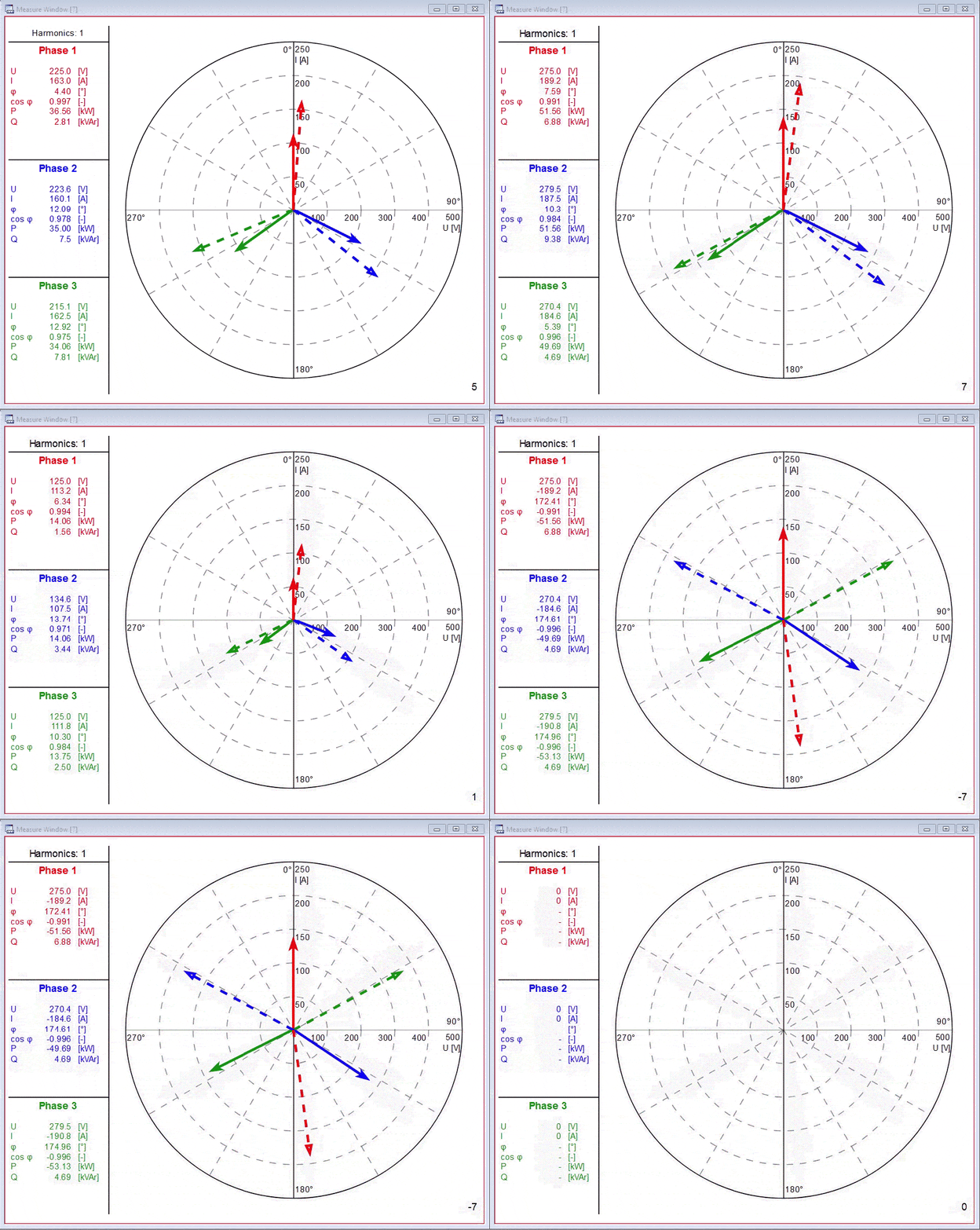
Utilize specialized widgets for real-time visualization of complex data streams. Crucially, the seamless implementation of Dewesoft's advanced Phasor Diagram directly within INCA allowed engineers to gain instant, deep insights into the three-phase power system, facilitating precise analysis of motor and inverter performance.
Record data
Efficiently record large datasets with precise time synchronization and comprehensive metadata, capturing the complete operational context for robust model development.ETAS Analyzer Tool Box (EATB)
Create data reports
Generate detailed, custom reports from acquired battery and powertrain data to aid understanding of system performance.Find crucial details
Identify critical events, anomalies, or specific operating points within extensive datasets that are vital for refining model behavior.Compare changes
Analyze behavioral drifts and compare characteristics across different setups or test cycles, essential for iterative model improvement.Communicate results
Facilitate clear, concise communication of complex analytical findings on system validation.Validate vehicle performance
Directly support the validation of vehicle performance and battery management strategies against design specifications, providing feedback for model calibration.Advanced Simulation and Calibration Model Optimization (ASCMO )
In-depth measurement analysis
Provide tools for detailed inspection and management of battery and powertrain datasets, feeding directly into the model creation.Multidimensional insights
Offer powerful graphical inspection and multidimensional analysis capabilities to understand complex system dependencies, crucial for model accuracy.Add computed signals
Enable the addition of computed signals (e.g., internal resistance, state-of-health estimates) to enrich the data and provide more robust inputs for model development.Build models from data.
Crucially, ASCMO empowers users to construct sophisticated predictive models directly from measured data, forming the core of the SoC estimation and other powertrain control algorithms.Optimize existing models
Refine and optimize existing models using new data and performance criteria to ensure continuous improvement and adaptability.


System instrumentation
SW products
RTA-VRTE + (RTA-Car)
MC Gateway
INCA (incl. EV-Instruments)
INCA SOME/IP-Addon
INCA Dewesoft-Addon
EHANDBOOK
ASCET Developer
HW products
XETK + BR-XETK
ES570
ES160
Dewesoft SIRIUS XHS-PWR
The Result
Enhanced predictive accuracy and reliable EV operation
The deployment of this integrated toolchain, powered by Dewesoft's comprehensive data capture, led directly to significant advancements in battery and powertrain management capabilities, specifically through the development of highly accurate predictive models:
Precise SoC estimation: The developed virtual sensors and state observer systems now rely on highly accurate, AI-derived models, providing unprecedented precision in SoC estimation.
Improved prediction capabilities: These models demonstrate superior predictive capabilities for SoC and remaining range, directly addressing and mitigating range anxiety.
Low computational demand: Despite their precision, the models are optimized for low computational demand, making them suitable for real-time, online estimation within embedded systems.
Bridging the virtual-physical gap: The solution successfully addresses the challenge of SoC being a virtual variable that cannot be measured directly by enabling robust, accurate online estimation.
Success factors
Precision, validation, and ECU integration
The critical components that contributed to the success of this approach include:
High-fidelity data from Dewesoft
The unparalleled quality and breadth of measurement data from Dewesoft XHS Power provided the essential foundation for building reliable and accurate models across the entire EV system.ECU-compatible model export
The ability to export models and their parameters in formats directly compatible with Electronic Control Units (ECUs), ensuring seamless deployment in vehicle systems.Rigorous model validation
Comprehensive validation of model performance through statistical KPIs and visual inspection ensures reliability and compliance with automotive standards.Data-driven calibration
The capability to calibrate model parameters directly from real-world measurements ensures that the models accurately reflect the physical system's behavior under various conditions.Experiment-based measurement collection
A systematic approach to collecting high-quality measurements from controlled experiments provided the essential foundation for robust model development and training.
Perspectives
The future of AI in automotive control systems with embedded AI coder
Looking ahead, the integrated ETAS and Dewesoft solution, particularly with the introduction of tiny AI models, opens new frontiers for automotive development:
Customer benefits
Improved efficiency
Faster modeling of new functions using machine learning (e.g., enhanced SoC estimation in battery management systems, precise object detection in parking systems, accurate air charge determination in engine control).Significant cost reduction
Via virtual sensors, e.g., AI-based Virtual Stator temperature sensor for electrical powertrains, replacing expensive physical sensors, thereby reducing mechanical complexity in E/E architectures.
Addressing the AI challenge
While AI model creation and ECU deployment traditionally require advanced skills in data science, AI algorithms, and a deep understanding of hardware and safety constraints, the ETAS solution, supported by Dewesoft's foundational data, simplifies this process. ASCMO for high-quality model creation; Embedded AI Coder for fast, safe, ISO 26262-compliant code generation, directly applicable to automotive ECUs.
Key advantages
User-friendly
Easy to use for beginners and advanced customization for experts.
Hardware agnostic
No need for special AI hardware; it works on any microcontroller or microprocessor, with no hardware vendor lock-in.
Functional safety support
Functional Safety Support for ISO 26262.
High performance & resource efficiency
High performance and resource efficiency of generated code.
Seamless integration
Seamless integration of code into existing ECU development toolchain and platform, including battery management software stacks.
Conclusion
By transforming the daunting task of processing vast, diverse, and often misleading raw measurement data into a streamlined, AI-driven model development process, ETAS, in collaboration with Dewesoft, has delivered a powerful solution. This approach not only resolves critical challenges like EV range anxiety by enhancing prediction accuracy but also lays the groundwork for a new generation of intelligent, efficient, and safe automotive control systems, driving the future of software-defined vehicles.