Medición y análisis de potencia eléctrica de alta precisión [AC⚡DC]
Explorar
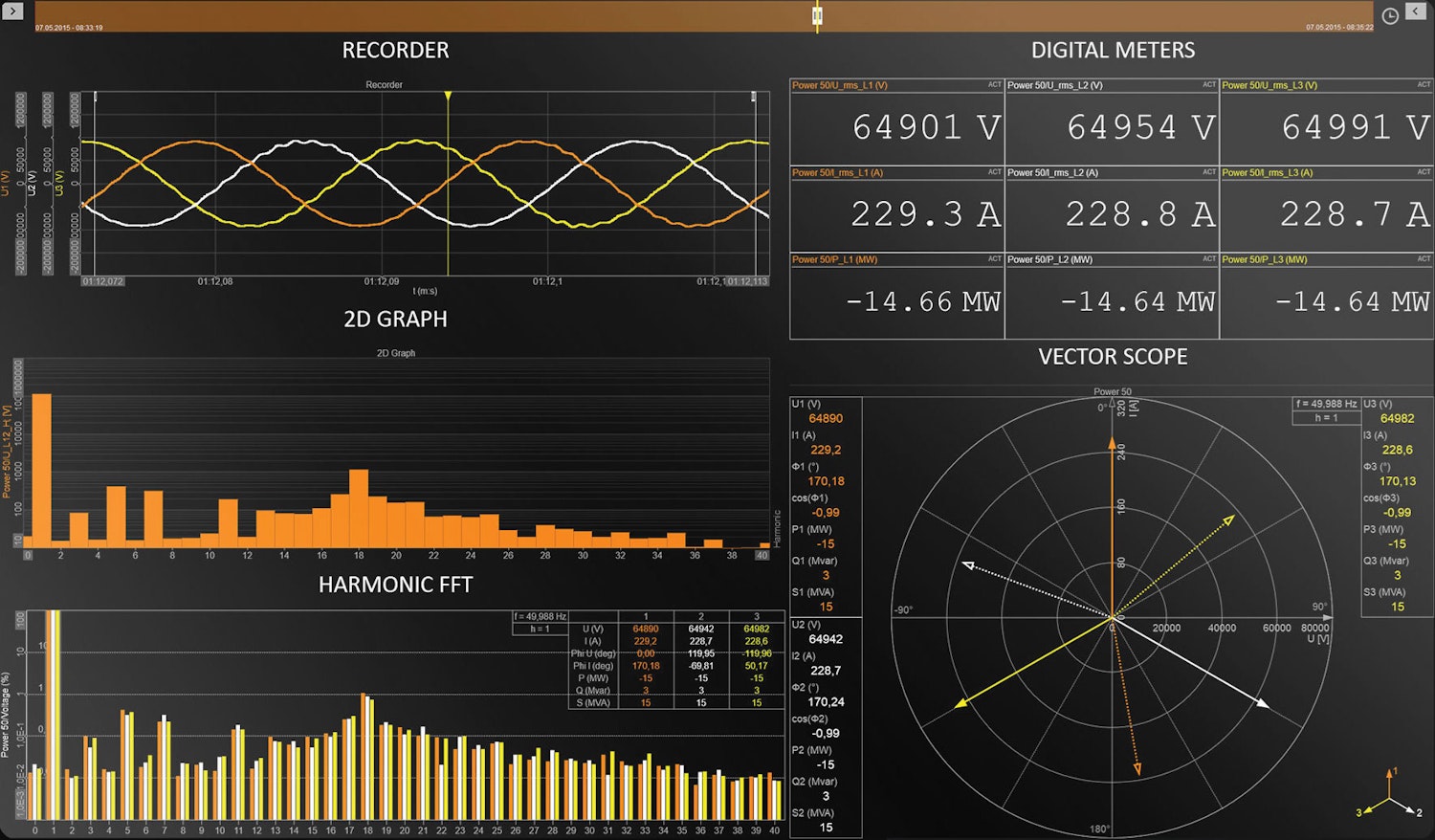
Los analizadores de calidad de la energía de Dewesoft combinan la medición de potencia, energía, osciloscopio y FFT en una sola unidad portátil. Las entradas de alta tensión CA/CC CAT II miden hasta ±1200 V con una precisión del 0,03 %. Todos los sensores de corriente son compatibles y pueden ser escalados y corregidos en fase a través de la base de datos de sensores incorporada. Los motores DAQ ofrecen una frecuencia de muestreo de hasta 15 MHz y pueden manejar las aplicaciones de medición de corriente más exigentes. Los analizadores Dewesoft miden los parámetros de calidad de la energía según la norma IEC 61000-4-30 clase A. Se pueden medir varias fases simultáneamente. Las pantallas vívidas y configurables por el usuario, que incluyen vectorscopios, osciloscopios, FFT y medidores, le permiten ver y analizar sus datos como nunca antes.
Buscar productos
Medición y análisis de potencia eléctrica de alta precisión [AC⚡DC]
Explorar
Medición y análisis de alta precisión de la calidad de la energía
Explorar
Soluciones completas de ensayo para vehículos eléctricos e híbridos
Explorar
Solución completa para las pruebas de transmisiones eléctricas e híbridas
Explorar
Equipos de alta precisión para medición y análisis de datos
Explorar
Adquisición sincronizada de tensión y corriente para pruebas de impedancia de baterías
Explorar
Análisis de potencia a escala de componente a microrred completa
Explorar
Soluciones de ensayo para transformadores de potencia
Explorar
Explorar
Pruebas de potencia eléctrica y calidad de la energía en aerogeneradores
Explorar
Solución completa de análisis de potencia y pruebas de calidad de la energía
Explorar
Pruebas de energía eólica, solar y geotérmica
Explorar
Pruebas de consumo de energía en dispositivos electrónicos
Explorar
Soluciones para ensayos estructurales, eléctricos, de NVH y de vuelo
Explorar
Instrumentación para pruebas completas de motores a reacción
Explorar
Un voltímetro vectorial para redes eléctricas y electricistas
Explorar
La potencia eléctrica es la velocidad a la que un circuito eléctrico transfiere energía eléctrica. Se suele medir en vatios (W), donde un vatio equivale a un julio de energía transferida por segundo. La potencia eléctrica puede calcularse mediante la fórmula
Potencia (P) = Tensión (V) * Corriente (I)
donde:
Tensión (V) es la diferencia de potencial entre dos puntos del circuito, medida en voltios.
Corriente (I) es el flujo de carga eléctrica a través del circuito, medido en amperios (amperios).
La calidad de la energía se refiere a las características de la energía eléctrica suministrada a un sistema que afectan a su rendimiento. Una buena calidad de la energía garantiza que los sistemas eléctricos funcionen de forma eficaz, fiable y segura. Una mala calidad de la energía puede provocar averías en los equipos, reducir su vida útil e ineficacia energética. Los aspectos clave de la medición de la calidad de la energía incluyen la estabilidad de la tensión, la estabilidad de la frecuencia, los armónicos, las sobretensiones transitorias, las caídas y subidas de tensión, las interrupciones y el factor de potencia.
Un analizador de potencia es un instrumento utilizado para medir y evaluar las características de potencia eléctrica de un sistema. Proporciona información detallada sobre diversos aspectos de la calidad de la energía, el consumo energético y el rendimiento eléctrico. Los analizadores de potencia son herramientas esenciales para diagnosticar, solucionar problemas y optimizar sistemas eléctricos. Se utilizan en una amplia gama de aplicaciones, como instalaciones industriales, edificios comerciales, servicios públicos y laboratorios de investigación.
Entre las principales funciones y características de un analizador de potencia se incluyen:
Medición de tensión y corriente: Los analizadores de potencia miden la tensión y la corriente de los circuitos eléctricos, proporcionando lecturas precisas tanto para sistemas de CA (corriente alterna) como de CC (corriente continua). ¡El analizador de potencia Dewesoft puede medir la tensión continua hasta ±2000 V!
Medición de la potencia: Calculan la potencia real (vatios), la potencia aparente (voltios-amperios) y la potencia reactiva (voltios-amperios reactivos). Esto ayuda a comprender el consumo real de energía y la eficiencia de los dispositivos eléctricos.
Factor de potencia: Los analizadores de potencia miden el factor de potencia, que indica la eficiencia del uso de la energía. Un factor de potencia bajo significa más potencia reactiva, lo que conlleva mayores costes energéticos.
Análisis de armónicos: Detectan y analizan las distorsiones armónicas en el sistema eléctrico. Los armónicos pueden causar sobrecalentamiento de los equipos, aumento de las pérdidas e interferencias con otros dispositivos.
Consumo de energía: Los analizadores de redes registran el consumo de energía a lo largo del tiempo y proporcionan datos sobre los kilovatios hora (kWh) utilizados. Esto es útil para la gestión de la energía y la asignación de costes.
Análisis transitorio: Capturan y analizan eventos transitorios como picos de tensión, caídas y subidas, que pueden afectar al rendimiento y la longevidad de los equipos eléctricos.
Registro y supervisión de datos: Muchos analizadores de potencia disponen de funciones de registro de datos, lo que permite una supervisión continua de los parámetros eléctricos a lo largo del tiempo. Estos datos pueden almacenarse y analizarse para identificar tendencias y problemas.
Interfaces de comunicación: Los analizadores de potencia avanzados suelen incorporar interfaces de comunicación como USB, Ethernet o conectividad inalámbrica, que permiten la supervisión remota y la integración con otros sistemas.
Los analizadores de potencia Dewesoft ofrecen una precisión de medida excepcional del 0,03% en un amplio rango de ancho de banda de hasta 5 MHz. Esta precisión se mantiene constante a lo largo de toda la cadena de medición, desde el transductor de corriente hasta el cálculo final de la potencia.
Tanto si se realizan pruebas de potencia al final de la línea como mediciones muy dinámicas en baterías, motores o inversores, nuestras soluciones garantizan resultados fiables y precisos.
Los analizadores de redes Dewesoft ofrecen configuraciones muy flexibles, desde trifásicas estándar hasta complejas configuraciones multifásicas, disponibles tanto en arquitecturas monofásicas como distribuidas.
Nuestros analizadores de potencia pueden ampliarse sin esfuerzo para incluir mediciones mecánicas totalmente sincronizadas como par, temperatura, vibración, deformación y fuerza. Además, admiten una amplia gama de interfaces digitales, como CAN, CAN FD, XCP, Ethernet, vídeo, GNSS, etc.
Los analizadores de potencia Dewesoft permiten calcular con facilidad y precisión cientos de parámetros de potencia, incluidos armónicos, FFT, consumo de energía y eficiencia de motores eléctricos. Los cálculos pueden realizarse en tiempo real, incluso a través de múltiples módulos de potencia paralelos con diferentes configuraciones. Gracias a la compatibilidad con NVIDIA CUDA, el procesamiento puede descargarse en la GPU, lo que garantiza un rendimiento fluido y eficiente en tiempo real. Además, todos los datos sin procesar se almacenan de forma segura, lo que permite realizar nuevos cálculos sin necesidad de repetir las pruebas.
Ejemplos de especificaciones técnicas para la precisión de la medición de potencia
Device
Voltage Amplifier
Current Amplifier
Current Sensor
Select a configuration to view accuracy data
Casos de estudio

Marco Behmer
26 nov 2024
Casos de estudio

Matjaž Strniša
5 oct 2023
Casos de estudio

Carsten Frederiksen
1 mar 2022
Notas de aplicación

Gabriele Ribichini
24 sept 2020
Notas de aplicación

Rupert Schwarz
10 jun 2020
Casos de estudio
Gabriele Ribichini
9 jul 2021