




Structural Health Monitoring of Scandinavia’s First Recycled Aluminum Bridge

March 4, 2026
The Hangar Bridge in Trondheim, Norway, is the first Scandinavian pedestrian bridge built entirely from recycled aluminum—marking a significant milestone in sustainable infrastructure. Designed as part of Norway’s FjordX research initiative, the lightweight structure presents unique dynamic and structural challenges. To support research and validate design codes, Dewesoft Monitoring and NTNU implemented a permanent structural health monitoring (SHM) system. The system ensures long-term performance and combines accelerometers, strain gauges, and synchronized daisy-chaining technology.
Introduction
The Hangar Bridge is a pedestrian arch bridge featuring a network configuration of cables. It is made entirely from recycled aluminum from the decommissioned oil platform in Trondheim, Norway. The Hangar Bridge is the first of its kind. It spans 55 meters. It is a pedestrian bridge commissioned by the Norwegian Public Roads Administration (Statens Vegvesen) to explore cost-effective and sustainable infrastructure solutions.
COWI, an international consultancy in engineering, architecture, energy, and environment, designed the Hangar Bridge. COWI is part of the FjordX research and development project. The FjordX program in Norway is a major R&D initiative focused on innovative, sustainable, and cost-effective solutions for crossing fjords, particularly floating bridges and other complex infrastructure. The scope includes projects such as the "Hangar Bridge," which uses recycled aluminum for greener construction.
The Hangar Bridge project is in coordination with Bane Nor, which is responsible for the operations, maintenance, and construction of railways throughout Norway, as it passes over the railway lines. Leirvik AS, a supplier of large aluminum structures and a leader in aluminum welding technology, fabricated and built the bridge.
The Hangar Bridge faces dynamic challenges due to its lightness in both material and design. The primary structural design code for aluminum structures in Europe is Eurocode 9 (EN 1999), which applies in conjunction with specific National Annexes (NAs) that provide country-specific parameters and rules.
To understand the system dynamics and calibrate the Aluminum Structures Structural Design Code Annex of Norway, the Norwegian University of Science and Technology (NTNU) and Dewesoft Monitoring designed a permanent structural health monitoring system that combined accelerometers, strain gauges, and Dewesoft daisy-chaining technology.
The Hangar bridge
The Hangar bridge is a 55-meter-long aluminum bridge. It is the first of its kind, installed in Trondheim, Norway. It has a width of 9 meters and a total weight of 60 tons. The Hangar bridge is a pedestrian and cycle bridge that spans the railway lines at Leangen Station.
The arch bridge with a network topology for the hangers is constructed entirely from recycled aluminum from the decommissioned Gyda Oil Platform. COWI and Hydro Aker Solutions collaborated to design the Hangar bridge.
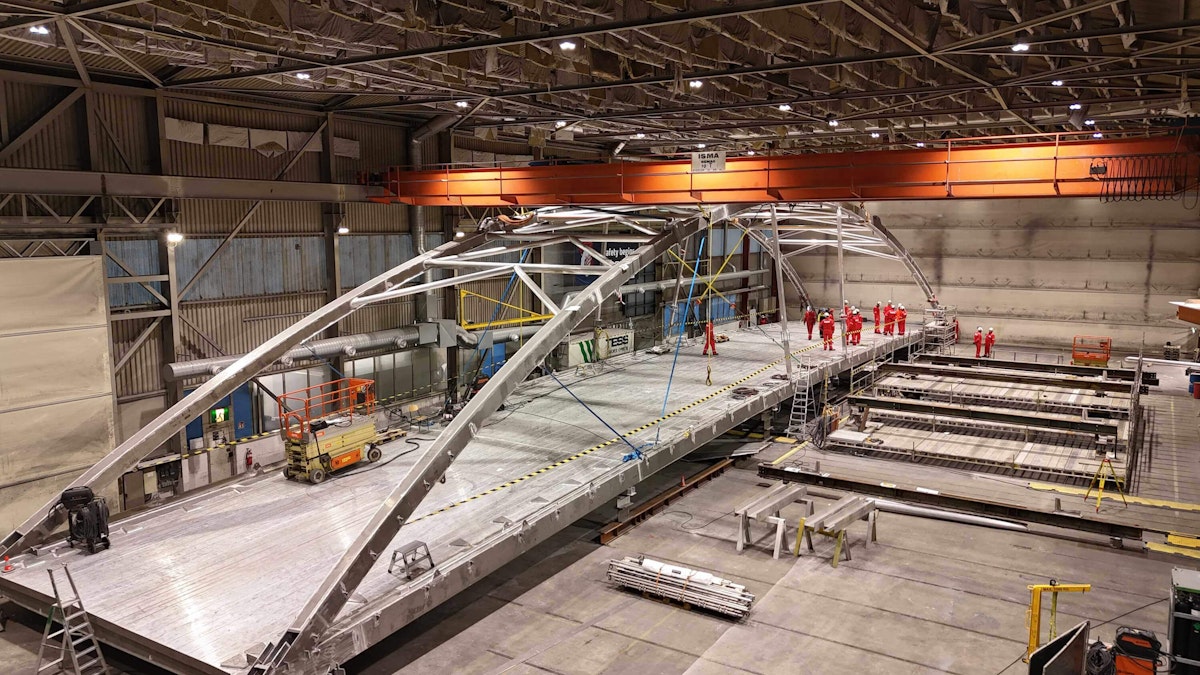
The project is developed by the Norwegian Public Roads Administration (Statens Vegvesen) under the FjordX research framework and assembled by Leirvik AS as the main contractor. Construction of the project began in May 2024, and it was test-assembled at Leirvik’s facility in December 2024. Four bridge segments were shipped from Stord to Trondheim in March 2025, and using Leirvik's cutting-edge aluminum welding technology, they were assembled on-site with the suspension rods and railings.
The Hangar Bridge is a landmark for structural engineers, offering the opportunity to test and develop sustainable, cost-effective, and environmentally friendly structural solutions.
Construction of the hangar bridge
The construction of the Hangar Bridge included:
The construction of the abutments
The construction of the retaining walls
Installation of the water and sewage system
Street lighting
Rerouting the high-voltage power cables of the stations and city supply
Development of the adjacent pedestrian infrastructures.
The construction and installation process of the Hangar Bridge includes the following steps: Figures 1 and 2 show some of them.:
Preliminary test lift to ensure balance (using four lifting lugs)
Lifting and positioning the bridge
Precise positioning on jacking points
Crane disassembly
Installation and casting of bearings
Installation of expansion joints
Removal of lifting lugs
Completion of retaining walls and approach roads
Asphalt paving of the bridge and adjacent paths
Installation of snow plough rails
Integration of lighting into rails


The Hangar bridge as a research project
The Hangar bridge project explores cost-efficient construction techniques and environmentally sustainable, safe systems. A single crane can easily install the lightweight construction. It requires no support between the train lines and is maintenance-free throughout its 100-year lifetime.
NTNU used the Hangar Bridge as an on-site research laboratory for developing master's theses and PhD research projects. To this end, NTNU features a structural health monitoring system to study the system's dynamic structural behavior and integrity.
The structural health monitoring system will give valuable data and information to contribute to the development of design standards for future aluminum bridges, showcasing the aluminum key advantages as a construction material, such as:
Corrosion-resistant, requiring minimal maintenance
Flexible design, enabling faster installation
Fully recyclable, with a low carbon footprint
Approximately 75% of all aluminum ever produced remains in use today
Monitoring system and instrumentation plan
The measurement system comprises 20 triaxial accelerometers, a weather station, and data loggers.
The measurement system allows several sensors to be connected to the same cable, making installation as simple as possible with Dewesoft daisy-chaining technology.
The structural health monitoring system proposed by Dewesoft provides these key features:
Digital sensor nodes (all-in-one) for 3D-accelerometers that reduce the cost of conventional structural monitoring accelerometers + external data acquisition channels.
Single-channel, software settable (quarter, half, full bridge), data acquisition devices for strain measurements along the bridge. The devices can be very close to the sensor, significantly reducing the length of analog cables and the risk of noise pickup (i.e., Electromagnetic Interference).
Sensor nodes and Data Acquisition Unit (DAU) front-end devices are connected over EtherCAT throughout the structure, reducing the overall number of DAUs and decreasing the amount of cabling by multiple units (installation cost and installation time).
Civil engineers can access data via the Dewesoft client software (Dewesoft Historian) or the open-source Grafana dashboard.
The available Dewesoft Historian components are:
DewesoftX MQTT client – A plugin that allows publishing channels in DewesoftX to an MQTT broker. The plugin can also act as an MQTT subscriber, streaming channels from a broker.
Dewesoft HISTORIAN - Provides data communication between measurement units, database, and clients. Includes an MQTT broker, a database, and the open-source Grafana web client. MQTT Client plugins on Measurement Units are required.
DewesoftX view client - Enables data access to the database and measurement units from a Dewesoft instance. The MQTT Client plugin provides live, real-time data streaming in Measure mode. The Historian Importer plugin provides historical data import in Analyze mode. Includes a dongle.
Figure 3 shows the architecture of the Dewesoft Historian platform.


EtherCAT communication between devices ensures one-to-one sample synchronization across the chain. The distance between devices does not affect synchronization precision. The measurement system allows civil engineers to connect multiple sensors to a single cable, making installation as simple as possible. The general proposal from the NTNU follows the topology depicted in Figure 4.


The west side and the east side of the instrumentation plan are depicted in Figures 5 and 6, respectively.


The weather station and strain gauges under the aluminum deck are shown in Figures 7 and 8, respectively.


The Dewesoft solution - permanent outdoor mounting with the IP67 waterproof casing
IOLITE data acquisition devices are available in a waterproof aluminum casing with cable glands. The enclosure is designed for outdoor mounting and is fully waterproof. It complies with IP67 environmental rating.
Cables are inserted through the cable glands at the installation location and crimped to the male RJ45 connectors. The female RJ45 connectors of the IOLITE 3xMEMS-ACC are inside the waterproof enclosure.
After the connectors are mated, the top lid can be fixed to the enclosure using an O-ring seal and four bolts. The outdoor enclosure automatically vents air to equalize the pressure inside the enclosure with the outside air pressure, while preventing water from entering. This equalization extends the seal's lifespan and increases the enclosure's durability.
Triaxial accelerometer sensor
For all positions, we proposed the Dewesoft IOLITEiw-3xMEMS-ACC. The devices have an integrated triaxial MEMS accelerometer. It is an integrated sensor-DAQ device that uses the EtherCAT protocol, allowing simple daisy-chaining of multiple devices mounted on the structure.
We used one CAT6 Ethernet cable for data, power, and synchronization among the daisy-chained devices. Notably, the sensor cost includes the total cost of the acceleration measurement, as you require no additional DAQ unit for data acquisition. A special waterproof case houses the device.
Strain gauges
The system includes KCW gaged (waterproof mounting by welding) and quarter- and full-bridge strain gauges. We connect the strain gauges to 1-channel IOLITEw-1xSTG data-acquisition modules. All strain channels can be converted from quarter-bridge to full-bridge mode via a graphical user interface, enabling modification of the monitoring system.
Weather station
For monitoring wind speed and direction, we use a METSense500 weather station. The device's operating temperature range is -40 °C to +70 °C. The wind speed measurement range is from 0.01 to 60 m/s, and the wind direction measurement range is from 0° to 359°.
Data acquisition system (DAQ)
The DAQ system consists of an industrial PC (i7 processor and 4 TB of disk space) running a local instance of DewesoftX software and external data-acquisition devices (DAQs). We connect the DAQ devices to the PC via the Ethernet port (except the Weather Station, which uses Modbus TCP/IP to communicate with our DAQ). This setup enables the distribution of DAQ devices throughout the structure, reducing the number of DAU systems overall and the amount of cabling. The power supply is inside the system’s monitoring cabinet.
Summarizing the devices, it follows:
IOLITEiw-3xMEMS-ACC triaxial MESM DAQ device
IOLITEw-1xSTG single-channel strain gauge DAQ system
METSense500 Wind speed and direction Modbus TCP/IP
Figure 9 depicts an example of the configuration.


The daisy-chained technology allows users to keep adding sensors to the measurement chain for future instrumentation campaigns. If we add another power injector, a completely new measurement chain is possible, with power, signal, and synchronization in a single cable, as shown in Figure 10 for daisy-chained measurement lines and a star configuration, respectively.


To further adapt to any system configuration, we can use an EtherCAT switch to deploy multiple measurement chains on the structure, as shown in Figure 11.


Finally, a combination of different sensors in the same measurement line is also possible and suitable for the project, reducing the installation time by daisy-chaining the sensors, as shown in Figure 12.


Figure 13 shows the final instrumentation plan.


Conclusion
The Hangar Bridge is a landmark reference from the material, construction technique, welding technology, and bridge design perspective, and installing the Dewesoft system resulted in many benefits, such as:
Minimizing cabling (less cost).
Minimizing installation time (less cost for the system integrator, fewer problems for the infrastructural owner).
Minimizing traffic downtime (less cost for the infrastructural owner and operator).
Electromagnetic immunity (high-quality signals even when power lines are around, such as in railway bridges).
High expandability of the system.
Synchronization to the microsecond.
Integration of any sensor.
Cloud capabilities for storing data on servers and in dashboards.
Alarm and triggering systems for early alerts, optimized data storage, and mathematical channels.
High level of reliability, integrating and synchronizing more than 100 sensors at the same time in real-time.
References
Dewesoft. (n.d.): Structural health monitoring of bridges.
Statens Vegvesen. (2025, January 6)Vellykket prøvemontering av Hangarbrua.
Leirvik AS. (n.d.): Hangar Bridge.